If a child with coeliac disease is baking or eating with you, the first step is to choose a biscuit explicitly labelled ‘gluten-free’. Clean work surfaces and separate utensils help prevent gluten-containing crumbs from contaminating the rest of the preparation. For decorating or making a crumb base, a plain butter biscuit is a good option. If you also need to consider lactose or other allergens, check the information on the specific pack.
Who is this choice important for?
Families with coeliac disease at home
For these families, the gluten-free label on the pack matters, as does having a baking area where gluten-containing crumbs cannot come into contact with the ingredients or finished biscuits. The German Coeliac Society recommends using separate equipment for children with coeliac disease.
Families with additional lactose or allergen requirements
Each product needs to be checked individually. A gluten-free label does not tell you whether it contains ingredients such as milk or lupin, or whether traces of other allergens are listed.
Parents decorating biscuits with children
Plain butter biscuits can make a simple base for a fun project. You can choose the pack size and portion accordingly once you have checked the label and ingredients.
What should you look for when shopping?
If you have coeliac disease, check the gluten-free label first and plan how to keep the baking process separate. Then you can choose the right biscuit shape for your project and check that the ingredients suit any other requirements.
| Criteria |
What to check before buying |
Who it matters most to |
| Gluten-free and protected from crumbs |
Look for ‘gluten-free’ on the pack. For baking, use clean surfaces and separate or thoroughly cleaned utensils. |
If a child with coeliac disease will be eating the biscuits, I want to choose them with confidence and avoid gluten contact while baking. Around 42% of consumers put this protection first. |
| The right biscuit base |
Check that plain butter biscuits and the pack size suit your plans for decorating or making a crumb base. |
For our shared project, I need a biscuit that’s suitable for the way we plan to use it. Around 33% of consumers prioritise this. |
| Other ingredients and allergens |
Check the ingredients list and any ‘may contain’ information on the specific pack. Don’t assume ‘lactose-free’ means ‘dairy-free’. |
If we also need to consider a lactose requirement or an allergy, the gluten-free label alone isn’t enough for me. For around 25% of consumers, checking additional ingredients is the most important factor in their choice. |
Which mistakes can you avoid?
-
Don’t confuse other labels with ‘gluten-free’
‘Butter biscuit’, ‘vegan’ and ‘lactose-free’ do not tell you whether a biscuit meets the requirements for a gluten-free label. Under EU Implementing Regulation No 828/2014, the term ‘gluten-free’ may only be used for food sold to consumers if it contains no more than 20 mg/kg of gluten.
When buying for a child with coeliac disease, first check that the pack is explicitly labelled ‘gluten-free’.
-
Don’t prepare gluten-free biscuits on a crumb-covered surface
Even a biscuit labelled gluten-free can come into contact with gluten-containing crumbs when you bake together. The German Coeliac Society recommends using separate equipment and storing food where it is protected from crumbs.
Clean the work surface, keep gluten-free ingredients separate, and use dedicated or thoroughly cleaned tools.
-
Don’t assume ‘lactose-free’ means safe for other allergies
Gluten-free butter biscuits can contain other relevant ingredients. Depending on the product, the varieties listed by REWE contain milk ingredients or lupin. Coppenrath products may contain traces of soya and nuts.
Check the ingredients and ‘may contain’ information on every pack against your individual requirements. Don’t assume that one claim means the product is free from other allergens.
Brands with suitable products
Schär
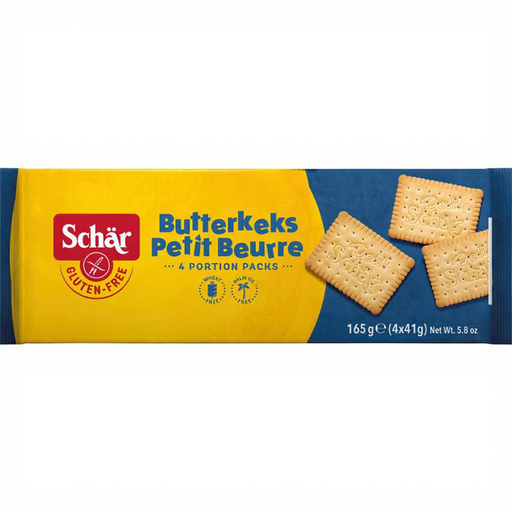
Schär offers gluten-free Petit-Beurre butter biscuits. According to Schär, they are individually wrapped.
- Individual packs can help you set aside biscuits separately for part of your project.
- The packaging does not replace checking the ingredients or using clean equipment.
Leibniz
REWE describes Leibniz Minis Glutenfrei as gluten-free and lactose-free butter biscuits.
- The additional lactose-free label can help you choose if your project requires it.
- Lactose-free does not mean milk-free or egg-free. If you have an allergy, check the ingredients on the specific pack.
Coppenrath
REWE stocks gluten-free butter cookies from Coppenrath, labelled lactose-free and sold in a 200-g pack.
- You can factor the stated pack size into your plans for a shared project.
- REWE lists possible traces of soya and nuts. If you have an allergy to either, check the information on the pack.
Poensgen
REWE stocks gluten-free butter biscuits from Poensgen.
- Another gluten-free butter biscuit option to compare.
- The recipe listed by REWE contains gluten-free wheat starch, sweet lupin flour and milk ingredients. Check that these suit your individual requirements.
Butter biscuits to consider
This Petit-Beurre butter biscuit, labelled gluten-free, could make a good base for a baking project with children. Before ordering, check the specific product variant to make sure the pack size and ingredients suit your plans.
 No image available
Schär Petit Beurre gluten-free butter biscuits
A Petit-Beurre butter biscuit labelled gluten-free, suitable for a baking project with children. Check the pack size before ordering. If you have a milk or egg allergy, also check the ingredients on the specific pack.
View on Joybuy
Frequently asked questions
What does ‘gluten-free’ mean on a biscuit pack?
For food sold to consumers in the EU, the claim means that the product contains no more than 20 mg/kg of gluten, as set out in EU Implementing Regulation No 828/2014. If a child with coeliac disease will be eating the biscuit, check that the specific pack is explicitly labelled gluten-free.
Is a gluten-free label on the biscuit enough when baking together?
No. You also need to protect the biscuit from gluten-containing crumbs while preparing it. The German Coeliac Society recommends using separate equipment and storing food where it is protected. So make sure you plan for clean surfaces and a separate place to put the finished biscuits.
Are gluten-free butter biscuits also lactose-free or dairy-free?
Not automatically. REWE labels some gluten-free varieties as lactose-free too, but that doesn’t mean they are dairy-free. If you have an allergy, check the ingredients and ‘may contain’ information on the specific pack.
Which biscuit is suitable for decorating with children?
A plain butter biscuit explicitly labelled gluten-free could make a simple base. Check the pack size and other ingredients to make sure they suit your project. However, this does not guarantee that the biscuits will stay intact while you decorate them.


