Who should take extra care when choosing?

Secondary school pupils with coeliac disease

They need biscuits for break time that are clearly labelled gluten-free and won’t be confused with snacks containing gluten. The German Coeliac Society stresses the importance of coordinated procedures and communication when providing food at school.

Families who also need to consider lactose

An additional lactose-free claim may be important for them. However, lactose-free does not mean dairy-free: if your child has a milk protein allergy, check the ingredients separately.

Families preparing a lunchbox

They look for a portion that’s easy to take along, without letting the packaging format take priority over the gluten-free labelling. Individually wrapped biscuits or snack packs can help you keep the intended biscuit separate until break time.

What should you look for when buying?

When choosing butter biscuits for a gluten-free school break, start by checking the labelling on the current pack. Then consider how easy they are to carry and, if relevant, any other ingredients or allergens when choosing between suitable options.

Criterion What to check Who it matters to
Gluten-free labelling Look for the words “gluten-free” on the current pack and check the ingredients and allergen information. The German Nutrition Society states that foods labelled gluten-free may contain no more than 20 mg of gluten per kg. If ordinary wheat butter biscuits can’t go in the lunchbox because of coeliac disease, a clearly labelled alternative must come first. This is the top priority for around 50% of consumers.
Taking them along and portioning Check the pack size and portion format, and store the snack separately from foods containing gluten until it’s eaten. If the biscuits need to go in a school bag, it’s especially important to have a portion that’s easy to identify as intended for break time. Around 30% of consumers prioritise this.
Other ingredients and allergens If you have additional requirements, check the lactose information, ingredients and precautionary allergen statements on the specific pack. Don’t assume “lactose-free” means “dairy-free”. If you also need to consider milk ingredients, other allergens or specific ingredient preferences, you’ll need to check these separately. This is the main priority for around 20% of consumers.

Common mistakes when choosing

  • Assuming “butter biscuit” or “spelt” means gluten-free

    The term “butter biscuit” tells you nothing about whether a product is gluten-free. LEIBNIZ lists wheat flour in its Original Butter Biscuit; spelt is also a type of wheat and is not a gluten-free alternative for people with coeliac disease.

    Choose a variety explicitly labelled gluten-free for the school break, and read the ingredients and allergen information on the pack.

  • Confusing “lactose-free” with “dairy-free”

    According to the product information, LEIBNIZ Minis Gluten- & Laktosefrei contain clarified butterfat and a dried milk product. Other gluten-free butter biscuits may also contain milk, egg or other allergens.

    If you have additional allergies, check the ingredients and precautionary allergen statements for the specific product rather than relying solely on the claim on the front of the pack.

  • Checking only the product page

    For the biscuits that actually go in the lunchbox, the information on the pack you buy is what matters – especially if the packaging or recipe has changed.

    Check the gluten-free claim, ingredients and allergens again before packing them.

Brands and product ranges to consider

LEIBNIZ

LEIBNIZ Minis Gluten- & Laktosefrei are small butter biscuits for families who need to consider lactose as well as look for a gluten-free claim.

  • LEIBNIZ describes the Minis as gluten-free and lactose-free; the product is stated to contain no more than 0.01 g of lactose per 100 g.
  • The ingredients include clarified butterfat, whole egg and a dried milk product. The lactose-free claim therefore doesn’t replace checks for milk or egg allergies.

Schär

Schär Butterkeks Petit Beurre is a gluten-free butter biscuit, and its individual wrappers make it a handy option for a separate portion at break time.

  • Schär says these butter biscuits are individually wrapped for taking on the go.
  • The product contains milk and egg; according to the product information, it may also contain traces of soya and lupin.

Alnavit

Alnavit offers organic gluten-free butter biscuits for shoppers who care about specific ingredients as well as the gluten-free claim.

  • Alnavit states that its 100 g variety contains 15% butter and no added flavourings.
  • Organic and ingredient claims don’t replace checking the current pack for other allergens that matter to your family.

Hammermühle

REWE stocks Hammermühle Organic Gluten-Free Butter Biscuits as a 130 g product in snack packs.

  • The snack packs described are an option if you want a separate portion for the school break.
  • The product may contain traces of egg and tree nuts; the pack labelling is particularly important if you have allergies to either.

Butter biscuits on Joybuy

For a separate snack to take to school, this gluten-free butter biscuit option from Schär may be suitable. Always check the information on the pack you buy before packing it.
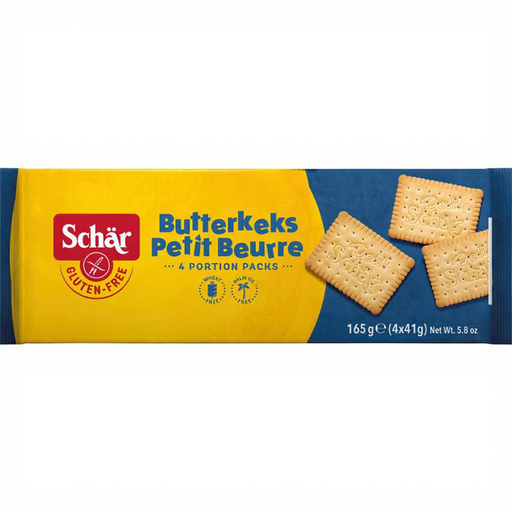
Schär Gluten-Free Petit Beurre butter biscuits, 165 g

Schär Gluten-Free Petit Beurre butter biscuits, 165 g

For a separate portion at break time, Schär describes these gluten-free butter biscuits as individually wrapped.

The product description lists milk and egg; according to Schär, it may also contain traces of soya and lupin. Before packing, check the gluten-free claim, ingredients and precautionary allergen statements on the pack you buy.

View on Joybuy

Frequently asked questions

What does “gluten-free” mean for butter biscuits?

The German Nutrition Society explains that foods labelled “gluten-free” may contain no more than 20 mg of gluten per kg. That’s why, for butter biscuits at school, it’s essential to check the labelling on the current pack; simply calling them butter biscuits isn’t enough.

Are standard butter biscuits made with wheat flour suitable for people with coeliac disease?

No, butter biscuits made with wheat flour are not a gluten-free alternative. LEIBNIZ lists wheat flour in its Original Butter Biscuit, and EDEKA lists wheat flour as an ingredient in GUT&GÜNSTIG Butterkeks. Instead, look for a variety explicitly labelled gluten-free for the school break.

Are lactose-free butter biscuits also dairy-free?

No, lactose-free doesn’t mean dairy-free. LEIBNIZ Minis Gluten- & Laktosefrei are described as containing no more than 0.01 g of lactose per 100 g, but they also contain clarified butterfat and a dried milk product. If you have a milk protein allergy, check the ingredients on the specific pack separately.

How can you pack gluten-free biscuits for school?

Keep gluten-free biscuits clearly identified and separate from snacks containing gluten; if possible, leave the pack sealed until they’re ready to eat. The German Coeliac Society highlights coordinated procedures, good hygiene and communication when providing gluten-free food at school.