What should you look for when buying?
For cookies intended for people with coeliac disease, the first thing to check is the gluten-free labelling on the specific pack. Organic status, other ingredients and the type of cookie you prefer are separate considerations.
| Criteria |
What to check when buying |
Who it matters most to |
| Gluten-free labelling |
Does the pack intended for the German market say ‘gluten-free’? Check the ingredients list on the pack too. |
If I have coeliac disease, I don’t want to rely solely on an ingredients list that doesn’t mention wheat. For around 39% of shoppers, an explicit gluten-free claim is the top priority. |
| Organic status |
Check the organic information on the specific product separately from its gluten-free labelling. |
When shopping at an organic shop, I also want to be able to tell whether a cookie is organic, as well as gluten-free. This is the next priority for around 23% of shoppers. |
| Other ingredients and allergens |
Read the ingredients list and any precautionary allergen information for each variety. |
If I also need to avoid milk, eggs or soya, ‘gluten-free’ isn’t enough on its own. Around 23% of shoppers prioritise checking other ingredients. |
| Cookie variety and pack size |
Once the required labelling checks out, compare the variety, texture and pack size. |
For everyday use, I might prefer a soft cookie or a particular pack size, without skipping the earlier checks. This choice is the deciding factor for around 15% of shoppers. |
Brands to help you choose
The examples below refer to specific varieties or range information, not every product from each brand.
Schär
REWE stocks Schär varieties including Choco Chip Cookies and Soft Cookies Cinnamon.
- For its Choco Chip Cookies, REWE provides an ingredients list as well as a gluten-free claim.
- REWE says this variety contains soya flour and may contain eggs; other ingredients and possible traces are listed for Soft Cookies Cinnamon. If you have additional allergy requirements, check the pack for the specific variety.
Alnavit
REWE lists Alnavit Bio Kakao Hanf Cookies and Bio Mandel Kokos Cookies in its gluten-free cookie range.
- In REWE’s listing, these specific varieties combine an organic designation with a gluten-free cookie option.
- Check the organic and gluten-free labelling, ingredients and allergens on the pack you buy; the selection in store may vary.
Gullón
Galletas Gullón has a gluten-free biscuit range, including Cookies de Cacao con Chips de Chocolate Sin Gluten.
- The manufacturer says this variety is gluten-free and contains no eggs or tree nuts.
- Galletas Gullón warns that it may contain traces of milk. If you’re buying in Germany, the information on the pack sold there is what matters.
Bahlsen / LEIBNIZ
REWE lists ‘Leibniz Minis Glutenfrei Keks 100 g’ among its gluten-free biscuits. This is a specific biscuit variety, not a blanket claim that it is a gluten-free cookie or that the entire brand is gluten-free.
- The variety name makes it easier to search for the gluten-free LEIBNIZ Minis option.
- Bahlsen says its general biscuit range contains wheat flour. So check the labelling on every individual Bahlsen or LEIBNIZ product.
Gluten-free cookies at Joybuy
This cookie selection is for shoppers looking for a chocolate chip variety that is explicitly labelled gluten-free. If organic status or other allergens matter to you, check these requirements on the specific pack too.
 No image available
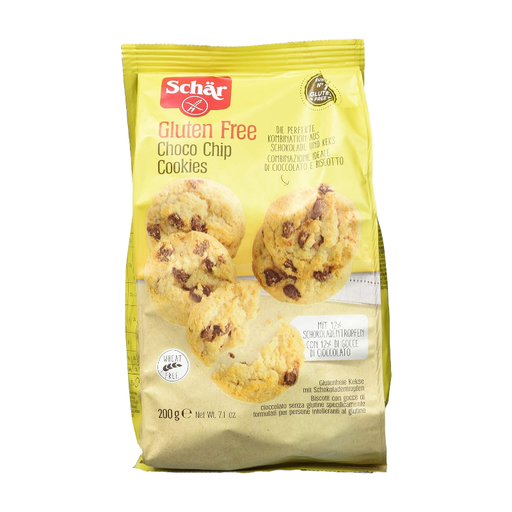
Schär Gluten-Free Chocolate Chip Cookies, 200 g
A chocolate chip cookie variety labelled gluten-free, in a 200-g pack. For the corresponding Schär Choco Chip Cookies variety, REWE lists soya flour and a warning that it may contain eggs. If you have additional allergy requirements, check the pack you buy. If organic status is essential, look for organic labelling on the pack too.
View at Joybuy
Frequently asked questions
What does ‘gluten-free’ mean on cookies?
Under EU Regulation No 828/2014, food sold to consumers may be labelled ‘gluten-free’ if it contains no more than 20 mg/kg of gluten. When you buy, look for this explicit claim on the specific product.
Is an ingredients list with no wheat enough for someone with coeliac disease?
For the purposes of choosing products covered in this article, an ingredients list with no wheat isn’t a substitute for an explicit gluten-free claim. Check the pack intended for the German market; the German Coeliac Society says that, for products sold under the same name, the ingredients list for the country where the product is sold applies.
Is an organic cookie automatically gluten-free?
No. Organic labelling and a gluten-free claim refer to different product qualities. If you’re shopping because you have coeliac disease and also want organic products, check both claims on the same product.
Can gluten-free cookies contain other allergens?
Yes. REWE lists soya flour and a warning that Schär Choco Chip Cookies may contain eggs; Galletas Gullón warns that its Cookies de Cacao con Chips de Chocolate Sin Gluten may contain traces of milk. So read the ingredients and precautionary allergen information for the variety you’re actually buying.
Do I have to buy organic cookies at an organic shop?
No. What matters is the labelling on the specific product, not the type of shop. For example, REWE also lists organic varieties in its gluten-free cookie range; availability depends on the shop you choose.


