Hosts catering for guests with coeliac disease
You want to provide clearly labelled gluten-free crackers for yourself or your guests, and avoid contact with gluten-containing baked goods when serving them.


If you’re hosting guests with coeliac disease, choose crackers whose packaging clearly states that they are gluten-free. Classic salted crackers work well with a range of toppings, while seed and cheese varieties have a more distinctive flavour. Check each product individually to see whether it is also vegan or lactose-free, or contains oats.
You want to provide clearly labelled gluten-free crackers for yourself or your guests, and avoid contact with gluten-containing baked goods when serving them.
You’re looking for a suitable base for a variety of sweet and savoury toppings, or a seed or cheese cracker that can also be served on its own.
As well as checking that crackers are labelled gluten-free, you may also be looking for a vegan or lactose-free option. Check the ingredients and allergen information for the guests concerned.
If the crackers are for someone with coeliac disease, start by checking the gluten-free labelling on the pack. Then consider the toppings and any other dietary requirements to find the right option for your coffee table.
| Criteria | What to check when buying | Who it matters most to |
|---|---|---|
| Gluten-free labelling | The specific pack must be clearly labelled gluten-free; check the ingredients and allergen information too. | If I’m buying crackers for a guest with coeliac disease, I need clear labelling rather than making assumptions based on the ingredients. This is the main consideration for around 50% of consumers. |
| Flavour and toppings | Match classic salted, seed or cheese varieties to the sweet and savoury toppings you plan to serve. | For a selection of spreads, I want a mild-flavoured cracker; for a savoury snack, I’m happy with a stronger seed or cheese flavour. Around 30% of consumers mainly focus on what will go with the food they plan to serve. |
| Other requirements | Check for vegan or lactose-free claims, as well as relevant ingredients, precautionary allergen statements and, where applicable, oats. | If a guest is also vegan or needs to avoid certain allergens, ‘gluten-free’ on its own isn’t enough. These additional requirements are the top priority for around 20% of consumers. |
These terms describe different product characteristics. For a guest with coeliac disease, the cracker you choose must be explicitly labelled gluten-free; any other requirements need to be checked separately.
Check the pack itself for every requirement, and read the ingredients and allergen information.
Gluten-containing baked goods, crumbs or shared knives can come into contact with food served as gluten-free.
Serve gluten-free crackers separately, and use clean, separate knives or individual serving bowls for the spreads that go with them.
Seed, Parmesan and cheese-and-onion varieties have a different flavour profile from classic salted crackers. This is especially worth bearing in mind if you’re serving sweet spreads.
Plan your toppings before you buy, then decide whether the cracker will be a base for toppings or a savoury snack in its own right.
Schär offers a range of products, including classic gluten-free crackers and Saltí salted snacks.
Alnavit offers a range of gluten-free crackers, including seed and Parmesan varieties.
Hammermühle offers savoury gluten-free snacks, including a cheese, onion and seed cracker.
This selection includes salted gluten-free crackers and two gluten-free crispbreads from Schär. Crispbread can also be used as a base for toppings, but it isn’t a classic cracker.
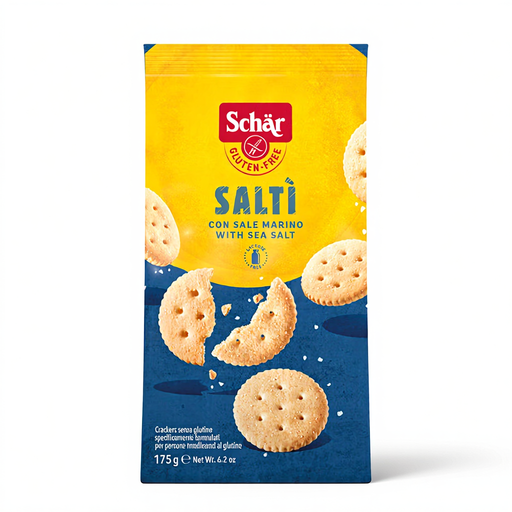 Image unavailable
A salted cracker option for when you’re planning to serve a selection of toppings with coffee.
The product name specifies 175 g and labels the crackers gluten-free. Check the current packaging before serving. If you have a soya or lupin allergy, pay particular attention to the ingredients and precautionary allergen information.
 Image unavailable
A crispbread alternative for guests who would like something other than crackers as a base for sweet or savoury toppings.
The product name specifies 125 g and labels the dark crispbread gluten-free. Bear in mind that it differs from classic crackers, and check the pack details if you have a soya allergy.
 Image unavailable
Another crispbread option if you’re looking for a base for a range of toppings, rather than a traditional cracker.
The product name specifies 150 g and labels the crispbread gluten-free. If you have coeliac disease or other dietary requirements, check the labelling, ingredients and allergen information against the current pack.
Choose crackers that are explicitly labelled gluten-free, and check the pack you actually buy. When serving, make sure the gluten-free crackers and their toppings don’t come into contact with crumbs or cutlery from gluten-containing baked goods.
No. ‘Wheat-free’ isn’t the same as ‘gluten-free’. If the crackers are for someone with coeliac disease, look for explicit gluten-free labelling and check the current packaging information.
No. Each claim needs to be stated separately. Alnavit describes its seed crackers as both vegan and gluten-free, but you can’t assume the same applies to other vegan crackers.
There’s no single answer. According to the manufacturer, Hammermühle’s cheese and onion cracker contains gluten-free oats. Hammermühle notes that people with coeliac disease can differ in how well they tolerate gluten-free oats.