Families who need to avoid gluten
If a gluten-free diet is essential, check the labelling on the specific product. Other ingredients and allergen information must also meet your individual requirements.


When choosing a snack for a toddler, there’s more to consider than the words ‘gluten-free’ on the pack. Choose a shape that suits your child and check the ingredients and allergen information on the specific pack. If you offer rice cakes regularly, it’s important to vary them with suitable snacks made from other ingredients. The consumer advice centre recommends switching between grains because rice products may contain inorganic arsenic.
If a gluten-free diet is essential, check the labelling on the specific product. Other ingredients and allergen information must also meet your individual requirements.
When a child is just beginning to eat independently, the age recommendation on the pack, how easy the snack is to handle and your child’s ability to eat it are all important. The Lower Saxony State Office for Consumer Protection and Food Safety lists different age recommendations for rice cakes intended for younger children.
If you often need a convenient snack, compare the ingredients, sugar and salt, as well as what the product is made from. The consumer advice centre recommends varying the grains children eat rather than relying solely on rice products.
First, check for allergens relevant to your child and look at the age recommendation. If you offer snacks regularly, also consider varying the ingredients and comparing product labels.
| What matters | What to check when buying | Who it matters most to |
|---|---|---|
| Gluten and other allergens | Check the ‘gluten-free’ label, ingredients list and information about relevant allergens separately. ‘Gluten-free’ does not mean free from sesame, milk or soya. | If my child needs to avoid certain ingredients, I don’t want to rely on the front of the pack alone. For around 29% of consumers, suitable gluten and allergen labelling is the top priority. |
| Variety instead of lots of rice snacks | Alternate rice with suitable cakes made from other ingredients, and check their ingredients and allergen information too. The Federal Institute for Risk Assessment points out that rice products may contain inorganic arsenic. | If you often pack a snack for when you’re out and about, you may not want rice to be the only regular option. This variety is a priority for around 29% of consumers. |
| Age and ability to eat | Check the age recommendation on the specific pack against your child’s ability to eat the product, and supervise them while they eat. An age recommendation is no substitute for supervision. | The shape and eating situation are particularly important for a child who is still learning to nibble independently. Around 24% of consumers put this first. |
| Sugar, salt and ingredients | Compare the ingredients and nutritional information per 100 g, particularly the sugar and salt content. For fruit varieties, check fruit ingredients such as juice concentrate too. | When offering snacks regularly, I want to know what plain and fruit varieties contain. For around 18% of consumers, the ingredients profile is the main concern. |
A gluten-free rice cake may contain other allergens. For example, the organic rice cake described by REWE contains sesame and carries a warning that it may contain traces of milk and soya.
For every pack you buy, read the ingredients list and check information about allergens and possible traces that are relevant to your child separately from the gluten-free label.
Even products with an age recommendation are still rice products. The Federal Institute for Risk Assessment highlights the possibility of inorganic arsenic, while the consumer advice centre recommends varying the grains children eat.
If you offer snacks regularly, alternate rice cakes with suitable snacks made from other ingredients, and check their labels too.
Fruit varieties may contain juice concentrate, while coatings change the ingredients and may introduce other allergens. So, a similar product name tells you little about what’s inside.
Compare the ingredients list and nutritional information per 100 g for the specific varieties, rather than choosing based on flavour or packaging alone.
What matters is the information on the product you actually buy, especially when ingredients, allergen information or age recommendations are important.
Check the current pack when you buy the product or after it’s delivered. If there’s a recall notice, compare the details of the affected product with your pack.
REWE describes both rice and corn cakes in its range. Its organic rice cake with sesame is one specific variety, not a description of every product from the brand.
EDEKA describes a plain rice cake made from rice, as well as an apple mini rice cake with an age recommendation from 8 months.
ALDI SÜD describes an apple mini rice cake for younger children’s snack times.
ALDI Nord describes organic apple mini rice cakes with an age recommendation from 8 months.
Kallo describes unsalted wholegrain rice cakes as a plain variety.
This selection features an apple rice cake with an age recommendation for younger children’s snack times. If your child needs to avoid a particular allergen, check the information on the current pack to see whether it’s suitable.
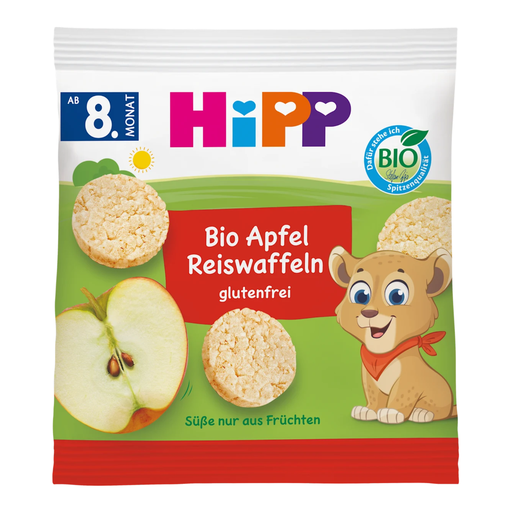 Image unavailable
The age recommendation makes these apple rice cakes an option for snack time from 8 months, provided the shape suits your child’s ability to eat them.
If your child needs to avoid gluten or other allergens, check the information on the current pack, particularly for milk, sesame and soya. Supervise your child while they eat.
No. Rice does not naturally contain gluten. If you need to choose a gluten-free product, look for the ‘gluten-free’ label on the specific product and check the other ingredients separately.
No. The label refers to gluten and does not rule out other allergens. The organic rice cake described by REWE contains sesame and may contain traces of milk and soya. If your child has an allergy, check the information on the pack you buy.
Rice cakes shouldn’t be the only grain-based snack you offer regularly. According to the Federal Institute for Risk Assessment, rice products may contain inorganic arsenic. The consumer advice centre recommends varying the grains children eat.
Check the age recommendation for the specific product and make sure your child is able to eat the cake safely. ALDI Nord and EDEKA describe apple mini rice cakes for children from 8 months. This recommendation is no substitute for supervising your child while they eat.
Compare the product and batch details in the official notice with the information on your pack. Official food alerts are published by the Federal Office of Consumer Protection and Food Safety and the German federal states.