
Lieferung heute & morgen

Qualitätsgarantie

Willkommens-Angebote freischalten: KOSTENLOSE Lieferung | Bis zu 80 % RABATT | Kostenlose 30-Tage-JoyPlus-Testphase
App herunterladen
Choosing the right smart home lighting can be a challenge given the multitude of standards and technologies. Clear information is crucial, especially when it comes to seamless integration with existing systems and dynamic lighting effects. This guide serves as a reference to explain how technologies like Matter and RGBIC work, providing you with a solid basis for making an informed decision about your smart home LED lighting.
Before making a purchase, it's helpful to understand a few technical fundamentals. These criteria will help you find a product that meets your requirements for compatibility, functionality, and durability.
Matter is a relatively new connectivity standard that aims to unify compatibility between smart home devices from different manufacturers. A Matter-certified LED strip can be integrated directly into ecosystems like Apple Home, Google Home, Amazon Alexa, and Samsung SmartThings without the need for manufacturer-specific hubs or cumbersome workarounds. This simplifies setup and ensures a future-proof investment, as your lighting system will work smoothly with a growing number of devices.
Conventional RGB LED strips can only display one colour at a time across their entire length. RGBIC (Independent Control) technology takes it a step further. Thanks to integrated IC chips, it enables segmented LED control. This means that different sections of the strip can display different colours and brightness levels simultaneously. This opens up creative possibilities for flowing colour gradients, animations, and dynamic effects, which are particularly sought after for gaming room lighting or creating atmospheric accents in living areas.
Modern LED strips offer various control options. A Wi-Fi LED strip connects directly to your home network, allowing control via a smartphone app or voice assistants from anywhere. The LED light strip with app control often provides advanced features like a DIY mode for creating custom light scenes, schedules, and an LED strip with music sync. The latter uses a built-in microphone to adapt the light effects to the rhythm of music or gaming sounds, creating an immersive experience.
Here is a selection of products that cover different requirements and applications. The descriptions are based on the product data provided by the manufacturer.
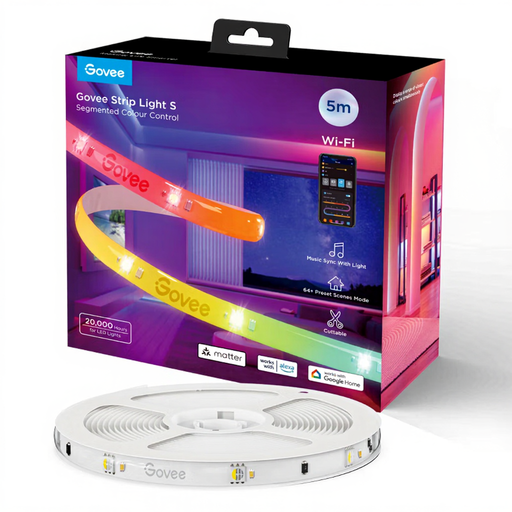
Why it stands out: This Govee RGBIC 5m LED strip combines the two most sought-after technologies: Matter for universal compatibility and RGBIC for segmented colour control. The additional protective coating not only increases durability but also ensures more even light distribution.
Pros:
Who it's for: Tech enthusiasts and gamers looking for a high-performance, flexibly controllable, and future-proof lighting solution that integrates effortlessly into an existing multi-platform smart home.
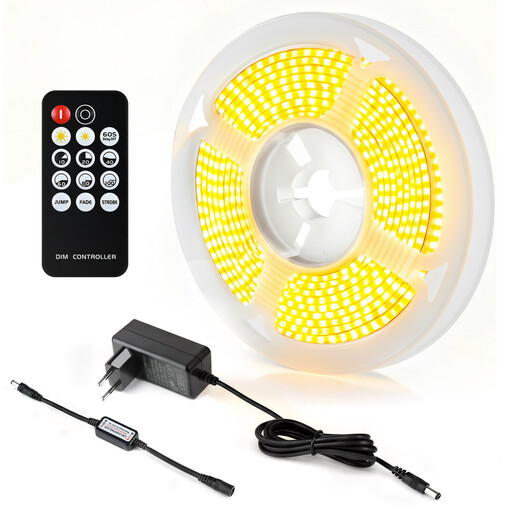
Why it stands out: This strip uses COB (Chip-on-Board) technology, which produces a completely uniform and dot-free line of light. Instead of individually visible LEDs, it creates a continuous beam of light, ideal for subtle and elegant indirect lighting.
Pros:
Who it's for: Users seeking high-quality, discreet accent lighting for living rooms, shelves, cabinets, or under kitchen counters, who value flawless light quality and natural colour rendering.
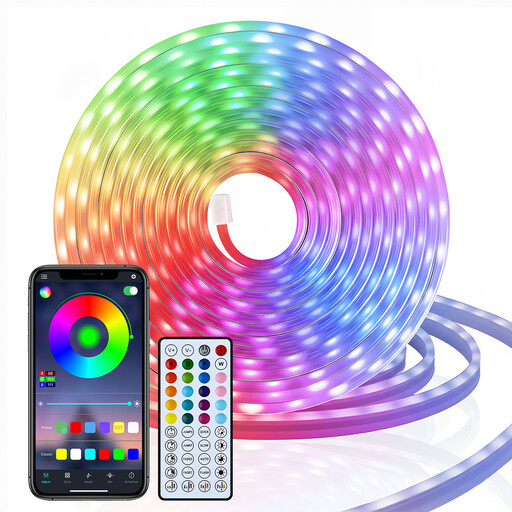
Why it stands out: This 15-metre strip mimics the look of classic neon tubes. The silicone coating provides soft, diffuse light distribution and makes the strip extremely flexible, allowing it to be easily bent into creative shapes and lettering.
Pros:
Who it's for: Creative users looking for eye-catching and flexible decorative lighting for party rooms, gaming setups, or for creating individual light art installations.
While this article focuses on LED strips, there is a wide variety of other smart lighting solutions for every purpose. From atmospheric string lights to functional bulbs, the selection is vast.
For more inspiration, especially in the area of decorative lighting, discover our selection of LED tree lights.
What is the main difference between RGB and RGBIC LED strips? The main difference lies in how the LEDs are controlled. On an RGB strip, all LEDs always light up in the same colour. An RGBIC strip has integrated control chips (IC) that allow individual segments of the strip to be controlled independently. This allows multiple colours to be displayed on the strip at the same time, enabling flowing colour gradients and dynamic effects.
Does the Govee Matter LED strip work with Apple Home, Google Home, and Alexa? Yes. Thanks to its Matter certification, the Govee Matter RGBIC LED Strip is designed to be cross-platform compatible with all major smart home systems that support the Matter standard. This includes Apple Home, Google Home, and Amazon Alexa. Setup is typically done by scanning a QR code directly within the respective system's app.
How is an LED strip with music sync set up? Setup is usually straightforward. The LED strip has a built-in microphone that picks up ambient sounds. In the corresponding app (e.g., Govee Home), you activate the music mode. You can then often choose from various styles for how the lights should react to the rhythm (e.g., pulsing, jumping). No external connection to the audio source is required.