People with a strict sugar target
You want to keep total sugars per 100 g as low as possible. When choosing, it matters whether the pack says “sugar-free”, “low sugar” or simply “no added sugar”.


If keeping total sugars as low as possible is important for your weekend breakfast, start by comparing the “of which sugars” figure per 100 g for granola and muesli. According to the German Consumer Advice Centre, “sugar-free” means no more than 0.5 g of sugar per 100 g; “no added sugar” is different and fruit-based mixes can still have a much higher sugar content. A low-sugar base and a fruit muesli therefore suit different preferences – ingredients and allergen information should also inform your choice.
You want to keep total sugars per 100 g as low as possible. When choosing, it matters whether the pack says “sugar-free”, “low sugar” or simply “no added sugar”.
You’d like a fruity flavour without added sugar, and are happy to accept that dried fruit can contribute to the stated total sugars.
You’re looking for a base to serve with milk, yoghurt, fresh fruit or other ingredients. Whether you want it to stay crunchy or soak to make Bircher muesli is just as important as the ingredients list.
First decide whether low total sugars, fruit flavour or your preferred way of preparing it matters most. Then compare individual granola and muesli mixes by looking at their nutritional information and ingredients.
| Criteria | What to check | Who it matters most to |
|---|---|---|
| Total sugars | Compare “of which sugars” per 100 g. According to the German Consumer Advice Centre, the limit for “sugar-free” is 0.5 g, and for “low sugar” it is 5 g of sugar per 100 g. | If I want to limit sugar strictly, I don’t rely on the wording on the front of the pack alone. For around 42% of consumers, the actual total sugars are likely to be the main reason for choosing a product. |
| Fruit flavour | For products labelled “no added sugar”, also check the fruit ingredients and sugars per 100 g. EDEKA24 lists 22 g of sugar per 100 g for Kölln Fruit Oat Muesli with No Added Sugar, which contains 40% fruit. | I want a fruity muesli, even if its total sugars are higher than those of a plain base. Fruit flavour is likely to come first for around 33% of consumers. |
| Texture and preparation | Choose between a crunchy mix and muesli that soaks; also check the ingredients and allergen information. Alnatura recommends soaking its Bircher muesli for around 10 minutes. | For my weekend breakfast, I want to prepare the mix to suit milk, yoghurt or other ingredients. Texture and preparation are likely to be the deciding factors for around 25% of consumers. |
The two claims answer different questions. According to the German Consumer Advice Centre, a solid food labelled “sugar-free” must contain no more than 0.5 g of sugar per 100 g. Fruit ingredients can contribute to total sugars even when no sugar has been added.
So, as well as checking the wording on the pack, look at the “of which sugars” figure per 100 g.
Fruit content, wholegrain content and total sugars describe different product characteristics. For example, EDEKA24 lists 40% fruit and 22 g of sugar per 100 g for Kölln Fruit Oat Muesli with No Added Sugar.
Compare the nutritional information and ingredients list side by side, rather than drawing conclusions about the whole nutritional profile from a single claim.
A mix may suit your sugar preferences but still contain ingredients you need to avoid. The mueslis discussed here include, among other things, gluten-containing grains and nuts; depending on the product, ‘may contain’ information may also be relevant.
Before buying, check the ingredients and allergen information on the specific pack, even if you plan to add your own ingredients later.
The differences here are between specific types of muesli, not between brands as a whole: you can’t compare a low-sugar base with a fruity muesli just by looking at the brand name.
Its Low-Sugar Muesli is a wholegrain base with little fruit, suited to anyone who looks at the stated total sugars first.
Kölln’s low-sugar wholegrain base and fruity muesli with no added sugar differ considerably in their stated sugar content.
Alnatura Bircher Muesli is for people who prefer a breakfast mix that softens as it soaks, rather than a crunchy option.
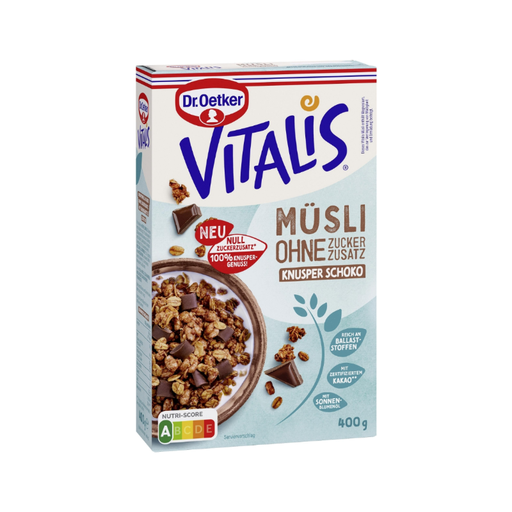
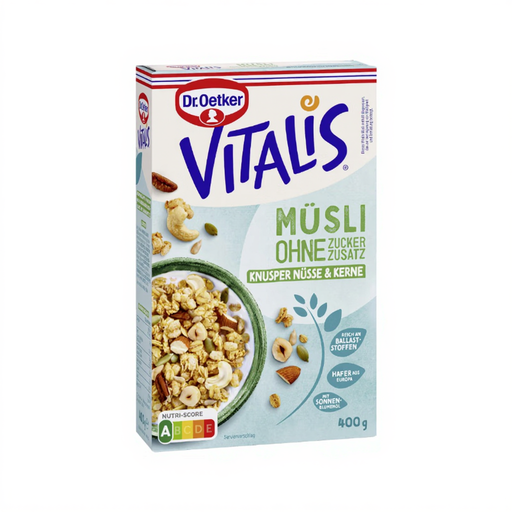
This selection includes two crunchy Vitalis mueslis with no added sugar and a fruity Kölln muesli with no added sugar for weekend breakfasts. None of these descriptions alone proves that a product is “sugar-free”; check the sugars per 100 g on the relevant pack to find out.
 No image available
A crunchy chocolate option if you prefer this flavour in your breakfast bowl.
“No added sugar” does not mean “sugar-free”. To meet your sugar target, check the “of which sugars” figure per 100 g, as well as the ingredients and allergen information on the pack.
 No image available
A crunchy nut option if you’d prefer this flavour to chocolate or fruit.
If you have a strict sugar target, compare total sugars per 100 g. As this is a nut variety, be sure to check the ingredients and allergen information on the pack.
 No image available
A fruit muesli option if you value fruit flavour more than choosing a product with the lowest possible total sugars.
The product name states that it contains 50% fruit and has no added sugar. As with any option, check the “of which sugars” figure per 100 g on the pack to see how it fits your sugar target.
No. According to the German Consumer Advice Centre, “sugar-free” means no more than 0.5 g of sugar per 100 g in solid foods. “No added sugar” means that no mono- or disaccharides, or other ingredients with a sweetening effect, have been added; naturally occurring sugars may still appear in the nutritional information.
Dried fruit naturally contains sugar, which counts towards total sugars. EDEKA24 lists 22 g of sugar per 100 g for Kölln Fruit Oat Muesli with No Added Sugar, which contains 40% fruit. This figure applies to that specific variety, not to every fruit muesli.
Alnatura recommends mixing the desired amount of its Bircher muesli with milk or yoghurt and leaving it to soak for around 10 minutes. If you want a crunchy breakfast mix, bear this soaking time in mind when choosing a product.
Read the ingredients and ‘may contain’ information on the specific pack. The varieties discussed here may differ in their gluten-containing grains, nuts and potential traces; a suitable sugar content tells you nothing about whether a product is suitable for your allergies.