People with a specific sugar limit
For them, the stated sugar content per 100 g matters more than a fruity recipe. Before choosing a mix to take with them, they distinguish between ‘sugar-free’, ‘low sugar’ and ‘no added sugar’.


If keeping sugar low is your priority when choosing breakfast to take with you, compare the ‘of which sugars’ figure per 100 g for granola and muesli, rather than relying on ‘no added sugar’ alone. For solid foods, the Rural Service Centre Rhineland-Palatinate defines ‘low sugar’ as no more than 5 g of sugar per 100 g, and ‘sugar-free’ as no more than 0.5 g. Fruity mixes can contain more sugar even without added sugar. For breakfast on the go, also consider whether you want to eat the product dry or prepare it in advance.
For them, the stated sugar content per 100 g matters more than a fruity recipe. Before choosing a mix to take with them, they distinguish between ‘sugar-free’, ‘low sugar’ and ‘no added sugar’.
They want a fruity mix to enjoy on the way to work or during a break. Sugar from dried fruit is more acceptable to them, as long as the ingredients list and total sugar content meet their own criteria.
They check the wholegrain ingredients and fibre content, while also looking out for nuts, gluten-containing cereals and possible traces. These characteristics need to be assessed for each product individually.
First decide how important the total sugar content is to you compared with fruity flavour. Then consider whether you want to eat the muesli straight away or prepare it before taking it with you.
| Criteria | What to check when buying | Who it matters most to |
|---|---|---|
| Sugar content | Compare the ‘of which sugars’ figure per 100 g with any ‘low sugar’, ‘sugar-free’ or ‘no added sugar’ claim on the pack. | If total sugar content is my priority, I want to check it against my limit before buying. Around 33% of consumers prioritise this. |
| Fruity flavour | Check which dried fruits are included, and look at the sugar content per 100 g even if the pack says ‘no added sugar’. | For a fruity mix on the go, I’m happy to have sugar from dried fruit. Around 27% of consumers put this flavour first. |
| Preparation | Check the serving instructions: is the mix intended to be eaten dry, or does it need liquid and time to soak? | On the way to my next appointment, I want to be able to have breakfast without mixing anything. Being ready to eat is the most important criterion for around 20% of consumers. |
| Wholegrains and ingredients | Compare the wholegrain and fibre information. If you have allergies, check the current ingredients and allergen information. | When choosing a breakfast mix, I focus above all on the cereal base and on which ingredients I need to avoid. This is the main consideration for around 20% of consumers. |
These claims don’t mean the same thing: sugar from ingredients such as dried fruit still counts towards the total sugar content. For solid foods, the Rural Service Centre Rhineland-Palatinate defines ‘sugar-free’ as no more than 0.5 g of sugar per 100 g.
If you need to stick to a particular sugar limit, check the ‘of which sugars’ figure per 100 g in the nutrition information.
Kölln states that its fruit and oat muesli with no added sugar contains 40% dried fruit; EDEKA24 lists 22 g of sugar per 100 g for the product. Here, ‘no added sugar’ doesn’t mean the total sugar content is low.
Choose a fruit muesli for its flavour only if its stated sugar content also meets your criteria.
These claims answer a different question. EDEKA24 lists wholegrain flakes and 15.8 g of sugar per 100 g for its EDEKA Bio berry muesli.
Assess wholegrain ingredients, other ingredients and sugar content separately, rather than assuming that one claim on the pack tells you about the rest.
A mix intended to be eaten dry is easier to take with you than Bircher muesli. Alnatura recommends mixing its Bircher muesli with liquid and leaving it to soak for around 10 minutes.
Before buying, think about whether you want to eat a portion straight away or prepare a bowl of breakfast in advance.
If you prepare a portion to take with you, you may also need a leakproof container and a spoon.
These examples show a range of recipes and ways to prepare muesli. Information about a particular product shouldn’t be assumed to apply to every muesli from the same brand.
Its low-sugar muesli is an option for people looking for a product with a low stated sugar content.
Its fruit and oat muesli with no added sugar is aimed at people who prefer a fruity mix.
Its Bircher muesli is an option for preparing a bowl of breakfast in advance.
With Brüggen, it’s worth distinguishing between the different muesli recipes.
The organic berry muesli is an example of a mix that, according to REWE, can also be eaten on its own as a snack.
The berry muesli in the 750-g pack is an example of an organic mix containing wholegrain flakes.
This selection features a crunchy muesli for a quick breakfast with milk or yoghurt. If you want to eat your portion dry while you’re out, check the serving instructions on the pack.
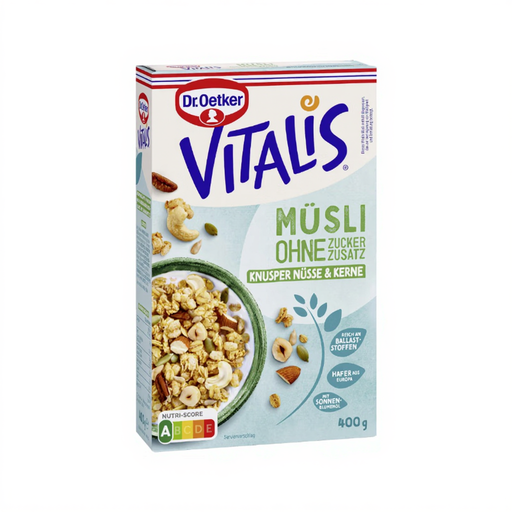 Image unavailable
This mix is an option for a quick breakfast with milk or yoghurt. To make your choice based on sugar content, compare the nutrition information per 100 g, and check the pack instructions before eating it dry while you’re out. If you have allergies, always refer to the current ingredients and allergen information.
No, the two claims have different meanings. For solid foods, the Rural Service Centre Rhineland-Palatinate defines ‘sugar-free’ as no more than 0.5 g of sugar per 100 g. Sugar from any fruit included still counts towards the total sugar content.
Dried fruit contains sugar, which is included in the muesli’s nutrition information. For its fruit and oat muesli with no added sugar, Kölln states that it contains 40% dried fruit; EDEKA24 lists 22 g of sugar per 100 g for the product.
If you don’t want to mix anything while you’re out, choose a product whose serving instructions say it can be eaten dry. REWE describes its organic berry muesli as suitable for eating on its own. For Alnatura’s Bircher muesli, however, the manufacturer recommends mixing it and leaving it to soak for around 10 minutes.
Yes. Sugar content and allergens are separate selection criteria. The Seitenbacher low-sugar muesli described here contains almonds and gluten-containing cereals. If you have allergies, always check the ingredients and allergen information on the pack you’re buying.