People looking to keep sugar intake low
If keeping total sugar low matters more to you than fruit flavour, compare the “of which sugars” figure per 100 g for each muesli. “Sugar-free”, “low sugar” and “no added sugar” do not mean the same thing.


If you mean “sugar-free” literally, “no added sugar” is not enough: the key figure is the sugar content per 100 g. If you’re looking for the lowest possible total sugar, the fruit-free mueslis labelled low in sugar are worth considering. If you prefer fruit or a crunchy texture, weigh up the sugar content and ingredients of the specific variety.
If keeping total sugar low matters more to you than fruit flavour, compare the “of which sugars” figure per 100 g for each muesli. “Sugar-free”, “low sugar” and “no added sugar” do not mean the same thing.
If dried fruit is a must, check the nutritional information as well as the ingredients list. Fruit and grains can contribute to the total sugar figure, even when no sugar has been added.
If one pack needs to cover several breakfasts, check the size and shelf life of the specific variety. The ingredients and allergen information also need to suit your household; a larger pack won’t answer those questions.
First, decide whether you’re looking for a low total sugar figure or simply want to avoid added sugar. Then consider the ingredients, the texture you prefer and the pack size to find a variety that suits your weekly shop.
| What to consider | What to check | Who it matters to |
|---|---|---|
| Total sugar | Compare the “of which sugars” figure per 100 g; “no added sugar” is no substitute for checking this. Under Regulation (EC) No 1924/2006, solid foods can be labelled “low sugar” if they contain no more than 5 g of sugar per 100 g. | If keeping total sugar as low as possible is my priority, I can do without dried fruit and a sweeter taste. Around 36% of consumers put this sugar figure first. |
| Pack size | Check the pack weight and whether you can use up that particular variety as part of your usual stock-up routine. | For my regular breakfast, I want to choose a pack size that suits my weekly needs. Around 29% of consumers prioritise this kind of meal planning. |
| Ingredients and allergens | Read the ingredients list and allergen information on the specific pack, including any “may contain” warnings. | If certain grains or nuts matter to my household, the exact recipe will determine whether I buy it. For around 21% of consumers, finding ingredients that suit their needs comes first. |
| Crunchiness | For crunchy muesli, check both the ingredients and the sugar figure per 100 g; “less sweet” does not mean “sugar-free”. | I want a crunchy mix and am happy to check how its sugar content compares with fruit-free muesli. This texture is the main reason to buy for around 14% of consumers. |
Fruit muesli can still contain sugar from dried fruit and grains, even if no sugar has been added. That’s why it’s important to check the total sugar figure too.
Check the sugar figure per 100 g. If you’re looking for a low figure, also look for varieties labelled low in sugar.
The GUT&GÜNSTIG “less sweet” variety described by EDEKA contains glucose-fructose syrup, sugar and honey. A description of the flavour does not mean that added sweetening ingredients have been left out.
For crunchy muesli, check the ingredients list and nutritional information for the variety you want.
A larger pack is only practical if the variety suits your household and you can use it before its stated best-before date.
Before choosing a larger pack, compare its weight and shelf life with how much you usually use.
The Seitenbacher low-sugar mueslis considered here contain gluten-containing grains; according to the manufacturer, “Müsli zuckerarm” also contains almonds. The sugar figure does not tell you whether a product is suitable for someone with an allergy.
Check the ingredients, highlighted allergens and any “may contain” warnings on the specific pack.
The fruit-free “Müsli zuckerarm” and “Spezial-Müsli 2” varieties are worth considering if total sugar is your main priority.
Kölln offers both fruit mueslis with no added sugar and crunchy mueslis labelled as having reduced sugar.
Alnatura presents mixing your own muesli as a way to choose ingredients for your weekly supplies.
The “less sweet” crunchy muesli is worth considering if crunchiness is important to you.
Here, REWE is the retailer of the 500 g pack of Kölln Müsli Früchte ohne Zuckerzusatz considered here, not the manufacturer of the recipe.
Brüggen makes muesli for retailers’ own brands, as well as recipes tailored to individual customers.
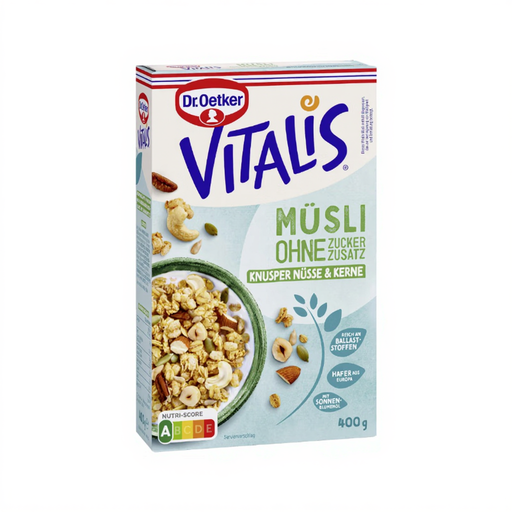
This crunchy nut muesli is one option for your weekly shop. Check the details on the specific pack to decide whether it suits your personal sugar limit and any allergies.
 No image available
A crunchy nut muesli in a 400 g pack, for anyone looking for a tasty breakfast option. “No Added Sugar” is part of the product name; also check the sugar figure per 100 g, along with the ingredients and allergens on the specific pack.
No. Regulation (EC) No 1924/2006 sets different conditions for the two claims: “sugar-free” means a product can contain no more than 0.5 g of sugar per 100 g, while “no added sugar” excludes added mono- and disaccharides, as well as foods used for their sweetening properties. Always check the nutritional information to see whether a product meets your preferred sugar limit.
Dried fruit and grains contribute to the total sugar figure. Kölln lists 22 g of sugar per 100 g for the fruit muesli with no added sugar considered here, so the claim alone does not mean it is low in total sugar.
No. For the “Knusper Klassik 50 % weniger Zucker” variety considered here, Kölln still lists sugar and glucose-fructose syrup among the ingredients. Check the ingredients list if you want to avoid added sweetening ingredients.
Follow the storage instructions on the specific pack. For the crunchy variety considered here, Kölln recommends storing it in a dry place away from heat. Once opened, a well-sealed container is handy for keeping it in your cupboard.