Weighing seeds one after another
If you’re adding several granola ingredients to the same bowl one after another, an easy-to-reach tare button and a clear display are important.


If you’re adding several seeds to the same bowl one after another, a digital kitchen scale with an easy-to-reach tare button, a display in grams and enough room for both the bowl and display is usually a good place to start. For very small individual quantities, a precision scale with finer increments may be worth considering. However, a lower maximum capacity and finer increments alone don’t prove that the scale has the accuracy you need. Check the combined weight of the bowl and ingredients, as well as the power supply and cleaning instructions for the specific model.
If you’re adding several granola ingredients to the same bowl one after another, an easy-to-reach tare button and a clear display are important.
If your recipe calls for very small individual quantities, compare the increments and weighing range of a precision scale with those of a standard kitchen scale.
For larger batches or a wide container, consider the total weight, weighing platform and display readability together.
Suitable if: You weigh typical recipe quantities in a bowl one after another, and gram increments are fine for your measurements.
Bear in mind: The bowl and ingredients count towards the maximum capacity; 1 g increments don’t prove that the measurement error is no more than 1 g.
Suitable if: You want to weigh very small individual quantities and the container and its contents are within the weighing range.
Bear in mind: The CASO FinoCompact has a maximum capacity of 500 g; finer increments alone don’t prove the measurement error.
Suitable if: A large bowl might obscure the display or controls, or the total weight exceeds the limit of a smaller scale.
Bear in mind: A larger weighing platform takes up more space on your worktop and in storage, and isn’t a reason on its own to choose a scale for small quantities of seeds.
| What you need | What to check | Who it matters to |
|---|---|---|
| Weighing seeds one after another | Check whether you can reach the tare button and see the display with your own bowl in place. | If I want to add several ingredients to the same container without transferring them, easy access to the tare function is essential. Around 36% of consumers are likely to prioritise weighing ingredients one after another. |
| Reading small individual quantities | Compare the smallest quantity in your recipe with the display increments and weighing range separately. | For very small portions of seeds, I want to be able to read a measurement that suits my recipe. Around 29% of consumers put this need first. |
| Bowl and total weight | Check the maximum capacity for the bowl and ingredients together, and make sure the display remains visible. | If I use a wide bowl or make a larger batch, the scale needs to suit both the weight and the visibility of the display. Around 21% of consumers place the greatest importance on this combination. |
| Storage and operation | Compare the dimensions, care instructions, battery type and what’s included with the exact model. | Between stages of preparation, I want to be able to store the scale easily and use it without having to find missing accessories. Around 14% of consumers are likely to have this as their main priority. |
A figure such as 1 g or 0.1 g initially tells you the increments shown on the display. On its own, it doesn’t tell you the size of the measurement error for the quantities of seeds you’re weighing.
Compare the display increments, weighing range and independently verified accuracy as separate specifications.
The bowl adds weight too. A wide container may also obscure the display or make the tare button harder to reach.
Check the weight of the bowl and your largest planned batch together, and make sure the display and controls remain accessible.
Finer display increments and a higher maximum capacity solve different problems. The CASO FinoCompact is limited to 500 g.
Choose a scale based on your smallest individual quantity and the heaviest combination of container and ingredients. If you want to weigh both, you may need a second scale.
Two AAA batteries aren’t included with the CASO FinoCompact.
Check the battery type and what’s included with the specific model. The German Environment Agency says that used batteries can be returned free of charge to retailers or other collection points.
You’ll need to have the two AAA batteries required for the FinoCompact ready separately.
The KS 19 Fresh is a slim kitchen scale for bowls and ingredients, up to its maximum capacity of 5 kg.
The FinoCompact is designed for small individual quantities, with 0.1 g increments.
The Page Profi 300 is a large-platform option for wide or heavy bowls.
The KS202 is a compact kitchen scale for weighing ingredients one after another in a bowl.
The CMMF 3201000754 digital kitchen scale has a 20 × 20 cm weighing platform and is designed for containers within its maximum capacity.
This selection includes digital kitchen scales for weighing ingredients in a bowl, a scale for heavier combinations of containers and ingredients, and an option for smaller individual quantities.
 No image available
The tare function and specified maximum capacity of 5 kg make this scale suitable for weighing ingredients one after another in a container, provided the bowl and contents stay within the limit.
 No image available
The tare function is useful for weighing several ingredients in one container; check that the bowl and contents together stay within the maximum capacity.
 No image available
Its higher stated maximum capacity may be useful for heavier combinations of bowls and ingredients; on its own, it doesn’t tell you whether the scale is suitable for very small quantities of seeds.
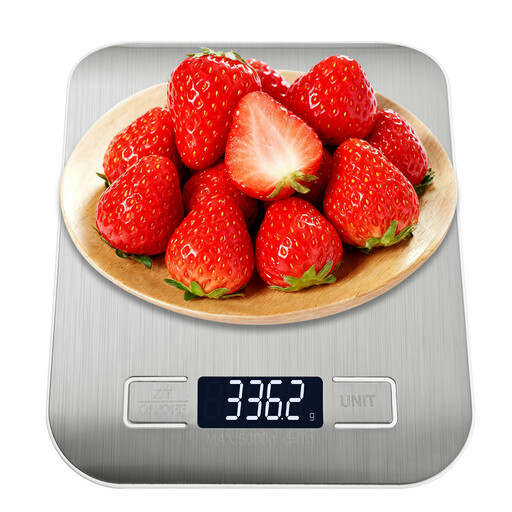 No image available
The 5 kg maximum capacity stated in the product name may suit weighing ingredients in a bowl, provided the container and ingredients together stay within the limit.
 No image available
As coffee scales, these are an option to consider for small individual quantities; the stated maximum capacity applies to the container and contents together.
Place the bowl on the scale and use the tare function to reset the display to zero. Repeat before adding each ingredient, as long as you can reach the button with the bowl in place. Don’t exceed the maximum capacity for the bowl and all its contents.
No. This figure describes the display increments, not necessarily the measurement error. If your recipe requires a specific margin of error, check the relevant measurement or test documentation separately.
A precision scale may be suitable if its increments match the quantities in your recipes and the container and contents are within its weighing range. Also consider whether you want to use the same scale for a larger bowl.
Follow the instructions for the specific model. GRAEF says to wipe the glass surface of the KS202 with a damp cloth; the CASO FinoCompact requires two AAA batteries, which aren’t included.
The German Environment Agency says used batteries can be returned free of charge to retailers or other collection points. Check which collection point is suitable for you before returning them.