If the same variety regularly features at Sunday breakfast and is also eaten during the week, 750 g to 1 kg is a practical place to start. A multipack containing several kilos makes sense only if the recipe, how quickly you get through it and your dry storage space all suit. If tastes vary or people have different ingredient and allergen requirements, smaller, separate packs give you more flexibility.
Which pack is right for you?
The number of people at the table on Sunday isn’t the only thing that determines how much to stock up on. It also matters whether everyone will keep eating the same variety afterwards.
Families who eat it regularly
If several people eat the same variety during the week too, it’s worth comparing individual 750 g to 1 kg packs with multipacks. Before buying a large case, make sure you have somewhere dry to store the individual packs and that the recipe suits everyone at the table.
Families with different tastes
If you’d like to offer several varieties at breakfast, smaller packs let you choose more freely rather than committing to a large supply of just one. Compare granola and other crunchy mueslis by their individual recipes, not just by pack size.
Families who check ingredients carefully
If the type of grain, nuts, sesame, milk or sugar affects your choice, the labelling for the specific variety matters more than the amount you buy. Check the ingredients, nutritional information, highlighted allergens and possible traces on the current packaging for each variety.
What to look for when buying
Start by choosing a variety with ingredients that suit everyone who’ll be eating it. Then compare the pack size and individual packs with how much you actually get through. A smaller pack leaves room for a few different varieties, while a large case commits you to one recipe.
| What to consider |
What to check when buying |
Who it matters to |
| Amount to stock up on |
Compare the total weight, number and size of individual packs, and storage instructions with how much you regularly eat. |
If we eat the same variety on Sundays and during the week, I want to stock up without committing to a large quantity we’re unlikely to use. For around 42% of consumers, getting the amount right is the top priority. |
| Ingredients and allergens |
Read the ingredients list, sugar and fat per 100 g, and allergen and trace warnings for the specific variety. |
When people at the table have different requirements, I need to know what’s actually going into each bowl. Around 33% of consumers prioritise choosing a recipe that suits their requirements. |
| Choice of varieties |
Decide whether one variety will suit everyone or whether several smaller packs make more sense. For online orders, check the selected store. |
If not everyone likes the same crunchy muesli, I want to offer a choice rather than open a whole case of one variety. For around 25% of consumers, having a range of varieties to choose from is the main priority. |
Common buying mistakes
-
Assuming the biggest pack is automatically the right family size
Kölln and Seitenbacher list multipacks containing 4 × 1,250 g and 12 × 750 g respectively. These quantities are a sensible way to stock up only if you eat the same variety regularly.
Before buying, think about how quickly your household will actually get through a variety. If you’re not sure yet, start with one pack or two smaller varieties.
A large case also needs plenty of storage space. If you change your mind about the flavour, you’ll have more of the same variety left over.
-
Assuming “organic” or “wholegrain” tells you everything about the recipe
These descriptions don’t replace a comparison of the ingredients and nutritional information. Crunchy varieties made with wholegrain spelt flakes, for example, can also contain sugar and oil, as Alnatura states for its Dinkel-Crunchy.
For the varieties you’re considering, compare the ingredients list and the sugar and fat content per 100 g.
-
Leaving allergen and trace warnings until after you’ve stocked up
Depending on the product, grains, nuts, sesame, milk or soya may appear as ingredients or in warnings about possible traces. The Federal Office of Consumer Protection and Food Safety explains how the relevant allergens are labelled in the ingredients list; a trace warning is different.
Check the current packaging for each variety before buying several packs of the same recipe. Don’t assume a product is suitable just because a pack you bought previously was.
-
Judging the fruit or nuts by the picture on the pack alone
A prominently featured ingredient may not be present in the quantity suggested by the picture. For breakfast products, the Rhineland-Palatinate Consumer Advice Centre recommends checking the ingredients list to understand how much is included.
For fruit, nut or coconut varieties, compare the stated quantities of the advertised ingredients.
Brands to consider
The examples below show a range of pack sizes and recipes. The brand alone won’t tell you whether a particular variety suits your household or which packs are available locally.
Kölln
Kölln also offers Knusper Klassik in a large 4 × 1,250 g pack. When comparing it with individual packs, consider both the total quantity and the recipe of this particular variety.
- The individual packs make the total quantity in the case clear.
- For Knusper Klassik, Kölln lists gluten-containing grains and possible traces of nuts and milk, among other information. Check the current labelling.
Alnatura
Alnatura Dinkel-Crunchy, in a 750 g pack, is a mid-sized organic option for households that don’t want a large case of the same variety.
- The individual 750 g pack lets you match the amount to how much of that variety you eat.
- Spelt is a type of wheat. Alnatura also lists sugar and warnings about possible traces of other allergens for this variety.
Seitenbacher
Seitenbacher offers Mühlen Müsli 2 in a 1 kg pack, as well as a separate case offer of 12 × 750 g Spezial-Müsli 2. These are different products and pack formats.
- The two formats give you a basis for comparing an individual pack with a larger supply.
- The case is listed as a special offer. When choosing, check the information for the variety actually on offer.
EDEKA Bio
EDEKA Bio lists 500 g granola varieties with different ingredient profiles, including Mandel-Kokos and Kerne & Saaten.
- The different varieties let you compare specific ingredients, not just pack sizes.
- EDEKA notes that packaging information may differ and that products may not be available in every store.
REWE
REWE stocks granola and crunchy muesli in a range of varieties, including smaller pack sizes. If people at the breakfast table have different tastes, it’s worth comparing the individual products.
- You can compare the different varieties by their ingredients and pack sizes.
- Check the specific product range for your chosen location rather than assuming that every product in the range is available there.
Brüggen
Brüggen describes itself as a manufacturer of cereals and muesli for own-label brands. When shopping, it’s the labelling on the specific own-label product that matters.
- Knowing the manufacturer can help you understand how own-label products fit into the muesli range.
- The manufacturer’s name alone won’t tell you the pack size, ingredients or allergens of a specific variety.
Crunchy muesli packs at Joybuy
This selection includes individual packs of crunchy muesli from 400 g to 750 g. The 750 g varieties are worth considering if you eat them regularly; smaller packs give you more flexibility if you want to try a variety first or switch things up at breakfast. Check the ingredients and allergens on the current packaging.
 No image available
Jeden Tag Less Sweet Crunchy Oat muesli, 750 g
This 750 g pack is worth considering if you eat the same crunchy muesli variety outside of Sunday breakfast too. Before buying, compare the current ingredient and allergen information with the requirements at your table.
View at Joybuy
 No image available
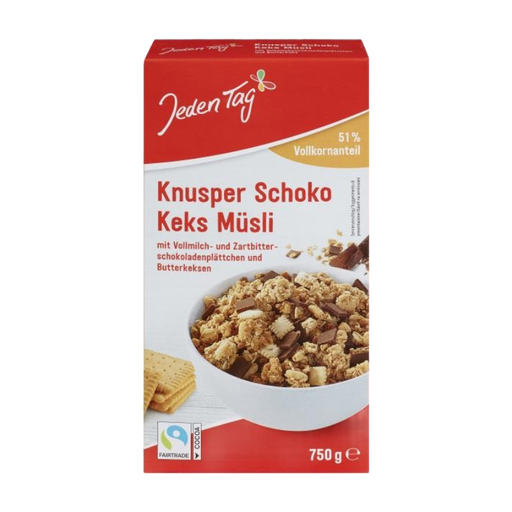
Jeden Tag Crunchy Chocolate Cookie muesli, 750 g
This 750 g pack is an option if you’re looking for a chocolate cookie variety and eat it regularly. To compare it with other varieties, check the nutritional information per 100 g and the current allergen labelling.
View at Joybuy
 No image available
Dr. Oetker Vitalis Less Sweet Pure Crunchy muesli, 600 g
This individual 600 g pack suits households looking for more than a 500 g pack but not wanting to commit to a multipack. The variety name is no substitute for comparing the nutritional information per 100 g. Also check the ingredients and allergens on the current packaging.
View at Joybuy
 No image available
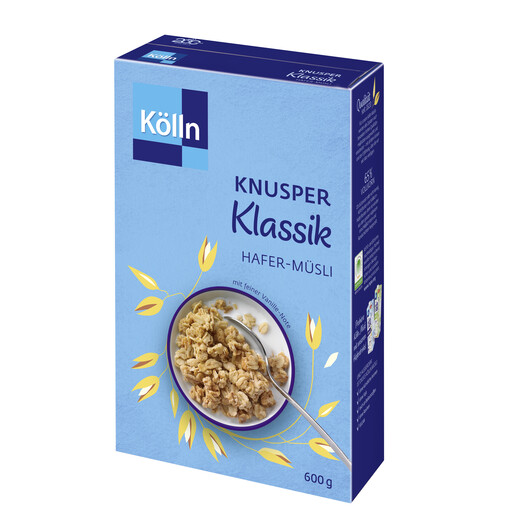
Kölln Crunchy Classic Oat muesli, 600 g
This individual 600 g pack is worth considering if you’re looking for an oat-based crunchy variety without buying a large case. It isn’t the same as Kölln’s large 4 × 1,250 g pack, so check the labelling on the pack you choose.
View at Joybuy
 No image available
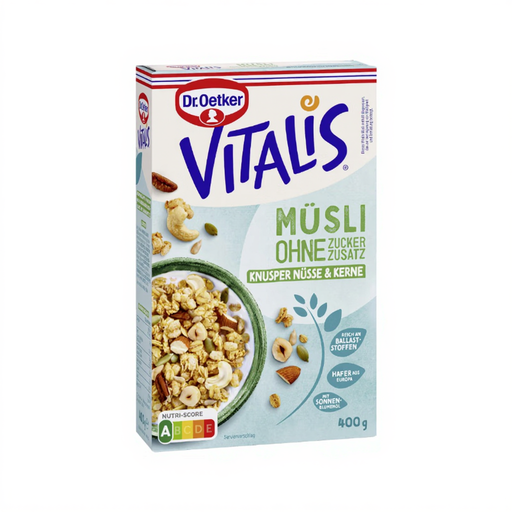
Dr. Oetker Vitalis No Added Sugar Crunchy Nut muesli, 400 g
This 400 g pack is a smaller option if you only want to serve a nut variety occasionally. The variety name alone doesn’t tell you whether it meets individual dietary requirements, so read the current ingredients list, nutritional information and allergen warnings.
View at Joybuy
Frequently asked questions
What pack size is right for regular family breakfasts?
An individual pack of 750 g to 1 kg is a good starting point if several people will keep eating the same variety after Sunday. Larger quantities, such as Kölln’s 4 × 1,250 g or Seitenbacher’s case of 12 × 750 g, assume regular consumption, suitable storage space and a recipe that everyone can enjoy.
How should I store an opened pack of crunchy muesli?
Follow the instructions on the specific pack and seal it well again after opening. Alnatura recommends storing its Dinkel-Crunchy somewhere dry and protected from heat. The German Food Federation also explains that a best-before date is not an expiry date; for unopened food, it assumes appropriate storage conditions.
How can I identify allergens in granola and crunchy muesli?
Read the ingredients list and any warnings about possible traces on the current packaging. The Federal Office of Consumer Protection and Food Safety explains that the relevant substances that can cause allergies or intolerances must be listed in the ingredients. Which ones matter to you depends on the specific recipe.
Is online product information enough to choose a variety?
Online information can help you narrow down your options, but the labelling on the specific pack is what matters for ingredients and allergens. EDEKA notes in its product information that website details may differ from the packaging and that a variety may not be available in every store.


