For transcribing gravestone inscriptions, a keyboard with a German layout makes sense. If you regularly enter dates of birth and death, consider whether a separate number pad would make your workflow easier. If you mainly check images, a compact model may leave more room for your mouse. Try a split keyboard before committing to a different hand position, and allow for the space and adjustment time it may require. No keyboard can check records for duplicate entries: compare images and existing records in your transcription software instead.
Which keyboard is right for you?
People transcribing names and dates of birth and death
If you’re entering several details for each gravestone, it helps to have easy access to numbers and German characters on your chosen keyboard layout. The Association for Computer Genealogy (Verein für Computergenealogie e.V.) and BillionGraves describe working with gravestone details and transcription forms.
People checking for possible duplicate entries
When checking records, compare images with existing entries and correct records where needed, rather than creating everything again from scratch. BillionGraves describes this kind of second review, while FamilySearch explains that duplicate photos can occur for different reasons.
Frequent typists who need more space or a different hand position
During longer sessions, you’ll need to balance the space required for your mouse and reference images against a key layout that works for you. The DGUV Institute for Occupational Safety and Health covers input devices for intensive computer work; Perixx notes that its split model may take some getting used to.
What should you look for when buying?
First decide whether you’ll mainly be entering lots of numbers or checking images and records. Then consider how much space you need and whether a familiar or split key layout is better suited to your workflow.
| Priority |
What to check when buying |
Who might find this important? |
| Checking for possible duplicate entries |
Check which record-matching features your transcription software offers; try the navigation keys in your own form. |
When comparing images with existing records, I want to correct specific entries rather than create everything again from scratch. Around 27% of consumers are likely to prioritise this kind of checking. |
| Entering dates of birth and death |
Confirm the exact DE-QWERTZ version; compare the number pad and top number row with the date fields you typically use. |
When entering lots of birth and death dates, I want to enter numbers easily and access German characters with ease. Around 27% of consumers are likely to put repeated date entry first. |
| Hand position during longer sessions |
If possible, try a split layout with the types of entries you usually make; measure the space available for your keyboard, mouse and reference images. |
When working at a screen for longer periods, I want to see whether a different hand position suits me. Around 20% of consumers are likely to prioritise finding a hand position that works for them. |
| Space for your mouse and reference images |
Check your desk space and mouse position; consider how often you use a separate number pad. |
When checking images of inscriptions, I want to keep space for my mouse and paperwork, and I can do without a separate number pad. Around 13% of consumers are likely to put available desk space first. |
| Quiet typing and easy connection |
Check the connection and set-up against your computer; treat manufacturers’ noise claims as specifications, not as a direct comparison. |
When working quietly at a screen, I want to type without fuss and pay attention to the key feel and connection. Around 13% of consumers are likely to see quiet, straightforward typing as their top priority. |
Avoid common buying mistakes
-
Confusing programmable keys with duplicate detection
A programmed action can trigger commands, but it can’t confirm whether two similar records are actually the same.
First check the record-matching and editing features available in your transcription platform. Set up keyboard shortcuts only for commands that your software actually supports.
-
Choosing a TKL keyboard simply because it’s smaller
A TKL keyboard doesn’t have a separate number pad. If you often enter dates of birth and death, using the top number row may not suit your workflow as well.
Try entering typical records using the top number row, and compare the process with a keyboard that has a number pad before you decide.
-
Buying a split keyboard without checking the space and adjustment time it needs
The unfamiliar key layout may take some getting used to, and the keyboard needs to fit on your available desk space.
Measure the space for your keyboard, mouse and reference images, and, if possible, try the layout with typical names and dates.
Brands to consider
CHERRY
The STREAM KEYBOARD is a wired full-size option, while the STREAM KEYBOARD TKL does without a number pad.
- CHERRY describes the scissor mechanism in both models as quiet. This is a manufacturer’s claim, not an independent noise comparison.
- The TKL model has no separate number pad, so consider how often you enter numbers using one.
Logitech
The MX Keys S offers customisable actions; the ERGO K860 is a split keyboard for people who want to try a different key layout.
- Logitech says that MX Keys S Smart Actions require Logi Options+ software.
- Customisable actions don’t replace checking existing records. Claims about a suitable hand position don’t guarantee a comfortable fit for everyone.
Perixx
The PERIBOARD-512 B is a wired split keyboard with a German QWERTZ layout and number pad.
- Perixx lists USB-A as the connection and gives the dimensions as 485 × 236 × 44 mm.
- The manufacturer notes that it may take some getting used to. A split design won’t suit everyone.
Keychron
The K10 Pro is a mechanical keyboard for people who want to customise their layouts.
- Keychron lists VIA support and several layout, switch and keycap options.
- Check the exact version: the layout, switches and keycaps vary by model.
Joybuy keyboards for transcription
The Joybuy keyboards featured here include German QWERTZ layouts and a range of designs, including models with a number pad, compact options and split keyboards. None of these keyboards can replace checking similar records in your transcription software.
 No image available
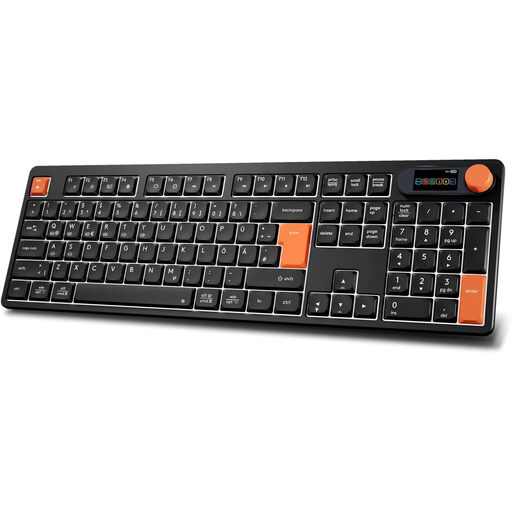
Wireless QWERTZ keyboard with LCD display and rotary dial
If you’re looking for a QWERTZ layout with an LCD display and rotary dial, this version may be worth considering.
The product name lists Bluetooth (4x), 2.4G and USB-C, a 2000 mAh battery and backlighting.
View at Joybuy
 No image available
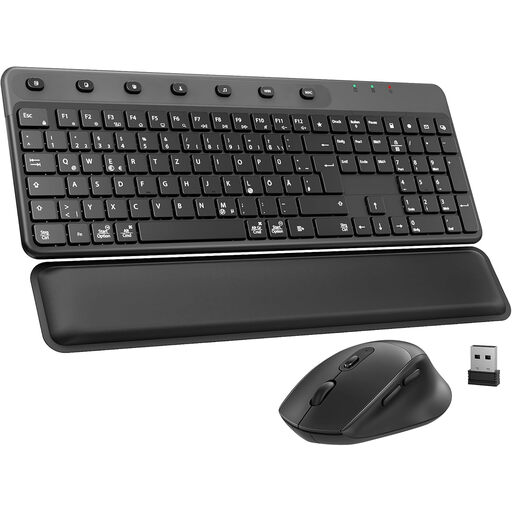
Wireless keyboard and mouse set, QWERTZ, full-size with number pad
For frequent number entry, this full-size model includes a separate number pad. A mouse is also included in the set.
The product name lists quiet keys, a detachable wrist rest, a 2.4-G USB connection and a mouse with 3-level DPI adjustment.
View at Joybuy
 No image available
CHERRY MX-LP 2.1, wireless, 65%, German QWERTZ
The 65% layout may suit you if you’re looking for a compact keyboard with a German layout and can manage without a separate number pad.
The product name lists low-profile MX Speed switches, RGB and tri-mode connectivity via 2.4 GHz, Bluetooth or USB-C.
View at Joybuy
 No image available
Logitech ERGO K860, split wireless QWERTZ keyboard
If you’d like to try a split key layout, this model is one option. Make sure you have enough space for its design.
The product name lists a curved, split keyboard, an integrated wrist rest, Bluetooth and a USB receiver.
View at Joybuy
 No image available
Logitech MX Mechanical, German QWERTZ
If you prefer mechanical keys and need a German layout, you can compare this version with other layouts and designs.
The product name lists Tactile Quiet switches, Bluetooth and Logi Bolt, as well as adjustable backlighting.
View at Joybuy
Frequently asked questions
Can a programmable key automatically detect duplicate entries?
No. Programming a key doesn’t check records for duplicates. Logitech says Smart Actions can trigger repeated commands; continue to compare similar entries using images and the features in your transcription software. FamilySearch lists several reasons why duplicate photos may appear in a collection.
How can I review entries a second time without creating them again?
First check which features your transcription platform offers. BillionGraves describes a second review in which existing names and details are checked and edited if needed; you can’t assume the same process is available on other services.
What should I check before connecting a keyboard or assigning keys?
Check that the exact layout and connection are compatible with your computer. Perixx says the PERIBOARD-512 B uses USB-A; Logitech lists Logi Options+ as a requirement for MX Keys S Smart Actions. Start by testing a single command supported by your transcription software.
What are my rights if a keyboard bought online is faulty?
When you buy from a business seller in the EU, the EU consumer rules described here generally provide a legal guarantee of at least two years from receipt. Distance purchases generally come with a 14-day right to cancel, although exceptions apply. This is separate from any voluntary manufacturer’s warranty.
Is it automatically legal to publish every gravestone inscription transcribed in Germany?
No, you can’t assume that publication is always permitted. The guidance from the Bavarian State Commissioner for Data Protection concerns the publication of civil status data by local authorities, not every private gravestone project. For a specific project, check the applicable publication rules and the conditions set by the relevant cemetery.


