
Lieferung heute & morgen

Qualitätsgarantie

Willkommens-Angebote freischalten: KOSTENLOSE Lieferung | Bis zu 80 % RABATT | Kostenlose 30-Tage-JoyPlus-Testphase
App herunterladen
A grill pan creates seared grill marks on meat, fish and vegetables without the need for an outdoor barbecue. However, models vary considerably in terms of material, weight, coating, heat source and cleaning requirements. If you focus only on a ridged surface or a well-known brand, you could end up buying a pan that is too heavy, too small or unsuitable for your hob.
A grill pan for the hob will not automatically work on induction. The key factor is a magnetic base. If you are buying a grill pan for induction, compatibility should be stated explicitly in the technical specifications. It is also worth checking the manufacturer’s information for gas, electric and ceramic hobs.
The base must also be sufficiently flat. If it is heavily curved, heat transfer may be restricted on a ceramic or induction hob.
High ridges create distinctive grill marks and allow some fat and liquid to drain away. At the same time, they reduce the direct contact area between the food and the pan. Preheating is therefore important for even browning. If the temperature is too low, meat may simmer rather than fry.
With coated grill pans, avoid heating the empty pan at a high temperature for an extended period. The permitted temperature depends on the particular model.
A cast-iron grill pan retains a great deal of heat, but depending on the design, it can weigh around two to three kilograms. This makes it harder to move and clean in the sink. Enameled cast iron generally does not require traditional seasoning, but it should still be protected from thermal shock.
With a coated grill pan, the surface is more vulnerable to metal utensils, wire wool and harsh cleaning products. “Dishwasher-safe” and “recommended for a long service life” do not always mean the same thing.
Cast iron is ideal for shoppers who want excellent heat retention and a heavy, stable pan. The material responds more slowly to changes in hob temperature, but it stays hot for longer. Enameled models are usually easier to care for than bare cast iron.
Aluminium is lighter and generally heats up faster. An aluminium grill pan with a suitable non-stick coating can be practical for everyday use. With coated models, follow the temperature limits and care instructions. Scratches can affect the performance of the surface.
A 26 cm grill pan provides a well-balanced cooking area for individual to medium-sized portions. A square grill pan often makes efficient use of the available space and is suitable for long foods such as courgettes, asparagus or several pieces of meat.
For two people, a cooking area of around 23 to 26 cm may be sufficient. If you want to prepare several portions at once, compare the internal cooking surface rather than just the external dimensions. A large pan also needs enough space on the hob and in the kitchen cupboard.
A ridged grill pan should have sufficiently high, neatly formed ridges. Pouring spouts at the sides make it easier to drain fat and meat juices. Two short handles provide better control with heavy cast-iron models, while a long handle can be more practical when taking the pan out of the oven.
With an ovenproof grill pan, the maximum temperature and the handle’s suitability are crucial. Statements such as “ovenproof up to 175 °C” do not automatically apply to every component of the pan. Plastic or Bakelite handles may restrict use in the oven.
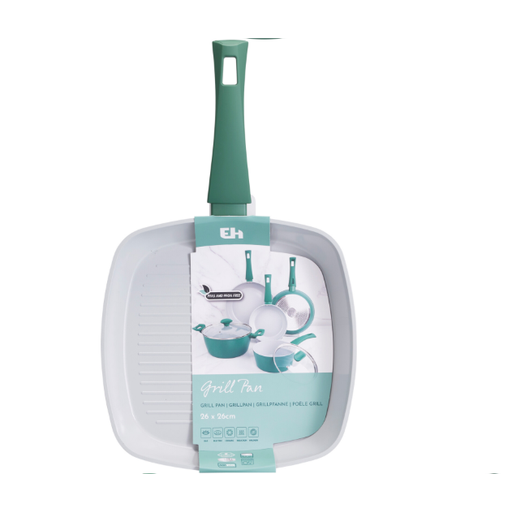
Why this product suits this profile: The aluminium construction is designed to heat up quickly and evenly. With a diameter of 260 mm, it offers a practical everyday cooking area for meat, fish and vegetables.
The stated dimensions and ridges are clearly specified. Even so, you should check compatibility with your own hob before buying.
Lighter than many cast-iron models, with a grill surface suitable for several types of food.
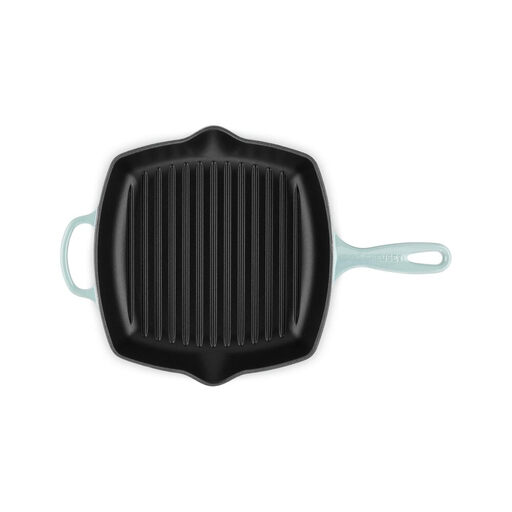
Why this product suits this profile: According to the product details, the 26 cm square cooking surface made from enameled cast iron is suitable for gas, induction, ceramic, halogen, oven and grill use.
The specifications list ridges, pouring spouts, two handle areas and clear oven suitability. At around 2.9 kg, its weight should be taken into account when moving it.
Enameled cast iron, raised grill ridges and a long handle with an additional helper handle.

Why this product suits this profile: Three separate sections allow you to cook different ingredients at the same time. According to the product details, the pan is suitable for induction, gas, electric, glass and ceramic hobs.
The product description explicitly states that it should be hand-washed and is not ovenproof. This means you can plan to use it on the hob, but not in the oven.
Three cooking zones, die-cast aluminium and an ILAG non-stick coating that is stated to be free from PFOA, PFOS, APEO, lead and cadmium.
We have put together a complete, regularly updated list of products that fully meet these strict selection criteria and the safety regulations applicable in the EU.
A grill pan for induction needs a magnetic base. Cast iron is often suitable for induction, but this should still be confirmed in the product details. Aluminium requires a magnetic stainless-steel base.
Cast iron retains heat for a long time and is comparatively heavy. Aluminium usually heats up faster and is easier to handle. Cooking habits, weight, coating, cleaning and the hob you have are more important considerations than the material alone.
Its service life depends on the material, coating, temperature control and care. Enameled cast iron can be used indefinitely if treated properly. With a coated grill pan, avoid overheating, scratches and abrasive cleaning products.