
Lieferung heute & morgen

Qualitätsgarantie

Willkommens-Angebote freischalten: KOSTENLOSE Lieferung | Bis zu 80 % RABATT | Kostenlose 30-Tage-JoyPlus-Testphase
App herunterladen
A growing wooden highchair should last for several years, stand securely at the dining table and adapt to your child’s height. In practice, however, models vary considerably in terms of safety harnesses, adjustment options, materials and space requirements. A low purchase price can also be misleading if the tray, seat reducer or cushions need to be bought separately later on.
This buying guide explains which details really matter and which product features suit different everyday situations.
Not every height-adjustable children’s chair is automatically suitable for several age groups. The key question is whether the seat and footrest can be adjusted independently. A fixed footrest may mean that your child’s legs do not have stable support. This is particularly important when the chair is used for longer periods at the family dining table.
The stated weight capacity should also be viewed in context: a growing highchair suitable up to 70 kg may be designed for use into the teenage years. This does not mean, however, that a toddler can sit in it without suitable restraints or without supervision.
A tray is practical, but it does not replace a safety harness. For babies who can sit unaided, a highchair with a safety harness is essential. Depending on the model, three-point or five-point harnesses may be used.
A highchair from 6 months should only be used once your child can sit upright without assistance and the manufacturer’s instructions explicitly permit it. The stated age alone is no substitute for your child’s individual development.
A folding highchair can be useful in a small kitchen or for occasional use. Before buying, however, check the dimensions when unfolded, the weight and the footprint. A foldable model does not automatically take up less space at the dining table.
With a traditional staircase highchair with a wide base, stability and long-term adjustability are the main priorities. In smaller homes, the footprint can be a decisive factor.
Look for clear product labelling and read the instructions for use. Several models in this selection refer to the European standard EN 14988. The roba Nature Up, for example, lists EN 14988:2017+A1:2020, while the roba folding highchair lists EN 14988-1:2006+A1:2012.
A standard reference describes the technical requirements for highchairs, but it does not replace correct assembly and use. Before every use, parents should:
For an ergonomic seating position, the footrest should be adjusted so that your child’s feet can rest on it. With an ergonomic highchair, information about height adjustment and, where applicable, depth adjustment is therefore more important than purely visual design features.
The roba Sit Up Flex has height-adjustable and removable seat and foot boards. The seat and footrest on the hauck Alpha Plus can also be adjusted. This means the chair can be used beyond the baby and toddler stages as a children’s or teenage chair, provided the relevant weight and age limits are observed.
Wood, bamboo and MDF differ in terms of their surfaces, care requirements and construction. Painted surfaces can usually be cleaned with a damp cloth. Even so, liquids should not be left on the material for extended periods.
If traceable sourcing is important to you, look for an FSC-certified highchair. The hauck Alpha Plus is described as being made from European beechwood sourced from FSC-certified forests. The roba Nature Up is also described as an FSC-certified bamboo model. When buying, check whether the certification applies to the entire product or only to specific components.
A highchair with a tray is suitable for mealtimes when your child is not yet ready to sit directly at the family table. The tray on the roba Nature Up is removable. For the white roba Sit Up Flex, the tray and seat reducer are listed as separately available accessories. The matching tray set for the hauck Alpha Plus is also available separately.
These additional costs should be included in the total price. A model with fewer accessories may still be the right choice if it is intended to be used directly at the dining table.
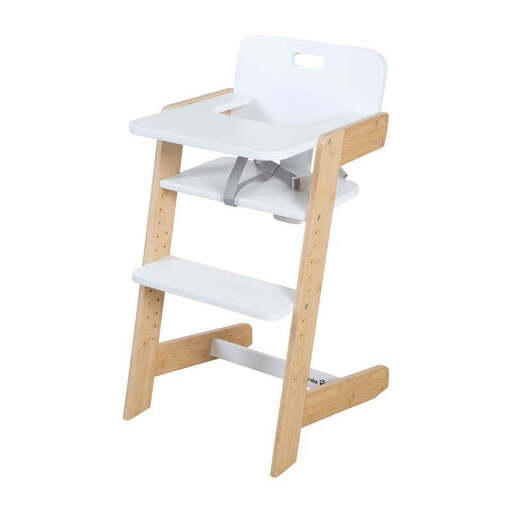
Why this product suits this profile: This model combines a removable tray with suitability from 6 months and a stated weight capacity of up to 70 kg. Its white and natural-coloured design suits a wide range of dining areas.
The option to use it as a standalone highchair or at the family table reduces the need for a second seat. The product details specify EN 14988:2017+A1:2020 and a three-point harness.
Bamboo side panels, removable tray, wipe-clean surfaces and stated suitability up to 70 kg.
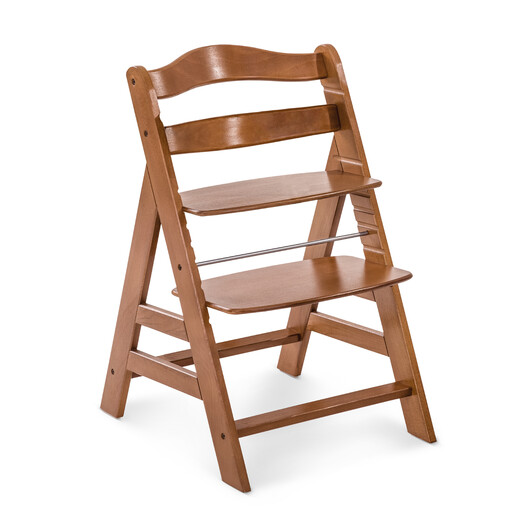
Why this product suits this profile: This chair is designed for long-term use and offers an adjustable seat and footrest. Its stated maximum weight capacity is 90 kg.
The adjustable elements prevent the chair from being suitable only for a short stage of your child’s growth. The tray is available as a separate accessory and should be included in your budget planning.
FSC-certified European beechwood, five-point harness, adjustable seat and footrest positions, and a stated weight capacity of up to 90 kg.
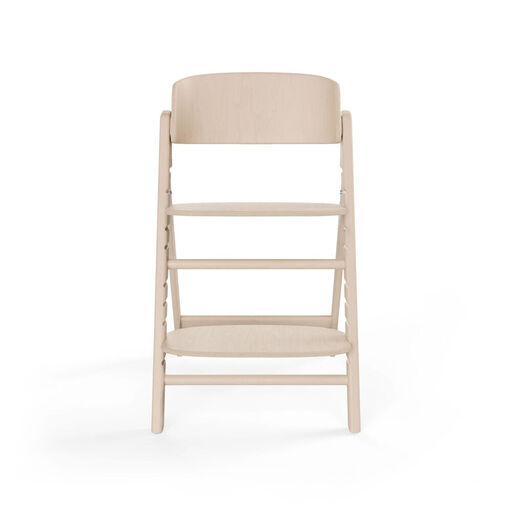
Why this product suits this profile: The folding function is ideal for homes with limited storage space or families who want to move the highchair regularly. The product details specify use from 3 years without additional baby equipment.
The folded dimensions of 27,4 × 47,3 × 91,5 cm make it easier to plan your storage space. Suitable accessories are required for younger children and should be checked separately.
FSC-certified beechwood, one-handed folding mechanism, adjustable seat and footrest positions, and a stated weight capacity of up to 99 kg in adult mode.
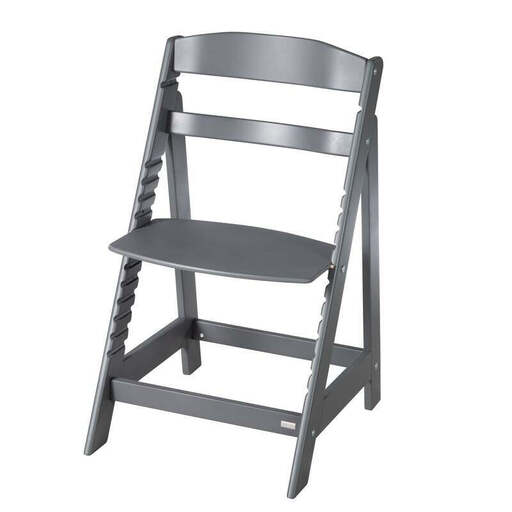
Why this product suits this profile: This staircase highchair can be adapted to different table heights and stages of growth using its adjustable seat and foot boards. A carry handle makes it easier to move around the home.
Its adjustability prevents the chair from being retired too soon because the seat height no longer suits your child. The manufacturer provides a harness system for toddlers, which can be removed later.
Dimensions of 44,5 × 54 × 80 cm, weight of 5,18 kg, height-adjustable boards and a stated weight capacity of up to 70 kg.
We have put together a complete, regularly updated list of products that fully meet these strict selection criteria and the safety regulations applicable in the EU.
Many models are listed as suitable from around 6 months. However, the deciding factor is whether your baby can sit unaided and steadily. Use must take place under direct supervision. The safety harness and seating position should be adjusted according to the instructions.
This depends on the construction, weight limit and adjustment range. Models with stated capacities of up to 70 or 90 kg can be used beyond the toddler stage. Use as a teenage or adult chair is only permitted if the manufacturer explicitly provides for it and the relevant settings are adjusted correctly.
As a rule, cleaning with a soft, damp cloth and a mild cleaning product is sufficient. Wooden components should not be soaked in water. Spilt liquids should be wiped up promptly. Regularly checking for loose screws, cracks and damaged harnesses is part of safe everyday use.