
Lieferung heute & morgen

Qualitätsgarantie

Willkommens-Angebote freischalten: KOSTENLOSE Lieferung | Bis zu 80 % RABATT | Kostenlose 30-Tage-JoyPlus-Testphase
App herunterladen
Selecting the right memory is a critical factor for system performance, especially on modern platforms like AMD AM5. The G.Skill Flare X5 32GB DDR5 6000 kit is positioned as a specialized solution for users seeking high data transfer rates and stability. This article analyzes the technical features of the Flare X5 series and highlights the relevant parameters for an informed purchasing decision.
When configuring a system based on the AMD AM5 platform, specific memory specifications are of central importance. The following parameters significantly influence overall performance and compatibility.
For AMD Ryzen 7000 series processors and newer generations, a clock speed of 6000 MHz has been established as an optimal operating point, or "sweet spot." This is related to the architecture of the memory controller (UCLK) and the system fabric (FCLK). Operating in a synchronous 1:1 mode (UCLK:FCLK) at 3000 MHz, which corresponds to a DDR5 6000MHz data rate, typically results in minimal latency and maximum bandwidth without requiring manual adjustments for system stability.
A total capacity of 32 GB, achieved with a kit of two 16 GB modules, represents the current standard for demanding use cases. This includes modern gaming with parallel applications like streaming software or communication tools, as well as professional workloads in video editing, 3D rendering, and software development. A 32GB RAM kit provides sufficient headroom for memory-intensive processes and future software requirements.
CAS Latency (CL) is a measure of the delay between sending a memory command and the moment the data is available. A lower CL value means a faster response time.
The choice between CL30 and CL36 is therefore a trade-off between maximum responsiveness and budget.
The physical height of the memory modules is an often-underestimated yet crucial compatibility factor. The G.Skill Flare X5 series is distinguished by its Low Profile RAM design, with a height of just 33 mm. This ensures high compatibility with large CPU air coolers, which might otherwise interfere with taller memory modules. This design is also advantageous for installation in compact small form factor (SFF) cases.
AMD EXPO (EXtended Profiles for Overclocking) is a memory profile developed by AMD that is stored in the RAM module's SPD (Serial Presence Detect) data. By activating the EXPO profile in the motherboard's BIOS/UEFI, the specified performance values—clock speed, timings, and voltage—are loaded automatically and stably. This simplifies configuration and ensures that the AMD EXPO RAM unleashes its full potential without manual overclocking.
Based on these technical parameters, we present two specific models from the G.Skill Flare X5 series, each designed for different user profiles.
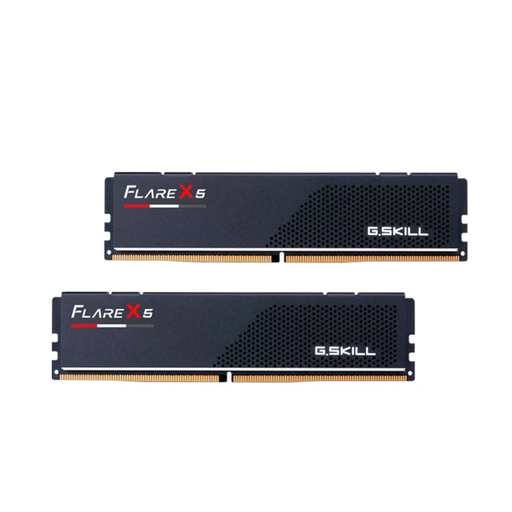
Why We Recommend This Product This kit, model number F5-6000J3038F16GX2-FX5, combines the optimal 6000 MHz clock speed with a very low CAS Latency of CL30. This combination is engineered to minimize system response times and deliver high performance in latency-critical applications.
Advantages
Who It's For This kit is aimed at PC enthusiasts, competitive gamers, and professional users for whom every millisecond of response time counts and who are willing to invest for lower latency.

Why We Recommend This Product The F5-6000J3636F16GX2-FX5 model also offers the high 6000 MHz clock speed but with a standard latency of CL36. It represents a balanced solution that provides excellent performance for a wide range of applications and often boasts an attractive price-to-performance ratio.
Advantages
Who It's For This kit is an excellent choice for the majority of users, including gamers and content creators, who are looking for a powerful and reliable 32GB RAM kit and do not place an absolute focus on achieving the lowest possible latency.
The G.Skill Flare X5 series is specifically designed for the requirements of the AMD AM5 platform. However, the market for memory and other PC parts is diverse. Users considering alternative capacities, speeds, or designs for their system can find a broader selection in our main Gaming Components category.
1. What is the practical difference between CL30 and CL36 at 6000 MHz? The difference lies in the memory's response time. CL30 reacts to requests faster than CL36. In benchmarks and for very latency-sensitive games (e.g., at high frame rates in esports titles), this can lead to measurably better results. For general use and most games, the difference is often only marginally noticeable in practice.
2. Is G.Skill Flare X5 memory compatible with Intel systems? Although the Flare X5 series was primarily developed for AMD platforms with EXPO support, the modules are physically and electrically compatible with DDR5-compliant Intel motherboards. Product descriptions often also indicate compatibility with Intel XMP (Extreme Memory Profile), which allows for easy configuration on Intel systems. However, it is always recommended to check the QVL (Qualified Vendor List) of your specific motherboard manufacturer.
3. Why is 6000 MHz called the "sweet spot" for AMD Ryzen 7000? This term arises because at a 6000 MHz DDR5 clock speed, the CPU's memory controller (UCLK) and the system fabric (FCLK) can ideally run in a synchronous 1:1 ratio (3000 MHz UCLK to 3000 MHz FCLK). This synchronicity minimizes internal system latencies and results in an optimal balance of bandwidth and response time, without the need for complex manual adjustments.