Which option suits you?

Listeners with a regular listening spot

If you listen carefully from your usual seat and can place a speaker on either side, a separate stereo pair could be a good choice. Edifier and KEF offer models with different connection options. The set-up should suit your room and the specific model.

Considerate flat-dwellers

If you listen in an open-plan living area, take your housemates and neighbours into account when choosing where to sit and how loud to play music. Germany’s Federal Environment Agency points out that rules on noise from neighbours can also depend on state law, local regulations and your building’s house rules.

Listeners without a regular music spot

If you move between listening spots or music sources, easy connections or a speaker you can move around may matter more than a fixed stereo set-up. Check that the speaker works with your sources, and whether you really need a battery.

What to look for when buying

Separate stereo pair

A good fit if: You usually listen from one regular spot and have room for two speakers.

Bear in mind: You’ll need space for both speakers, and will need to plan how they connect and where to position them in the room.

Single Wi-Fi speaker

A good fit if: You want to start with one speaker and may add a second later. Sonos describes this option for two Era 100 speakers.

Bear in mind: A single unit can’t be positioned separately to the left and right of your listening spot. You’ll need a separately sold adapter to use Line-In with the Sonos Era 100.

Portable or movable speaker

A good fit if: You move between listening spots or don’t have a permanent place for your speakers.

Bear in mind: A single speaker isn’t the same set-up as two separate speakers, and stated battery life depends on how you use it.

Buying priority What to look for Who it matters to
Spatial sound Check you have room for two separate speakers, and consider their spacing and position in relation to your listening spot. If you mainly listen to guitar recordings from one regular spot, you may want to position the speakers to your left and right. Spatial sound is the main priority for around 36% of consumers.
Consideration in your living space Check how the speakers sound from your actual listening spots at a considerate volume. If relevant, check your building’s house rules and local regulations. If other people in your open-plan living area or neighbourhood could be affected, you’ll want to listen in a way that suits your living situation. Considerate listening at home is the main priority for around 29% of consumers.
Connecting your music source Check the inputs and outputs on your speaker and playback device match, and factor in any adapters and cables you’ll need. If you want to connect your existing music source without unnecessary extra steps, its output should match the speaker’s input. Compatibility with existing sources is the main priority for around 21% of consumers.
Moving between listening spots Check whether you need a battery and which connections are available at the different listening spots. If you often move around your open-plan flat, a speaker you can move may suit your routine better than two speakers kept in fixed positions. Being able to move between listening spots is the main priority for around 14% of consumers.

Common misconceptions

  • More watts automatically mean better sound

    Power ratings describe a feature of a particular model, not how your recordings will sound in your room. Your listening spot and speaker placement matter too.

    Start by comparing the type of speaker, placement options and suitable playback sources. Don’t treat manufacturers’ power ratings as an independent listening test.

  • USB-C is always an audio input

    The USB-C port on the Sonos Era 100 isn’t a standard audio input. You need the designated adapter for Line-In.

    Check that your music source’s output matches the speaker’s intended input, and whether you’ll need an adapter or cable.

    A separately sold adapter may be required to use the Sonos Era 100’s 3.5 mm Line-In.

  • A single portable speaker is the same as a stereo pair

    A single speaker is easier to move, while two separate speakers can be positioned to the left and right of a regular listening spot.

    Think about where you usually listen and whether portability or separate speaker placement matters more to you.

Key brands at a glance

Edifier

The R1280DBs are a separate pair of active bookshelf speakers, while the D32 is a single speaker you can move around. Features vary by model.

  • Edifier lists Bluetooth, optical, coaxial and RCA inputs for the R1280DBs. For the D32, the manufacturer lists a battery, AirPlay 2 and Bluetooth.
  • A single D32 doesn’t offer the separate-pair set-up of the R1280DBs.

KEF

KEF describes the LSX II LT as a separate active system for a regular listening spot, with several digital connection options.

  • KEF lists USB-C, HDMI-ARC and an optical connection.
  • Allow for space and cabling for the specific system, and check that its connections work with your devices.

Sonos

According to Sonos, you can start with the Era 100 as a single Wi-Fi speaker and add a second Era 100 later.

  • Sonos lists Wi-Fi and Bluetooth. According to the manufacturer, two Era 100 speakers can create a wider soundstage.
  • You’ll need a separately sold adapter to connect a 3.5 mm audio cable for Line-In. Some microphone-dependent features aren’t available when the microphone switch is off.

Bose

The SoundLink Max is a portable alternative if you often move between listening spots.

  • Bose lists a carry handle and battery life of up to 20 hours.
  • The stated battery life isn’t guaranteed at every volume or with every type of use. A single unit can’t be positioned like a separate pair of speakers.

Speakers at Joybuy

This Joybuy selection includes bookshelf speakers for a regular listening spot, as well as compact and portable speakers for listening in different places.

Lemega active bookshelf speakers, 40 W, pair

Lemega active bookshelf speakers, 40 W, pair

A pair for a regular listening spot if you want to position two separate speakers.

40 W; Bluetooth; HDMI ARC; optical, USB, AUX and RCA inputs.

Bass and treble controls and a remote control are listed in the product name.

Joybuy
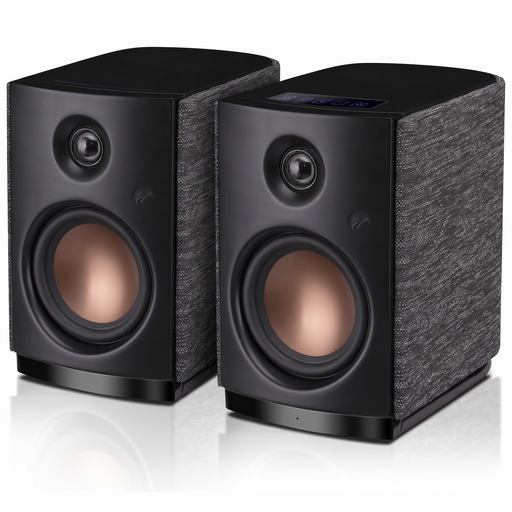
HiVi-Swans OS-10 HiFi stereo bookshelf speakers

HiVi-Swans OS-10 HiFi stereo bookshelf speakers

For a regular listening spot if you’re looking for active bookshelf speakers with Bluetooth or an AUX input.

4-inch woofer; 62 W RMS; Bluetooth 5.0; touch controls.

Joybuy
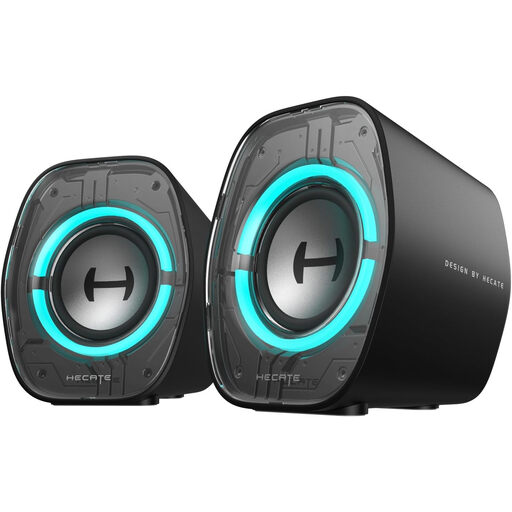
Edifier G1000 II desktop speakers

Edifier G1000 II desktop speakers

For a compact spot on your desk, if Bluetooth, USB-C or AUX works with your music source.

2.1-channel configuration; Bluetooth 5.4; USB-C and 3.5 mm AUX.

The product name also lists a 2.5-inch full-range driver and nine RGB lighting modes.

Joybuy

JBL Flip 6 portable Bluetooth speaker, Blue

JBL Flip 6 portable Bluetooth speaker, Blue

For listening in different places if you’re looking for a portable Bluetooth speaker.

Bluetooth 5.1; stated playback time of up to 12 hours.

To enjoy separate left and right channels in TWS stereo mode, you’ll need to pair two Flip 6 speakers.

Joybuy
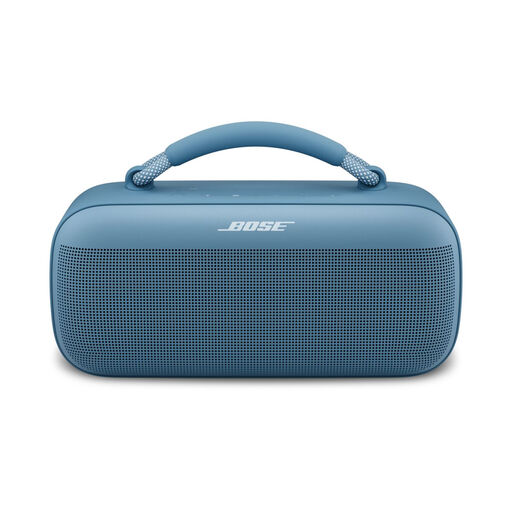
Bose Portable SoundLink Max speaker, Large, Blue Dusk

Bose Portable SoundLink Max, Large, Blue Dusk

For listening in different places if you’d prefer a single portable speaker to a separate pair.

Bluetooth; 3.5 mm AUX input; stated battery life of up to 20 hours.

As a single unit, it can’t be set up like two separately positioned speakers.

Joybuy

Frequently asked questions

Where should you start when positioning a stereo pair in an open-plan living area?

Start with your usual listening spot, then try out different speaker positions in the room. KEF recommends using your listening spot as a starting point, but doesn’t give one set of measurements for every room. Check the instructions for your specific model too.

Can you connect a device with a 3.5 mm output directly to the Sonos Era 100?

Not with a standard 3.5 mm plug alone. According to Sonos, you’ll need a separately sold Sonos Line-In Adapter or Combo Adapter, as well as a suitable audio cable.

Is there one nationwide cut-off time for playing music in Germany?

For noise from neighbours, Germany’s Federal Environment Agency refers to state law, local regulations and house rules. Check the rules that apply to your flat rather than assuming there’s one cut-off time for the whole country.

What are your rights if you don’t like the sound at home or find a fault after buying online?

According to the consumer advice centre, online purchases generally come with a 14-day right to cancel. Exceptions may apply, and the exact start of the cancellation period matters. If there’s a fault, statutory rights against the seller are different from a voluntary manufacturer’s warranty.

What should you look for in a Bluetooth or Wi-Fi speaker for use in Germany?

Germany’s Federal Network Agency lists CE marking, accompanying documentation and safety information in German among the requirements retailers must meet for radio equipment. A product listing alone doesn’t confirm that a specific device complies with the rules.