
Lieferung heute & morgen

Qualitätsgarantie
App herunterladen
Kategorien
Upgrading vehicle headlights from halogen to LED technology is a technical evolution based on different physical principles of light generation. While halogen lamps heat a tungsten filament until it glows, light-emitting diodes (LEDs) produce light through electroluminescence in a semiconductor crystal. This process is more energy-efficient and allows for a longer operational lifespan. For vehicle owners considering modifying their lighting system, understanding the technical parameters of H7 LED bulbs is a fundamental prerequisite for making an informed decision.
Selecting the right H7 LED bulbs requires an analysis of several technical specifications. These parameters determine the bulbs' performance, compatibility, and longevity.
Luminous flux, measured in lumens (lm), is the unit for the total visible light emitted by a light source. A higher lumen value correlates with greater brightness. However, the crucial factor is not just the absolute value, but also the beam pattern. A precise beam, modelled after the original halogen bulb's pattern, ensures correct illumination of the road without dazzling oncoming traffic. Products with 360-degree illumination and defined chipsets aim to replicate this pattern.
Color temperature, specified in Kelvin (K), describes the color appearance of a light source. Halogen bulbs typically range from 2,700 K to 3,200 K (warm white). H7 LED 6000K or higher produce a light perceived as Xenon White or cool white. This light more closely resembles daylight and can be perceived by many drivers as offering higher contrast and being more comfortable for night driving.
Modern vehicles use a Controller Area Network (CAN bus) to monitor the function of electrical components. Since LEDs have lower power consumption than halogen bulbs, the system may incorrectly diagnose a faulty bulb and display an error message on the dashboard. H7 LED Canbus bulbs integrate a load resistor or special circuitry to simulate the electrical load of a halogen bulb, thereby ensuring compatibility with the onboard computer.
The physical dimensions of the LED bulb are crucial for a hassle-free installation. Models manufactured in a 1:1 design matching the original halogen bulb allow for a simple Plug and Play installation. This means the bulb fits directly into the existing socket without requiring modifications to the headlight housing or additional adapters. Compact designs without external drivers or large heat sinks simplify installation, especially in tight spaces.
LEDs generate heat at the semiconductor chip, which must be dissipated efficiently to avoid compromising performance and lifespan. There are two primary cooling methods:
The use of LED retrofit bulbs for headlights on public roads in Germany is strictly regulated. For legal use as an H7 LED low beam, a type approval for the specific combination of bulb and vehicle model must be in place, for example, in the form of a General Operating Permit (Allgemeine Betriebserlaubnis, ABE). Without such approval, operating the headlights is not permitted under the German Road Traffic Licensing Regulations (StVZO). Vehicle owners should check before purchase and installation whether an approved road-legal H7 LED exists for their chosen product and vehicle.
Based on technical specifications and practical utility, we present a few models here.
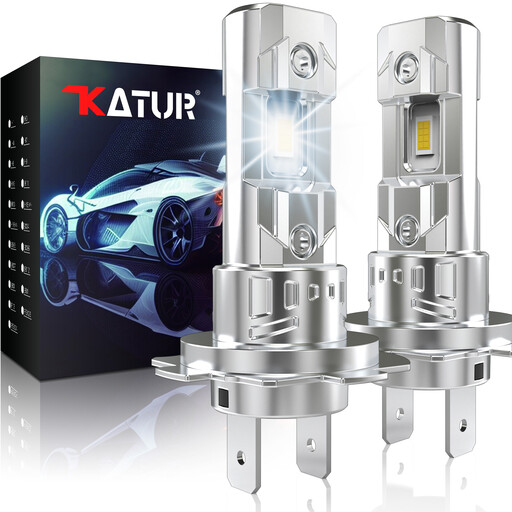
Why we recommend this product This model is distinguished by its fanless design, which relies on passive cooling via an aluminium body. Its 1:1 mini size, matching that of a halogen bulb, allows for a straightforward installation without external drivers or wiring harnesses.
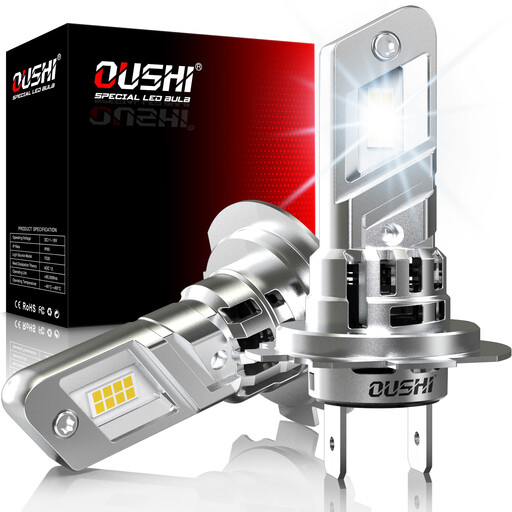
Why we recommend this product According to the manufacturer, this bulb offers a very high light output of 30,000 lumens per pair and a color temperature of 6500 K. The active cooling system, featuring a high-speed turbo fan, serves to maintain the operating temperature. The integrated CAN bus system is designed for high compatibility with European vehicles.
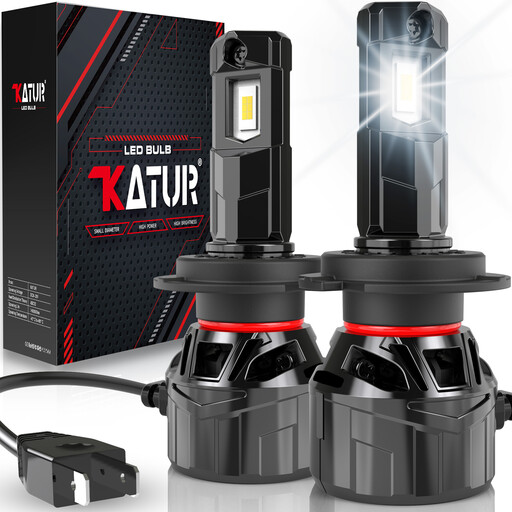
Why we recommend this product This model combines a high power consumption of 120 watts per pair with an advanced cooling system. It uses copper heat pipes and a 16,000 RPM turbo fan to efficiently dissipate heat from the LED chips. Despite its high performance, it maintains a compact 1:1 design for easy installation.
Should the featured models not exactly meet your requirements, the market offers a wide variety of other technical solutions. You can find a broader selection of bulbs with different specifications in our main category for Headlights.
What is the technical difference between H7 halogen and H7 LED bulbs? The fundamental difference lies in how light is generated. An H7 halogen bulb produces light by heating a tungsten filament inside a glass bulb filled with halogen gas. An H7 LED generates light through the flow of current across a semiconductor chip (electroluminescence). This results in differences in efficiency (lumens per watt), lifespan, color temperature, and electrical power consumption.
Do I need a CAN bus adapter for H7 LED headlights? This is necessary for many modern vehicles, especially from European manufacturers. The onboard network monitoring system (CAN bus) is designed to detect the higher resistance of a halogen bulb. Since LEDs consume less power, the system can trigger an error message. Many H7 LED products already have a CAN bus-compatible system integrated. If not, an external CAN bus decoder (load resistor) may be required.
Are H7 LED retrofit bulbs legal in Germany? Legality depends on official approval. In Germany, an LED bulb can only be legally operated in a halogen headlight on public roads if a General Operating Permit (Allgemeine Betriebserlaubnis, ABE) or another form of type approval exists for that specific combination of bulb model and vehicle model. Manufacturers of approved bulbs typically provide compatibility lists. It is advisable to check the approval status with the German Federal Motor Transport Authority (Kraftfahrt-Bundesamt, KBA) or the manufacturer before purchasing.