
Lieferung heute & morgen

Qualitätsgarantie

Willkommens-Angebote freischalten: KOSTENLOSE Lieferung | Bis zu 80 % RABATT | Kostenlose 30-Tage-JoyPlus-Testphase
App herunterladen
As a car owner without a garage or carport, you know the anxiety that comes with the threat of a storm. A sudden hailstorm can cause dents and paint damage in minutes, with repairs easily costing thousands. A hail protection cover is an effective solution to preserve your vehicle's value. However, the market is crowded, and not every product delivers on its promises.
This guide will help you identify the crucial quality features and avoid common purchasing mistakes. We'll show you what to look for to find a reliable and durable car cover for hail protection.
Many covers fail to provide adequate protection because they lack critical design features. Be sure to avoid these two costly pitfalls:
To make an informed decision, you should examine three technical features. These define the protective performance and durability of a full car cover with hail protection.
The core component of any hail protection cover is its padding. Look for the following specifications:
A secure fit is essential to protect the vehicle during a storm and prevent paint abrasion from flapping fabric.
The outer material protects the padding and the vehicle from the elements. A robust 300D Oxford fabric is a good standard here. It is tear-resistant, water-repellent, and UV-resistant, which extends the lifespan of the entire cover. Additional features like ventilation openings prevent moisture buildup underneath the cover.
Based on the criteria above, we have identified several products suitable for specific vehicle types and requirements.

Why It's a Great Fit: Ideal for owners of popular mid-size sedans like the BMW 5 Series, Audi A6, or Mercedes E-Class. The size is precisely tailored to this segment to ensure an optimal fit.
The cover uses a 5 mm thick EVA composite padding that effectively absorbs impact energy. Three separate straps running underneath the vehicle ensure high storm resistance.
The extended padded area protects not only the roof but also the side windows, side mirrors, and rear window—areas that remain unprotected on many other models.
Why It's a Great Fit: Specifically designed for shorter vehicles like the Porsche 911, BMW M2, or Mercedes SLK. The tailored length prevents excess, flapping fabric that could damage the paint.
This model avoids the "one-size-fits-all" problem. The precise fit, combined with the wind straps, ensures a secure hold that remains stable even at high wind speeds.
It offers the same robust hail protection as the larger models but is optimised for the specific dimensions of sports cars and compact sedans.
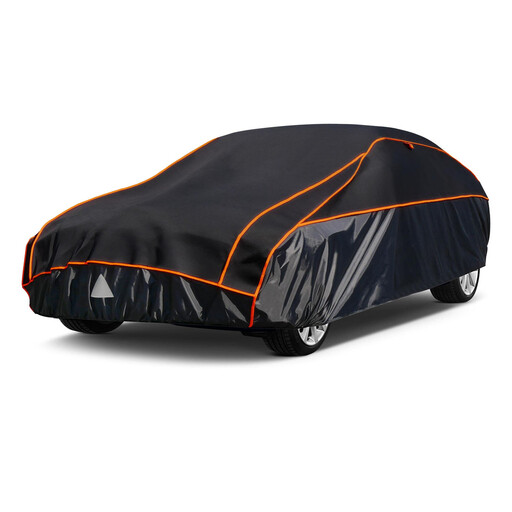
Why It's a Great Fit: Designed for large vehicles in the full-size and luxury class, such as the Mercedes S-Class, BMW 7 Series, or Audi A8. The generous dimensions ensure complete coverage.
The tear-resistant 300D Oxford fabric and robust seams are built to handle the increased weight and larger surface area of this cover, preventing material fatigue or tears during handling.
Despite its size, the cover remains securely fixed to the vehicle thanks to the three storm straps and the elastic hem. Reflectors on the front and rear increase visibility at night.
A suitable cover protects not only against hail but also against UV radiation, bird droppings, and tree sap. Discover more solutions for preserving your vehicle's value.
Ensure the vehicle is clean and dry. Pull the cover over the car from front to back. Pass all the provided straps underneath the vehicle and tighten them securely. The centre strap is the most important. Make sure the elastic hem is tucked under the bumpers at the front and rear. If possible, park the vehicle with its front facing into the prevailing wind direction.
With proper use, the risk is minimal. A high-quality car cover for hail protection has a soft inner lining. The main cause of scratches is dirt on the paint or on the cover itself, as well as a loose cover flapping in the wind. Clean your vehicle before covering it and ensure the cover is held firmly and securely in place by the straps.
There is no official standard, but experience shows that padding made from a dense material like EVA with a thickness of 4 to 5 millimetres offers reliable protection against hailstones up to the size of a nickel. Thinner or less dense materials may not sufficiently dampen the impact to prevent dents.