
Lieferung heute & morgen

Qualitätsgarantie

Willkommens-Angebote freischalten: KOSTENLOSE Lieferung | Bis zu 80 % RABATT | Kostenlose 30-Tage-JoyPlus-Testphase
App herunterladen
A hair dryer needs to do more than just blow hot air. Depending on your hair type, styling routine and travel habits, different features matter: a powerful hair dryer can reduce drying time, while a foldable hair dryer saves space in your suitcase. If you want to define curls or style precisely with a brush, you will need the right attachments and finer temperature control.
However, some common marketing claims can lead to poor purchasing decisions. A high wattage, for example, does not automatically mean a pleasant or particularly fast airflow. Claims such as “ionic care” should also be viewed objectively: according to the product description, the ionic function may reduce static electricity. This does not indicate any medical or therapeutic effect.
Power consumption in watts mainly describes how much electrical energy the appliance uses. Drying time also depends on air volume, air speed, motor design, and how the heater and fan are matched. A 1,200-watt travel hair dryer may be sufficient for fine hair, while thick or long hair may benefit from a model with 1,600 to 2,200 watts and a stronger airflow.
A hair dryer with just one heat setting can be impractical for everyday use. Fine hair often needs a lower temperature, while thicker hair can dry more quickly with a higher airflow. At a minimum, look for separate temperature and fan settings, as well as a cool-shot setting if you want to set your style afterwards.
A compact hair dryer is not automatically suitable for worldwide travel. Check whether the model is designed exclusively for 220–240 volts or offers a switchable setting for 110–120 and 220–240 volts. Dual-voltage appliances may also require a suitable plug adapter. A voltage converter should only be used if the manufacturer expressly permits it.
Several specifications are important when choosing a hair dryer for fast drying:
Also check the noise rating, if one is provided. A quiet hair dryer rated at, for example, 58 or 59 dB may be more comfortable for everyday use than a louder model with similar power. However, the noise you actually perceive depends on the distance, room and operating setting.
At least two fan settings and two temperature settings allow you to adjust the appliance more effectively. Models with three or four temperature settings offer even greater flexibility. A cool-shot setting is useful for switching from warm to cooler air after drying. It does not replace suitable styling techniques, but it gives you an additional setting option.
A hair dryer with temperature control should also have unobstructed air intake. Blocked intake or outlet grilles can cause overheating. Clean removable filters regularly and unplug the appliance before cleaning it.
A styling concentrator directs the airflow and makes it easier to work with a brush. A diffuser spreads the air more widely and may be more practical for curly or wavy hair. Check whether the attachments are included and removable.
Weight matters during longer styling sessions. A lightweight hair dryer weighing around 330 to 450 grams can put less strain on your hand. For travel, a foldable handle, removable filter and suitable voltage switch are also important. However, a very compact design may come with fewer settings or a weaker airflow.
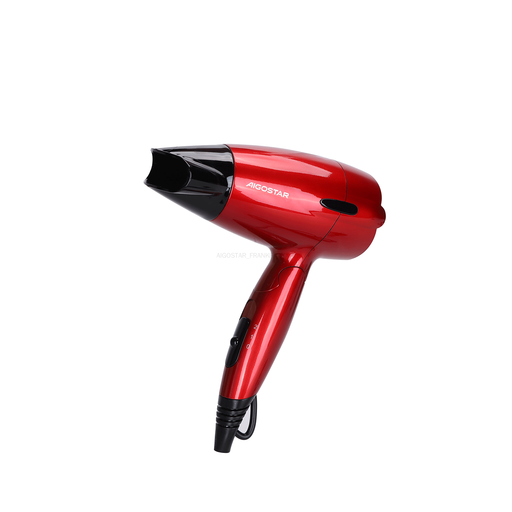
Why this product suits this profile: Weighing 400 g and offering two speed settings and two heat settings, this appliance is suitable for simple everyday use and short trips.
Its clearly stated 1500 watts are combined with specific settings and a weight of 400 g, rather than relying solely on a high wattage claim.
Compact dimensions, overheating protection and, according to the product specifications, a power supply of 115/230 volts.
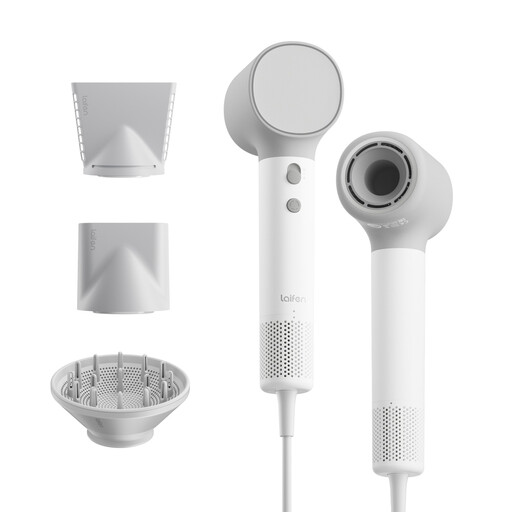
Why this product suits this profile: This model combines a weight of 390 g, a stated noise level of 59 dB, an ionic function and several magnetic attachments for regular use.
The selection takes into account not only motor speed, but also weight, noise rating and the available attachments.
According to the product description: 110,000 revolutions per minute, air speed of up to 22 m/s, two fan settings and three attachments.
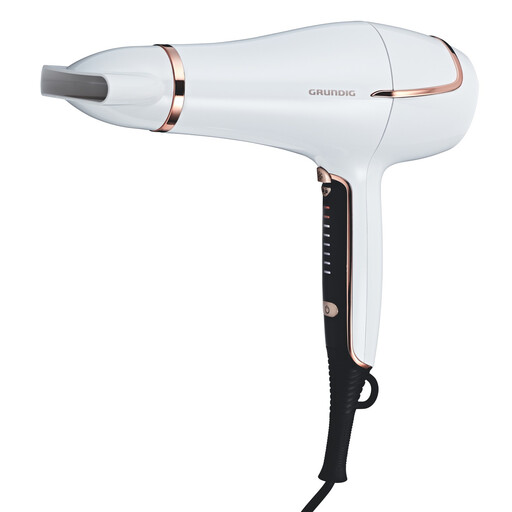
Why this product suits this profile: If you dry your hair frequently or style it precisely, you get a wide choice of temperature and airflow settings, as well as a narrow styling concentrator.
The eight temperature and seven airflow settings reduce the limitations of relying on a single, difficult-to-adjust operating mode.
According to the product description: 2,200 watts, LED display, touch control, cool-shot setting, ionic function and removable air intake grille.

Why this product suits this profile: The foldable handle, weight of around 430 g and switchable voltage are useful features for travelling outside Germany.
The dual-voltage specification prevents travel suitability from being judged solely by the compact design.
According to the product description: 1,600 watts, two heat and fan settings, ionic function, cool-shot setting and switchable voltage from 110–120/220–240 volts.
We have put together a complete, regularly updated list of products that fully meet these strict selection criteria and the safety regulations applicable in the EU.
Keep a hair dryer away from the bath, shower and washbasin. Only use the appliance with dry hands, keep the air grilles clear and unplug it after use. Stop using the appliance if you notice an unusual smell, smoke, a damaged cable or unusual noises.
For electricity costs, wattage and usage time are the key factors. An appliance rated at 1,800 watts uses 0.3 kWh when operated for 10 minutes. The actual cost depends on your electricity tariff. A higher wattage may shorten drying time, but it is not automatically the cheaper option.
For fine or short hair, 1,000 to 1,600 watts may be sufficient. For long or thick hair, 1,600 to 2,200 watts is often a sensible choice, provided the airflow and temperature can be adjusted. Wattage alone does not determine the actual drying time.
Its lifespan depends on the motor, build quality, frequency of use and care. Clean the air intake grille regularly, avoid kinking the cable and only store the appliance once it has cooled down. A general lifespan cannot be stated without a specific manufacturer’s warranty.
Check the mains voltage and frequency at your destination. For worldwide use, choose a model with switchable voltage, such as 110–120 and 220–240 volts. Depending on the country, you will also need a plug adapter. Set the voltage switch correctly before plugging the appliance in.