
Lieferung heute & morgen

Qualitätsgarantie

Willkommens-Angebote freischalten: KOSTENLOSE Lieferung | Bis zu 80 % RABATT | Kostenlose 30-Tage-JoyPlus-Testphase
App herunterladen
A hair dryer with styling attachments can replace several appliances: a concentrator can smooth individual sections, a diffuser helps define waves and curls, while brush attachments can create volume. However, the choice can be overwhelming. Wattage, ionic technology and extensive accessories often sound more impressive than they actually are in everyday use.
What matters is not the longest list of features, but the right combination of airflow, temperature control, weight, attachments and safety features.
A high power rating can indicate strong airflow, but on its own it says little about noise levels, motor design, heat distribution or ease of use. A powerful 2,200- or 2,400-watt hair dryer can dry long or very thick hair more quickly, but may be unnecessarily heavy or intense for fine hair.
Several clearly separated temperature and speed settings are more important. They allow the performance to be adapted to your hair type and styling goals.
The ionic function can reduce static during drying. However, that does not mean all frizz will disappear or that your hair will automatically look shiny. Moisture levels, brushing technique, humidity and the temperature used also affect the result.
If you want to use this function, you should also check whether it can be switched on and off separately. This is particularly useful when you want more texture and grip for certain styles.
A comprehensive set is not automatically a worthwhile choice. For straight hair, a hair dryer with concentrator and brush attachment may be sufficient. For natural waves or curls, a hair dryer with diffuser is usually more relevant. A multi-styler adds extra curling or brush attachments, offering more styling options but also requiring more storage space.
Before buying, it is therefore worth asking yourself a simple question: which two or three hairstyles do you actually style regularly?
At least two speed settings and several temperature settings make it easier to adjust the dryer to your needs. A hair-dryer-with-cool-shot-button function is useful when you want to finish your style with cool air. It does not replace careful heat protection, but it can complement your finishing routine.
A low-temperature setting should be available for delicate or fine hair. For thick hair, stronger airflow is useful, without necessarily having to use the highest temperature all the time.
The attachment should fit securely and be removable after use without direct contact with hot surfaces. Magnetic systems can make changing attachments easier, while conventional push-fit or twist-lock mechanisms often hold them particularly firmly.
A lightweight hair dryer reduces strain during longer styling sessions. The product specifications, for example, state 355 g for the Dreame Hair Glory Master and 364 g for the Beurer HC 150; when comparing models, remember to check the respective weight without the cable.
For everyday use, a swivel cable joint, sufficient cable length and conveniently positioned controls are important. If you often travel, look for a travel hair dryer, a folding handle and – for international travel – check the actual voltage compatibility. An adaptor alone does not convert mains voltage.
An integrated sensor or temperature control can make the dryer easier to use, but it cannot prevent all possible hair damage. A hair dryer with heat protection should always be used at an appropriate distance, with continuous movement and at a temperature suited to your hair.
Maintenance is equally important: an accessible filter makes cleaning easier. Blocked air inlets can reduce airflow and increase heat build-up. Before changing attachments, cleaning or storing the appliance, switch it off and disconnect it from the mains.
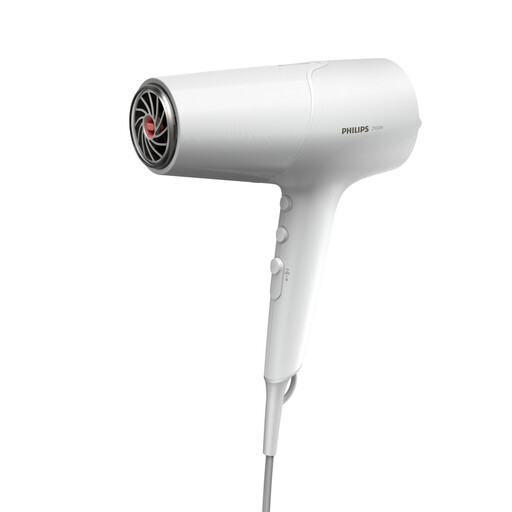
Why this product suits this profile: With 2,100 watts, six temperature/speed combinations, a concentrator and a diffuser, it covers essential drying and styling tasks.
Rather than relying solely on the wattage, it offers six clearly combinable settings and two different attachments.
ThermoShield technology according to the product specifications, a cool-air function, plus a 14-mm styling nozzle and volume diffuser.
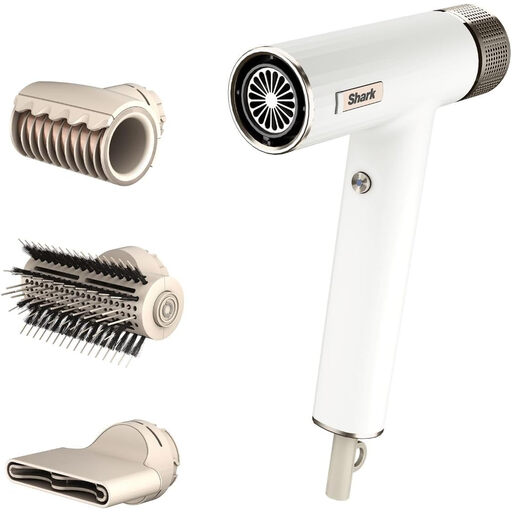
Why this product suits this profile: This appliance is aimed at people with straight or wavy hair who want to combine targeted drying and smoothing in one system.
The attachments are clearly separated by purpose: RapidGloss Finisher, QuickSmooth Brush and Turbo Concentrator.
1,700 watts, ionic function and, according to the product specifications, temperature monitoring 1,000 times per second with a maximum of 110 °C.
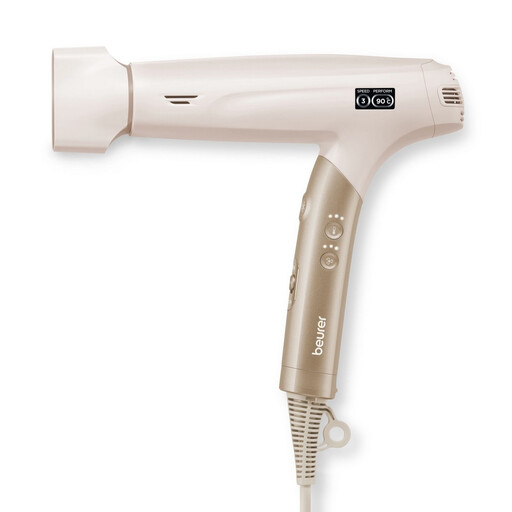
Why this product suits this profile: This compact 2-in-1 appliance is suitable for small bathrooms, frequent use and travel with limited luggage.
At 364 g, its weight and folding handle reduce the drawbacks associated with many heavier or bulkier appliances.
1,600 watts, three temperature/speed settings, a separate cool-shot button, plus diffuser, concentrator and brush attachment.
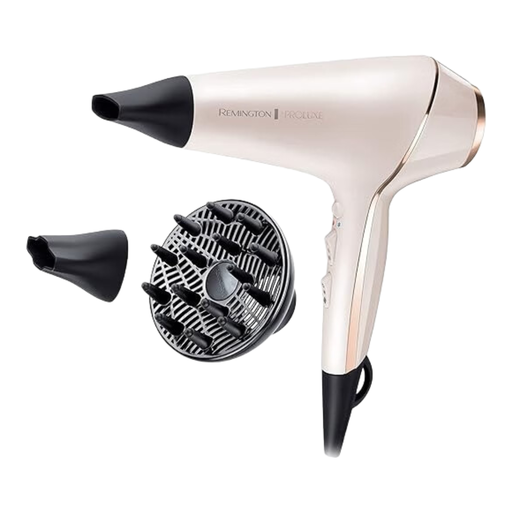
Why this product suits this profile: If you regularly switch between sleek styles, volume and defined curls, this model combines strong airflow with several attachments.
Alongside 2,400 watts, it has three heat settings, two speed settings and a genuine cool-shot button, keeping the power adjustable.
Ionic function according to the product specifications, a 3-m cable, plus diffuser, 7-mm concentrator and additional styling nozzle.
We have put together a complete, regularly updated list of products that fully meet these strict selection criteria and the safety regulations applicable in the EU.
For most households, a concentrator and diffuser are sufficient. A hair styler with a brush or curling attachments is worthwhile if you regularly create different looks. What matters is how you will actually use it, not the number of included parts.
Its lifespan depends on the motor, frequency of use, filter maintenance and how the cable is treated. It is not possible to guarantee a fixed period reliably. Signs that it is time for a replacement include damaged cables, unusual noises, smells, repeated overheating or a noticeably reduced airflow.
For the same duration of use, a higher-wattage appliance generally requires more electrical energy. The actual cost also depends on the running time and electricity tariff. A more powerful model may run for less time when drying thick hair, so wattage alone does not provide a reliable comparison of running costs.