Choose a camera based on whether you mainly want to zoom in on distant façade details from where you can stand, or switch between wide views and close-ups with as few lens changes as possible. A fixed zoom covers both types of shot without changing lenses, while an interchangeable-lens kit gives you more options. Compare the angle of view, exactly what the kit includes, the telephoto aperture and the weight of the complete set-up.
Which camera suits you
Distant façade details
If you want to capture carvings, timber joints or roof details in close-up from a suitable vantage point, look at the optical telephoto reach and how steadily the camera can take a shot. Panasonic Deutschland, Nikon Deutschland and Sony Deutschland list different optical focal-length ranges for their respective models.
Whole houses on narrow streets
If you want to fit the whole façade into the frame from where you can stand, a wide angle of view is important. Also think about your position and how you hold the camera if you want to control how the house’s lines appear in the image. Canon Academy Deutschland covers these aspects in its architectural photography guidance.
Photo trips without changing lenses
A fixed zoom can save you changing lenses as you move between wide views and details. Still, compare the sensor, weight and angle of view at the telephoto end you need. A high zoom ratio alone doesn’t tell you how a camera performs in low light.
What matters when buying
Bridge camera with a fixed superzoom
A good fit if: You want to switch between a view of the house and distant details from one spot without changing lenses.
Trade-off: The lens is fixed, and a long optical telephoto range on its own says nothing about image quality in low light.
Bridge camera with a shorter telephoto range
A good fit if: You prefer a fixed zoom and want to factor sensor size and the maximum aperture at the telephoto end into your choice.
Trade-off: The stated reach is shorter than that of the superzoom models mentioned here; this does not mean there is an overall difference in quality.
Mirrorless camera with wide-angle and telephoto zoom lenses
A good fit if: You want to use different lenses for wide views and distant details, and expand your system over time.
Trade-off: You’ll need to carry and change lenses. Check exactly what’s included, as not every offer comes with a telephoto lens.
| What matters |
What to look for |
Who it matters to |
| Distant details |
Compare the optical focal length and the 35mm-equivalent focal length using the same aspect ratio. For a mirrorless camera kit, check whether it includes a telephoto lens, and don’t confuse digital zoom with optical reach. |
If I want to capture timber joints or roof details in close-up from where I can stand, the optical telephoto range matters. Around 33% of consumers put distant details first. |
| Whole façades and lines |
Compare the widest 35mm-equivalent setting in the aspect ratio you’ll use. Consider your position and options for controlling perspective. |
To capture a whole house from a narrow street, I need a wide enough angle of view and a suitable vantage point. Around 27% of consumers prioritise the full view. |
| Changing light |
Compare the sensor size, maximum aperture at the focal length you’ll use, and the stabilisation offered by the specific camera-and-lens combination. |
When I’m photographing a roof detail in the shade, I want to consider the lens’s light-gathering ability and the risk of camera shake, rather than looking at focal length alone. Changing light is a priority for around 20% of consumers. |
| Ease of use on the go |
Check the weight of the complete set-up, what’s included and whether you want to switch between wide views and telephoto without changing lenses. |
On a longer photo walk, I want to carry less equipment and avoid constantly changing lenses. Around 20% of consumers prioritise ease of use on the go. |
Common camera-buying pitfalls
-
Confusing digital zoom with optical telephoto reach
For the Nikon COOLPIX P1100, Nikon distinguishes between optical zoom up to a 3000 mm 35mm-equivalent focal length and Dynamic Fine Zoom, which gives an angle of view equivalent to 6000 mm.
When comparing cameras for distant façade details, start by looking at the optical maximum and the actual framing you need.
-
Assuming a standard zoom kit is a complete twin-zoom kit
The EOS R50 twin-zoom and Z50II twin-zoom kits mentioned here each include a telephoto lens in addition to the shorter zoom. Offers with the same camera name may come with different lenses.
Before you buy, check the full model and lens list for the specific offer.
-
Comparing camera body weight with the weight of a complete set-up
Panasonic lists the DC-FZ82D at around 596 g, including the battery and memory card. Canon lists the EOS R50 body at around 375 g, including the battery and card but excluding the lens. These figures therefore don’t describe comparable complete set-ups.
Compare the weight of the set-ups you’d actually take with you, and check which items are included in each figure.
A guide to relevant camera brands
Panasonic
The LUMIX DC-FZ82D is a bridge camera with a fixed zoom lens. For 4:3 photos, Panasonic Deutschland gives a 35mm-equivalent focal-length range of 20–1200 mm.
- Panasonic lists 60x optical zoom and optical image stabilisation.
- Factor in the 1/2.3-type sensor and the focal-length figures given for the 4:3 format when comparing cameras. The zoom ratio alone doesn’t indicate low-light performance.
Nikon
The COOLPIX P1100 offers a fixed zoom with extensive telephoto reach. The Z50II kit with 16–50 mm and 50–250 mm VR lenses, on the other hand, is an interchangeable-lens system.
- Nikon Deutschland lists a 35mm-equivalent range of 24–3000 mm, 16 MP and RAW for the P1100. Both zoom lenses in the Z50II kit are stabilised.
- The advertised extension to an angle of view equivalent to 6000 mm on the P1100 is Dynamic Fine Zoom, not its maximum optical focal length. Nikon also notes that the Z50II kit mentioned here does not include a charger.
Canon
The EOS R50 twin-zoom kit listed here includes the RF-S 18–45 mm and RF-S 55–210 mm lenses, which cover different focal-length ranges.
- Canon Deutschland specifies a 24.2 MP APS-C sensor for the EOS R50 body.
- Canon does not list in-body image stabilisation for the camera body. The telephoto lens is included in the twin-zoom kit mentioned here, but not necessarily in every offer described as an EOS R50.
Sony
The RX10 IV is a bridge camera with a fixed 24–600 mm zoom and a 1.0-type sensor. The E 70–350 mm lens is a separate option for compatible APS-C E-mount cameras.
- Sony Deutschland lists an F2.4–4 aperture across the zoom range and 20.1 effective MP for the RX10 IV.
- The E 70–350 mm lens is not part of the RX10 IV. For APS-C, Sony gives it a 35mm-equivalent focal-length range of 105–525 mm.
Joybuy product selection
This selection includes compact cameras with wide-angle or zoom specifications, as well as an APS-C mirrorless camera with a 16–50 mm lens. For details at greater distances, the telephoto reach of the specific model or lens is what matters.
 No image available
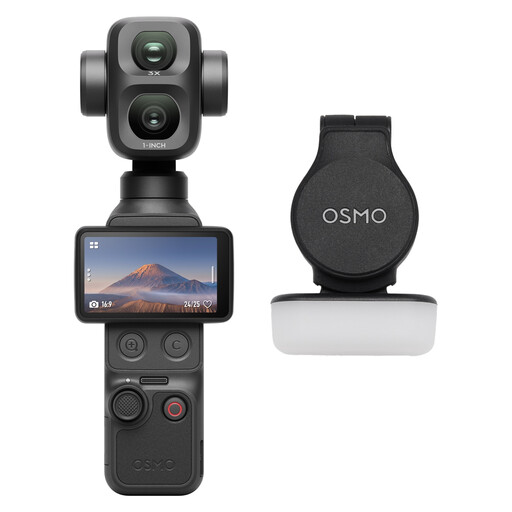
Osmo Pocket 4P Standard Combo, Black
The stated 112° wide-angle lens is designed for wide views of façades.
Specifications include a 1-inch CMOS sensor, a 20 mm wide-angle lens and a 3-axis gimbal.
View at Joybuy
 No image available
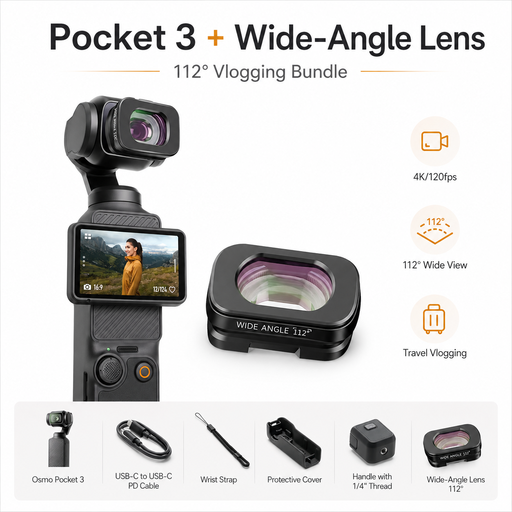
DJI Osmo Pocket 3 Standard Combo with ULANZI F35 112° wide-angle lens
According to the product details, the additional wide-angle lens is designed to give you a wider view.
Specifications include a 1-inch CMOS sensor, 4K/120fps video and a 3-axis gimbal.
View at Joybuy
 No image available
Komery W6 digital camera
The optical zoom stated in the product name is relevant for distant subjects; check whether its angle of view will work from where you plan to shoot.
The product title lists 12x optical zoom, 4K and 64 MP.
View at Joybuy
 No image available
Sony Alpha 6100 APS-C mirrorless camera with 16–50 mm power zoom lens
The included 16–50 mm lens covers wide-angle to short-zoom shots; its reach is limited for subjects that are a long way off.
The product title lists a 16–50 mm power zoom lens; the product details also mention a 24.2 MP CMOS sensor and autofocus.
View at Joybuy
Frequently asked questions
Is a mirrorless camera’s standard lens enough for distant roof details?
Not necessarily; it depends on the framing you need from your planned vantage point and exactly what’s included in the kit. The EOS R50 twin-zoom kit described by Canon Deutschland pairs the 18–45 mm lens with a 55–210 mm telephoto lens. The Z50II kit mentioned by Nikon Deutschland includes a 50–250 mm lens as well as the 16–50 mm lens.
What should I check before a longer photo trip?
Check the charging accessories, memory card and lenses included with the specific product. Nikon Deutschland notes that the Z50II twin-zoom kit mentioned here does not include a charger; Canon Deutschland lists a battery charger with the EOS R50 twin-zoom kit described here. Also factor in where you’ll be able to take photos and how the lines of tall façades will appear in your shots.
Who is responsible if a camera bought in Germany is faulty?
The seller is responsible for the statutory warranty, which is separate from a voluntary guarantee. The Verbraucherzentrale states that, in general, goods purchases are covered by a two-year period during which the retailer is responsible for ensuring the goods are free from defects at the time of delivery.
Can I photograph a half-timbered house from a public street and publish the image?
This may be permitted under § 59 UrhG if the building is permanently situated beside a public path, street or square; for buildings, the provision applies only to their exterior appearance. This does not amount to blanket permission for every photograph or publication. If identifiable people appear in the image, you must also consider § 22 KunstUrhG and possible exceptions under § 23. The Bundesgerichtshof has also ruled that freedom of panorama did not cover the aerial images of protected works taken by drone in the case before it.


