
Lieferung heute & morgen

Qualitätsgarantie

Willkommens-Angebote freischalten: KOSTENLOSE Lieferung | Bis zu 80 % RABATT | Kostenlose 30-Tage-JoyPlus-Testphase
App herunterladen
By a Joybuy Product Recommendation Officer, July 28, 2026
A cluttered hallway strewn with shoes is a common nuisance in many homes. A suitable hallway shoe cabinet promises a quick fix, but the selection is vast, and not every model delivers on its promise. Before you make a decision, it's crucial to understand the typical shortcomings that can quickly turn a supposed organisational tool into a source of frustration.
Many buyers focus on appearance and price, overlooking three critical flaws that severely limit functionality:
To avoid a bad purchase, you should focus on a few crucial technical features. These determine whether a shoe cabinet will provide long-term organisation and satisfaction.
The stability of a shoe cabinet is directly linked to the materials used and its construction.
Measure the available space in your hallway precisely before choosing a model.
The choice of design affects not only the look but also everyday practicality.
Instead of making a blanket recommendation, we have identified models tailored to specific needs and living situations.
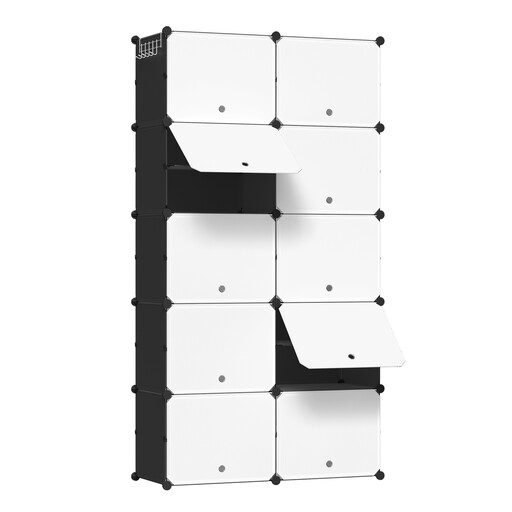
Why it's a great fit: Ideal for users with high storage needs. The modular design allows it to be adapted to the room and the shoe collection—from kids' shoes to boots.
It bypasses the misleading capacity trap with its enormous and customisable volume. Dividers can be removed to create space for boots, which is often not possible with fixed shelves.
High capacity for up to 40 pairs of shoes (according to the manufacturer). The DIY assembly allows for flexible arrangement as a tall rack, a sideboard, or several small boxes.
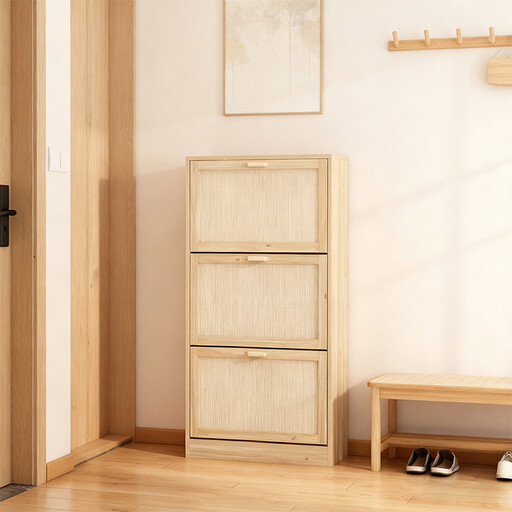
Why it's a great fit: With its shallow 24 cm depth, this tilt-out cabinet is specifically designed for narrow German hallways. The design, featuring bamboo-weave doors, is visually appealing.
Solves the instability problem with an included anti-tip device for secure wall mounting. The adjustable shelves in the tilt-out compartments also offer more flexibility than rigid shelves.
Extremely space-saving depth of 24 cm. The combination of PB (E1) and MDF (E1) for the body provides a solid base for its price point.
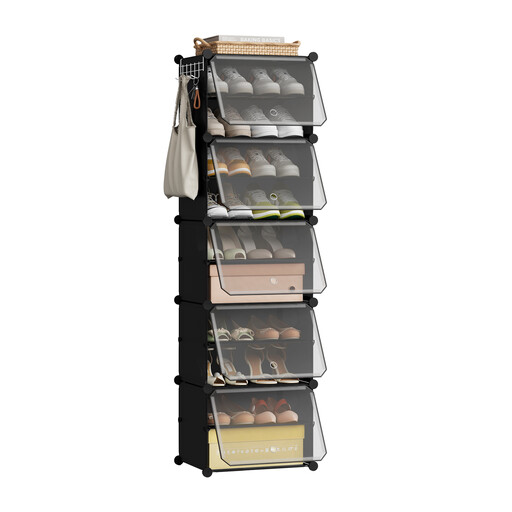
Why it's a great fit: A cost-effective and flexible starter solution. Ideal for a first apartment, students, or smaller shoe collections where needs might still change.
Its modular design avoids the problem of an ill-fitting, rigid piece of furniture. You build only what you need and can reconfigure it as required. The included anti-tip device increases stability.
Flexible assembly and a very accessible price. The waterproof PP panels are also easy to clean, which is a bonus in a hallway.
We've curated a complete, up-to-date list of products that meet these strict selection criteria.
For very narrow hallways, models with a depth of 17 cm to 25 cm are optimal. Tilt-out shoe cabinets are the most common solution here. They use vertical space and depth efficiently. Be sure to measure the available space before buying, and also account for the swing clearance of doors or flaps.
Ensure that only dry and clean shoes are stored in the cabinet. When buying, look for models with ventilation openings in the back panel. If these are missing, you can leave the doors open regularly for a few hours. Alternatively, special shoe deodorants or small sachets of activated charcoal or cedarwood can help absorb moisture and neutralise odours.
The stability of a modular system depends on the quality of its components. Look for metal frames within the plastic panels and sturdy ABS connectors. When the system is assembled correctly and tightly, it is sufficiently stable for storing shoes and other light items. Many manufacturers also include an anti-tip device for wall mounting to increase safety. However, they are less suitable for very heavy objects.