
Lieferung heute & morgen

Qualitätsgarantie

Willkommens-Angebote freischalten: KOSTENLOSE Lieferung | Bis zu 80 % RABATT | Kostenlose 30-Tage-JoyPlus-Testphase
App herunterladen
A hallway shoe cabinet should keep shoes tidy, leave the entrance clear and make footwear easy to reach every day. In practice, though, important differences often only become apparent once it’s assembled: drop-down doors need room to open, slim designs aren’t always suitable for larger shoe sizes, and open shoe racks can quickly make a hallway look cluttered.
This buying guide explains which dimensions, materials and features to consider before buying a shoe cabinet, shoe rack or shoe bench with a seat.
A slim shoe cabinet may take up little floor space, but depending on the door mechanism, it could need extra room in front to open. A shoe cabinet with drop-down doors is usually more suitable for narrow hallways than a model with wide-opening hinged doors. As well as the width, check the depth when open.
For a multi-tier shoe rack, height is the key consideration. A 10-tier model makes use of vertical space, but should be stable and positioned somewhere it’s unlikely to be knocked into.
Trainers, flat shoes, ankle boots and taller footwear all need different amounts of vertical space. Fixed shelves can therefore leave some compartments unused. Adjustable shelves or removable shelf panels give you more flexibility when storing shoes.
Also check the usable width of each compartment. The external dimensions of a shoe cabinet don’t always tell you whether wider shoes or larger sizes will fit comfortably.
A shoe bench with a seat is used differently from a standard shoe rack. If you regularly sit down to put your shoes on, check the stated load capacity. For tall, narrow racks, a sturdy frame and level floor are important. Depending on the design and your household, it may be sensible to secure the unit to the wall, particularly if you have children or pets.
Before buying, note down:
For smaller homes, vertical shoe storage with a compact footprint may be a good option. In a wider entrance, a shoe cabinet with a seat or extra storage surface could work well.
Shoe cabinets made from MDF or coated wood-based materials can usually be cleaned easily with a slightly damp cloth. A smooth, coated surface can be practical in hallways, where dust and dirt are often brought in from outdoors.
Metal frames with textile or non-woven fabric shelves are lightweight and versatile. However, take care not to overload the shelves. Open shoe racks allow for better ventilation, while closed drop-down doors keep shoes out of sight.
A shoe cabinet with adjustable shelves is more versatile if you have different types of footwear. Removable or adjustable elements also make it easier to accommodate boots and larger shoes. If you choose a shoe bench with a padded seat, check that the cover is removable or at least easy to clean.
Colour matters too: a white shoe cabinet can look understated in a small or poorly lit hallway. Dark surfaces may seem less prone to showing marks, but depending on the material, dust can be more visible.
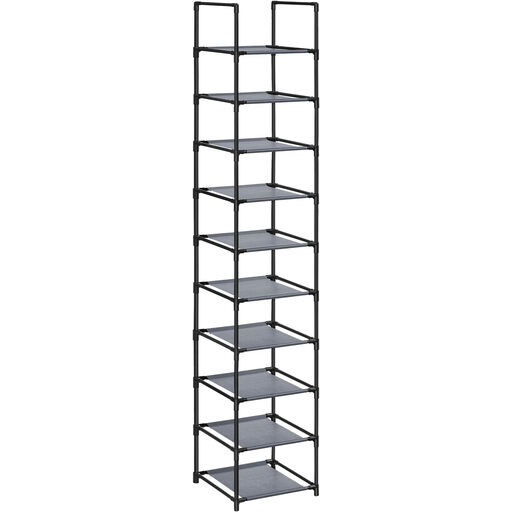
Why it suits this profile: Measuring 33 × 33 × 173 cm, its vertical design makes good use of floor space and is intended for hallways, bedrooms or smaller homes. According to the product description, the rack has ten tiers and holds up to 30 pairs of shoes.
The ten tiers avoid a rigid layout of just a few large compartments. Its open design also makes it easy to see your shoes at a glance.
Metal frame, ten tiers and wipe-clean non-woven fabric shelves. Assembly instructions are included.
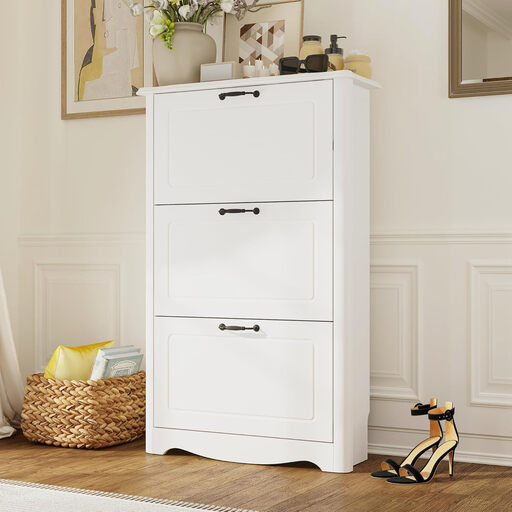
Why it suits this profile: Its enclosed design and three drop-down doors are a good choice for households that prefer to keep shoes out of sight. The stated dimensions are 71.6 cm wide, 26.5 cm deep and 112 cm high.
The doors open forwards, so there’s no need for side-opening doors. Adjustable or removable shelves help accommodate shoes of different heights.
Coated MDF surface, three drop-down doors and adjustable shelves. According to the product description, the surface can be wiped clean with a cloth.
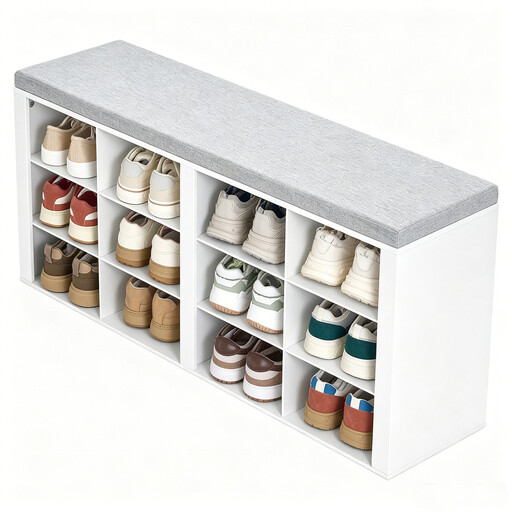
Why it suits this profile: With a seat and twelve compartments, this bench is well suited to families and households where shoes are changed regularly in the entrance. It measures 30.5 × 104.5 × 49.5 cm.
The height-adjustable shelves are designed to accommodate different types of footwear. The removable seat cover can be cleaned separately.
Twelve compartments, adjustable shelves and a stated load capacity of 150 kg. Made from a mix of particle board, foam and a cotton-linen cover.
We’ve put together a complete, regularly updated list of products that meet these strict selection criteria and fully comply with the safety regulations in force in the EU.
Shallow models are practical for narrow hallways. However, the internal width and the way the doors or drop-down fronts open are also important. Measure the walkway with the unit fully open, and allow for larger shoes.
Capacity depends on the shelf height, shoe size and storage design. According to the product details, an open shoe rack with ten tiers can hold up to 30 pairs of shoes. With cabinets that have drop-down doors, the actual capacity depends more on the internal layout.
A shoe bench can make it easier to put shoes on and take them off in the hallway. For everyday use, check the stated load capacity, the stability of the frame and the size of the seat. It’s also important to place the bench on a level surface and follow the assembly instructions.