
Lieferung heute & morgen

Qualitätsgarantie
App herunterladen
Kategorien
A hand blender, also known as an immersion or stick blender, is a versatile tool in any modern kitchen. Its primary function is to purée and blend ingredients directly in a pot or beaker. However, choosing the right model depends heavily on your individual needs. Crucial technical parameters include motor power, the material of the blending shaft, and the range of included accessories. These factors determine whether a device is suitable just for preparing soups and smoothies, or if it can also handle more demanding tasks like chopping nuts or processing dough.
Your decision should be based on an analysis of the technical specifications and your intended use.
A hand blender's power is measured in watts (W) and indicates its ability to process tough ingredients.
The material of the blending shaft is crucial for durability and hygiene.
Another key feature is the shape of the blender head. An optimised design can significantly reduce splashing during operation.
A hand blender set significantly expands the device's functionality. Common hand blenders with accessories include:
The ease of swapping accessories, often implemented with a click system, enhances user convenience.
Based on the technical criteria mentioned, we present three models with different specialities.
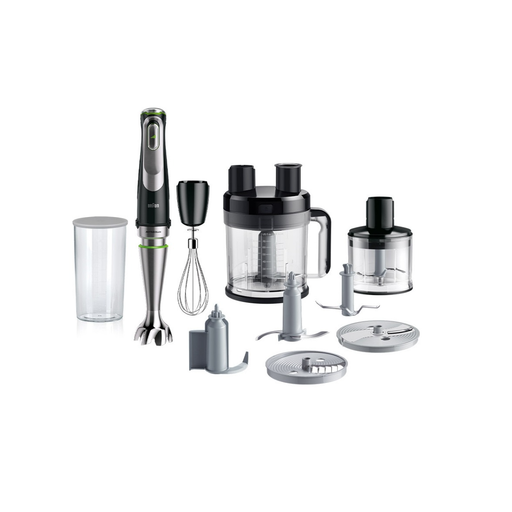
Why we recommend this product: The Braun MultiQuick 9 MQ 9195XLI is equipped with a 1200-watt motor and an extensive accessory package, which includes a 2-litre food processor attachment. This allows the device to function not only as a hand blender but also as a full-fledged chopper and food processor for slicing, shredding, and kneading. The Active PowerDrive Technology ensures efficient power delivery when processing tough ingredients.
Pros:
Best for: Users looking for a multifunctional device that can replace several kitchen appliances and is designed for demanding tasks like processing dough or chopping large quantities.
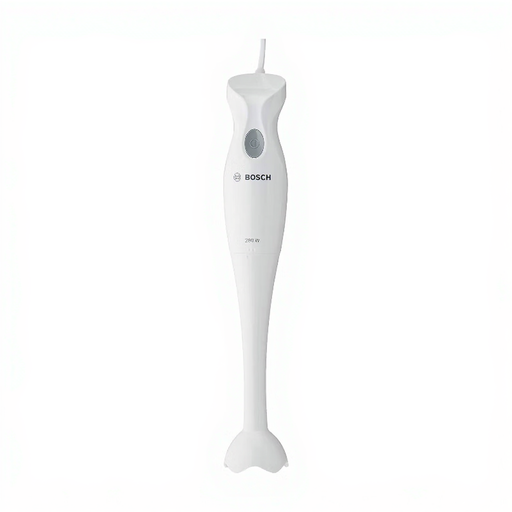
Why we recommend this product: The Bosch MSM 6B100 focuses on the core functions of a hand blender. With 280 watts of power, a low weight of 0.6 kg, and a detachable, dishwasher-safe blending shaft made of heat-resistant plastic, it is a straightforward and efficient tool for basic blending tasks.
Pros:
Best for: Users who need a simple, reliable, and affordable device for daily preparation of soups, sauces, or baby food and do not require extensive accessories.
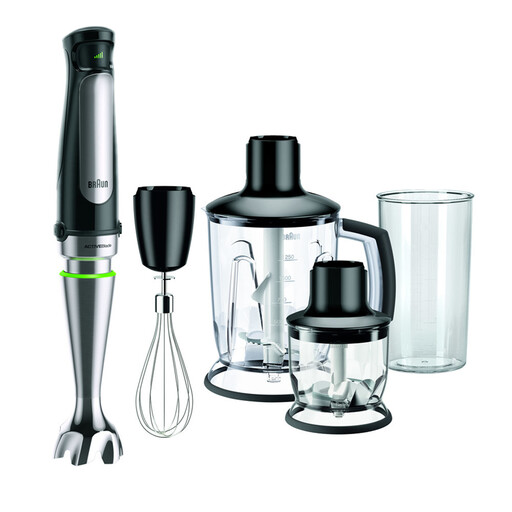
Why we recommend this product: This model offers high performance with 1000 watts in a compact design. Its standout feature is the ACTIVEBlade technology, where the blade moves up and down to blend even the hardest foods with less effort. The included hand blender set contains a blender attachment with an ice-crushing blade, a 350 ml chopper, and a whisk, ensuring high versatility.
Pros:
Best for: Home cooks looking for a powerful and versatile hand blender for regular use, who need functions like crushing ice or chopping smaller quantities without needing a full-sized food processor.
The products featured here represent a selection covering different user profiles. The market offers a wide variety of other devices that differ in performance, features, and price. You can find a broader overview of available models in our Hand Blenders category.
1. How many watts should a good hand blender have? The required wattage depends on the intended use. For simple tasks like puréeing soups, 300–500 watts is sufficient. If you plan to regularly process hard ingredients like nuts, frozen fruit, or raw vegetables, you should consider a model with at least 800 watts to prevent the motor from overheating and to achieve a fine consistency.
2. Can you crush ice with a hand blender? Crushing ice is a demanding task that not every hand blender can handle. It requires both a powerful motor (typically over 1000 watts) and specially hardened blades. Models like the BRAUN MultiQuick 7 MQ7045X are explicitly supplied with an ice-crushing blade in their accessory kit and are designed for this task. Attempting to crush ice with an unsuitable device can damage the motor and blades.
3. What is the difference between a hand blender and a chopper? A hand blender is primarily designed for puréeing and emulsifying liquid to creamy mixtures. A chopper is a separate attachment or a standalone device with an enclosed container and S-shaped blades at the bottom. It is ideal for quickly dry-chopping solid foods like onions, herbs, nuts, or chocolate. Many hand blender sets include a chopper attachment, thus combining both functions.