
Lieferung heute & morgen

Qualitätsgarantie

Willkommens-Angebote freischalten: KOSTENLOSE Lieferung | Bis zu 80 % RABATT | Kostenlose 30-Tage-JoyPlus-Testphase
App herunterladen
A hand blender should purée soups, blend smoothies, process sauces and, when needed, chop ingredients or whip cream. In many households, it replaces several individual appliances. However, impressive wattage figures and extensive accessory lists do not automatically guarantee the right purchase.
As a Joybuy Product Recommendation Officer, I filter the key details from product descriptions and assess them according to typical usage scenarios. This makes it easier to distinguish marketing claims from features that are genuinely useful in practice.
A motor power rating of 900 or 1,000 watts can be useful for more demanding tasks. On its own, however, it does not indicate how well an appliance will handle particular ingredients. Blade design, speed control, operating time and accessories also play a role.
For occasional soups or soft fruit, a lightweight hand blender with lower power may be sufficient. If you regularly process nuts, vegetables, frozen ingredients or larger quantities, you should also look for a powerful hand blender with a suitable chopping bowl.
A hand blender set with a whisk, chopper, measuring jug and additional blades initially appears versatile. The key question is whether the attachments suit your everyday needs. A hand blender with chopper is useful for herbs, onions and smaller portions. A hand blender with whisk complements the appliance when whipping cream or egg whites.
For yeast dough and heavy mixtures, however, a hand mixer with sturdy dough hooks is generally more suitable. A hand blender cannot replace it for every task.
Food residue can collect around blades, joins and lids. Therefore, check which removable parts are actually dishwasher-safe. For almost all appliances, the following applies: The motor unit, cable and plug must not be immersed in water.
Storage should also be taken into account. An appliance with lots of individual parts requires more space than a compact hand blender with a single attachment.
The wattage describes the motor’s electrical power consumption, not directly the processing speed or the result. For simple applications such as sauces, soft fruit and cooked vegetables, 280 to 600 watts may be sufficient. For frequent chopping or larger quantities, models with 900 to 1,200 watts offer greater power reserves.
Several speed settings allow for better adjustment:
A continuously adjustable dial or pressure control can be more precise than just two fixed settings. Even so, the appliance should still be easy to operate with one hand.
A stainless-steel blending shaft is resistant to many common foods and is often easier to clean. When working with hot ingredients, always follow the instructions in the relevant user manual. If necessary, allow hot food to cool slightly and keep the blending shaft fully submerged in the liquid to prevent splashes.
A tall, narrow measuring jug helps to maintain even circulation. A 350 or 500 ml chopper is practical for small quantities. For larger portions, pay attention to the capacity and maximum fill level.
Look for clearly named attachments and details of their functions. The following components can be useful with a multifunctional hand blender:
BPA-free materials in parts that come into contact with food are a clear and useful product feature. Whether an accessory is dishwasher-safe should be explicitly stated in the manufacturer’s specifications.
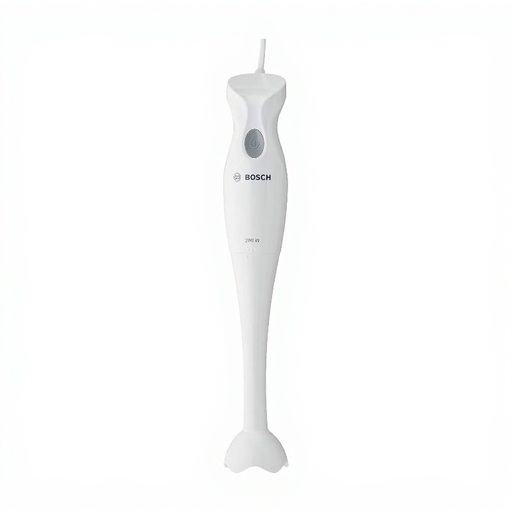
Why this product suits this profile: With 280 watts, a weight of 0.6 kg and a Turbo button, this model is suitable for simple everyday blending and puréeing tasks.
The product details clearly state the power, weight, Turbo function and dishwasher-safe blending shaft, without suggesting an excessive number of accessories.
Low weight, stainless-steel blade, splash guard and removable blending shaft.
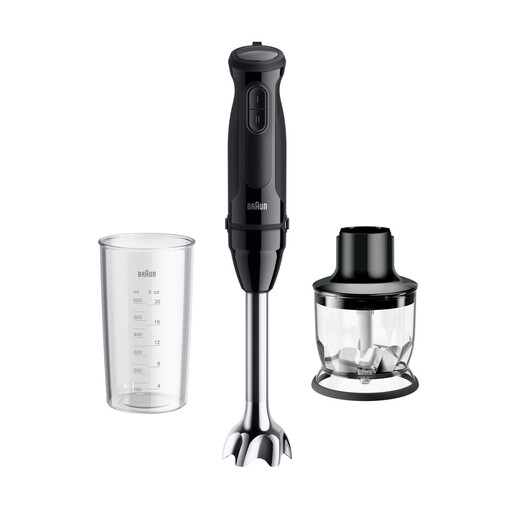
Why this product suits this profile: The 900-watt motor, 600 ml measuring jug and 350 ml chopper cover a range of common kitchen tasks.
The EasyClick attachment system makes it easier to switch between the blending shaft and chopper. According to the product description, SplashControl is designed to reduce splashing.
900 watts, chopper, measuring jug and dishwasher-safe accessories according to the product details.
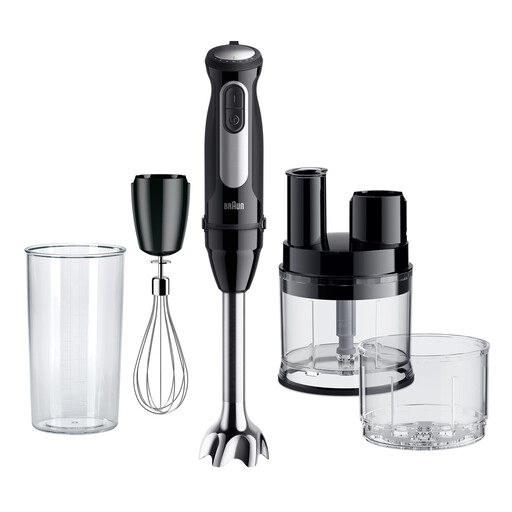
Why this product suits this profile: 25 speed settings plus Turbo and several attachments are aimed at users who regularly prepare a variety of recipes.
The accessories are listed clearly: blending shaft, whisk, mini food processor, chopper and slicing or grating disc.
1,000 watts, 25 settings, Turbo function, stainless-steel blending shaft and dishwasher-safe removable parts according to the product description.
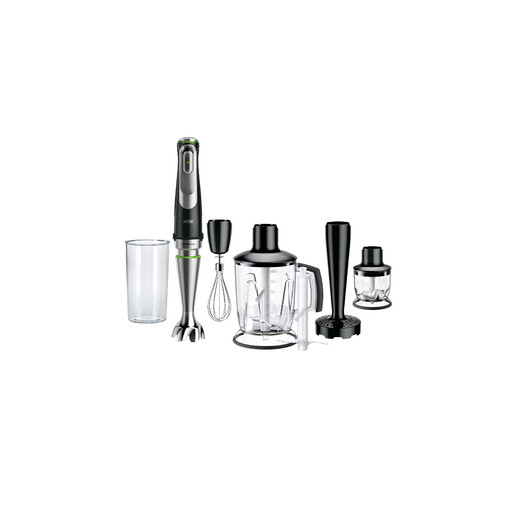
Why this product suits this profile: With a comprehensive set including a masher, whisk, chopper, ice-crushing blade and 1,250 ml container, this model is designed for a wide range of preparation methods.
The functions are assigned to individual attachments. This allows you to check before buying whether you genuinely need the accessories for the dishes you plan to prepare.
1,200 watts, ActiveBlade technology, SmartSpeed control and an extensive selection of attachments according to the manufacturer’s specifications.
We have put together a complete, regularly updated list of products that fully meet these strict selection criteria and the safety regulations applicable in the EU.
A hand blender works directly in a saucepan, measuring jug or chopper. It is therefore particularly practical for soups, smoothies, sauces, dips and baby food. A hand mixer, on the other hand, is used with beaters or dough hooks in a bowl. It is suitable for cream, egg whites, sponge batter and light to medium doughs.
If you bake frequently, combining both types of appliance can be a sensible choice. For small kitchens, a hand blender set with a whisk is a space-saving alternative, provided your requirements for dough and quantity remain moderate.
This depends on the instructions for the particular appliance. Hot liquids can cause splashes and scalding. Use a suitable container, keep the blending shaft fully immersed in the liquid and observe the maximum fill level. The motor unit must never come into contact with water or soup.
Its lifespan depends on how often it is used, the ingredients, cleaning and the recommended operating intervals. Overloading, hard foreign objects and long periods of uninterrupted operation can put strain on the motor and blades. A removable, dishwasher-safe blending shaft makes regular care easier, but does not replace the manufacturer’s instructions.
Power consumption is specified in watts. An appliance rated at 1,000 watts uses, in purely theoretical terms, 1 kilowatt-hour per hour of operation at full power. As a hand blender usually runs for only a few minutes at a time, actual consumption per preparation is generally much lower. The key factor is therefore not just the wattage, but also the required operating time.