
Lieferung heute & morgen

Qualitätsgarantie

Willkommens-Angebote freischalten: KOSTENLOSE Lieferung | Bis zu 80 % RABATT | Kostenlose 30-Tage-JoyPlus-Testphase
App herunterladen
A hand blender can purée soups, blend smoothies, process sauces and, with the right accessories, chop or whisk ingredients too. However, a high price or a large wattage rating does not automatically mean it is the right choice. What matters is whether the motor, attachment, controls and cleaning requirements match the kitchen tasks you actually carry out.
A rating such as 1,000 or 1,200 watts initially describes the electrical power consumption. On its own, it does not indicate how smooth a purée will be or how long the appliance can be used without a break. The blade design, housing, gearing and cooling system also affect performance.
A basic model may be sufficient for occasional soups and soft vegetables. If you regularly process frozen fruit, nuts or firmer ingredients, you should also look for a suitable attachment, a turbo function and the manufacturer's information on operating time.
A hand blender set with a whisk, chopper, measuring jug and potato masher may appear versatile. In practice, not every household needs every component. Unused accessories take up space and increase the cleaning workload.
Before buying, you should therefore decide whether you need a hand blender with chopper, a hand blender with whisk or simply an immersion blender for soups and sauces. A whisk attachment is suitable for regular whisking, while an enclosed chopper is more practical for onions, herbs or smaller quantities than an open blending foot.
A stainless-steel blending foot is durable and less likely to absorb odours or become discoloured in everyday use than certain plastic surfaces. Plastic can, in turn, be lighter. Above all, check whether the foot can be removed and which parts are actually dishwasher-safe.
The motor unit must not be immersed in water. Blades and attachments remain sharp and must be handled carefully during cleaning. You should also observe the container's maximum filling level to prevent hot liquids or splashing food from spilling over the edge.
For a powerful hand blender, wattage is a useful comparison value, but it is not the only indication of quality. The models in our selection range, for example, from 280 watts for the Bosch MSM 6B100 to 1,200 watts for the Braun MultiQuick 9 MQ9147X and the Kenwood Triblade XL Pro HBM80327BK.
The following questions are also relevant for a typical household:
An appliance with two speeds may be sufficient for simple tasks. Several settings are worthwhile if you regularly switch between coarse chopping, creamy soups and delicate mixtures.
A bell-shaped blending foot can guide ingredients more effectively into the blade area and reduce splashing. Systems such as PowerBell, ActiveBlade and Triblade are brand-specific design features. When choosing, focus on the tasks the product description says they are designed to handle.
A stainless-steel hand blender is a good choice if you often process hot soups, sauces or strongly coloured ingredients. The blending foot should be fully immersed in the ingredients before the appliance is switched on. Extra care is required with hot liquids because of steam and splashes.
An ergonomic handle, an easy-to-reach button and a motor housing that is not too heavy make longer preparation tasks easier. A hand mixer with a whisk, on the other hand, is primarily designed for whisking and stirring; a hand blender works with a blade and is designed for puréeing and blending. The two appliances can therefore only partly replace one another.
When checking a hand blender with accessories, consider the following:
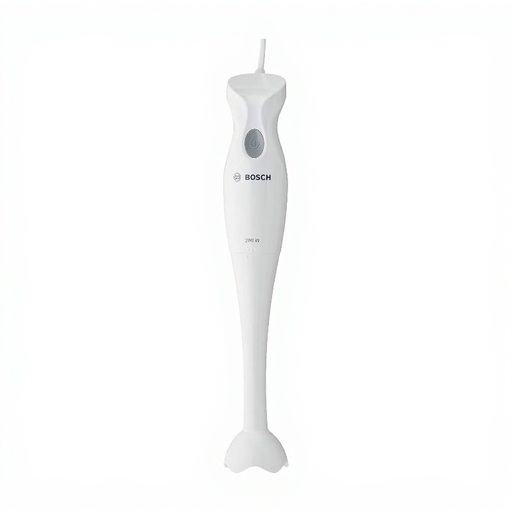
Why this product suits the profile: At 0.6 kg, this model is comparatively light and designed for basic tasks such as puréeing, blending and chopping. A turbo button adds to its straightforward operation.
The technical specifications are easy to understand and make it clear that this is not an extensive accessory set. That helps prevent buying attachments that go unused.
280 watts, 0.6 kg weight, splash guard and removable, dishwasher-safe blending foot.
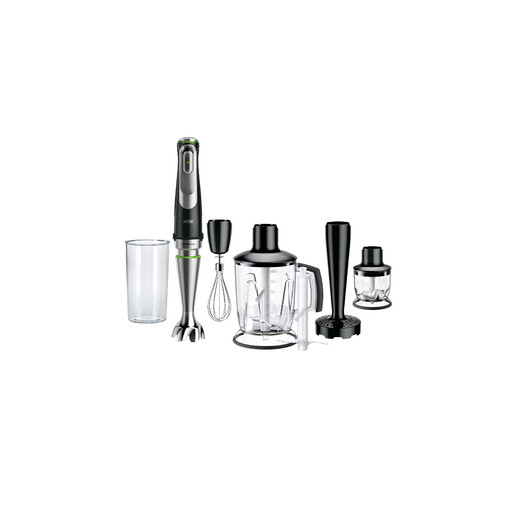
Why this product suits the profile: The Braun MultiQuick model combines 1,200 watts with several attachments for households that regularly prepare soups, sauces, smoothies and side dishes.
The possible uses are clear from the specifically listed components. These include a whisk, chopper and masher.
1,200 watts, removable blending foot, 600 ml measuring jug, 350 ml chopper, whisk and potato masher.

Why this product suits the profile: The 20 cm XL blending arm is suitable for larger or deeper containers. Several attachments support puréeing, whisking, chopping and emulsifying.
The contents of the package and the variable speeds are clearly specified. An overheating protection function is also listed.
1,200-watt motor, XL blending arm, whisk, 500 ml chopper, emulsifying attachment and dishwasher-safe removable parts.
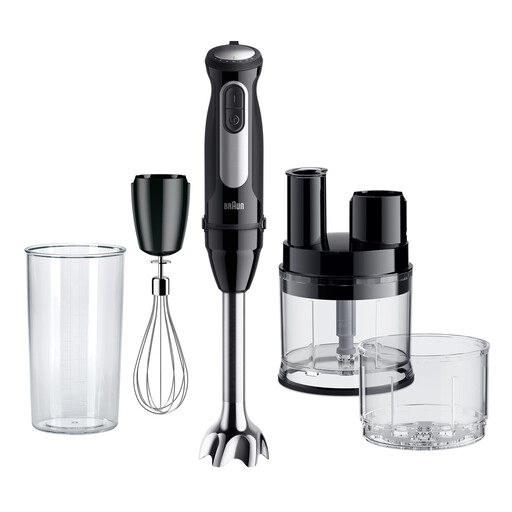
Why this product suits the profile: The combination of 25 speed settings, turbo mode and several kitchen attachments is aimed at households with frequently changing preparation needs.
The speed control can be adapted to different ingredients. The package contents are clearly described, including the blending foot, whisk, chopper and additional discs.
1,000 watts, 25 speed settings plus turbo, stainless-steel whisk and dishwasher-safe parts.
For a longer service life, rinse the blending foot immediately after use. Dried-on food makes cleaning more difficult and can put strain on the seals. Unplug the appliance before changing attachments and before cleaning.
When preparing hot soups, use a sufficiently tall container. The motor unit, cable and plug must not be placed in water. Do not test the blades with the edge of your hand. The appliance should also be switched off and allowed to cool completely if you notice unusual noises, odours or excessive heat.
We have put together a complete, regularly updated list of products that fully meet these strict selection criteria and the safety regulations applicable in the EU.
That depends on the manufacturer's specifications and the blending foot used. Hot liquids can produce steam and splashes. Use a sufficiently tall container, do not overfill it, and keep your face and hands away from the blade area.
Lower power ratings are often sufficient for simple tasks such as soft vegetables, sauces and soups. For frozen fruit, firmer ingredients or frequent chopping, models from around 900 watts may be worth considering. Wattage should always be assessed together with the blade design, accessories and permitted operating time.
There is no one-size-fits-all answer for the service life. It depends on how often the appliance is used, the ingredients, cleaning and observing the recommended breaks. Avoiding overloading the motor, using turbo only briefly and cleaning removable parts carefully can reduce typical everyday strain.