Raita fans who like chunks of cucumber
If you want a creamy yoghurt base but still want to see and taste pieces of sliced or grated cucumber in your raita, blend the base separately and stir in the cucumber afterwards.


If you want chunks of cucumber in your raita, blend just the yoghurt base or herbs, then stir in the sliced or grated cucumber; recipes from Swasthi’s Recipes and Spice Cravings use this method. If you regularly make larger batches, a set that explicitly includes a slicing or grating attachment can save you a step or two, but it also means more parts to store and clean. Whatever blender you use, keep the finished raita chilled.
If you want a creamy yoghurt base but still want to see and taste pieces of sliced or grated cucumber in your raita, blend the base separately and stir in the cucumber afterwards.
If you regularly prepare larger quantities, consider whether a slicing or grating attachment would genuinely save you time, and whether you have room to store it and time to clean the extra parts.
If you want to keep the number of parts to clean to a minimum after preparing yoghurt and raw cucumber, check the instructions for the exact model and each attachment you use.
| Priority | What to check before buying | Who is it important to? |
|---|---|---|
| Keeping chunks of cucumber | Speed control for blending the yoghurt base; prepare the cucumber separately by slicing or grating it, or use an attachment that is explicitly included. | If I want chunks in my raita, I blend just the base and stir in the cucumber afterwards. Around 36% of consumers put their preferred cucumber texture first. |
| Preparing several portions | Check whether a slicing or grating function is included, and compare the container’s stated capacity with the permitted fill level in the instructions. | If I regularly prepare larger quantities of cucumber, I want to know whether the attachment can do the job and is also suitable for other foods. Around 29% of consumers prioritise preparing several portions. |
| Making cleaning easier | Check for each part individually whether it can be removed and whether the instructions say it is dishwasher-safe; don’t assume the motor unit and attachments are the same. | If I don’t want to wash lots of parts by hand after preparing raita, I look for clear care instructions for the parts I’ve used. Around 21% of consumers say easy cleaning is their top priority. |
| Blending with control | Compare the speed control, shape of the blending foot and suitable beaker; don’t assume the splash guard will prevent splashes at every fill level. | When I blend yoghurt or herbs in a beaker, I want to control the process and keep the worktop as clean as possible. Around 14% of consumers prioritise controlled operation designed to reduce splashing. |
The texture you want depends on whether you prepare the cucumber separately or blend it with the yoghurt base. The wattage alone won’t tell you what texture your raita will have after blending.
First decide whether you want to slice, grate or purée the cucumber. Then compare how the appliance works and what’s included.
A chopper and a food processor attachment with slicing or grating discs are different accessories. The presence of a chopper doesn’t mean a suitable grating function is included too.
Check the specific model to see exactly which functions and attachments are included.
The stated capacity doesn’t tell you the permitted fill level when blending, or whether the container will hold a whole batch for meal prep.
Check the filling instructions against the quantity in your recipe, and make sure you have separate, covered containers for chilling the finished raita.
The Triblade HDP106WG is a straightforward hand blender with a metal blending foot and a 700 ml beaker.
The ErgoMaster MSM6M8X1 is a set with a dicing attachment and other accessories for extra prep work.
According to the manufacturer, the SM 3773 has a removable stainless steel blending foot, stepless speed control and a 0.7-litre container with a lid.
What’s included varies by MultiQuick model: the MQ 55001 M comes with a blending beaker and measuring beaker, while the MQ 7045 X includes, among other things, a chopper and whisk.
The 5000 Series HR2685/00 is worth considering if preparing vegetables is also part of the job when making several portions.
This selection includes hand blenders for blending the yoghurt base separately; you can then stir in sliced or grated cucumber.
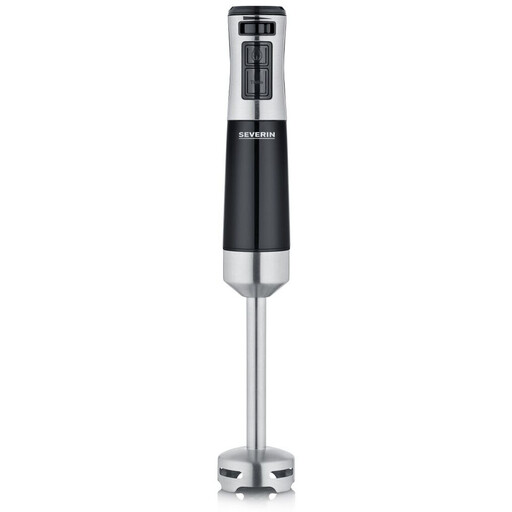 No image available
For blending the yoghurt base separately before stirring in the cucumber.
According to the product description: stepless speed control and a removable blending foot, which is described as dishwasher-safe.
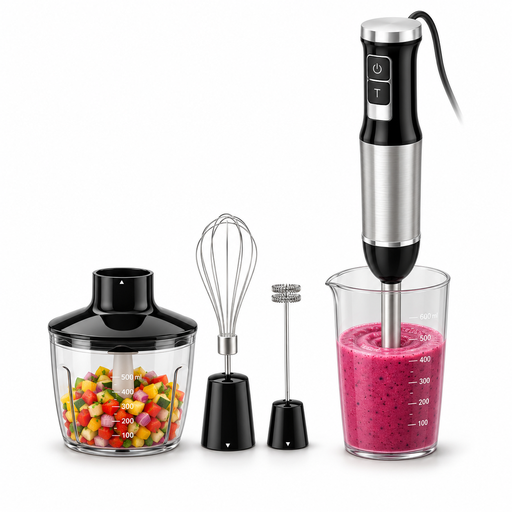 No image available
Blend the yoghurt base separately, then stir in the cucumber chunks.
The product name lists 6 speeds and a turbo function; the description mentions a chopper and a stainless steel blending foot.
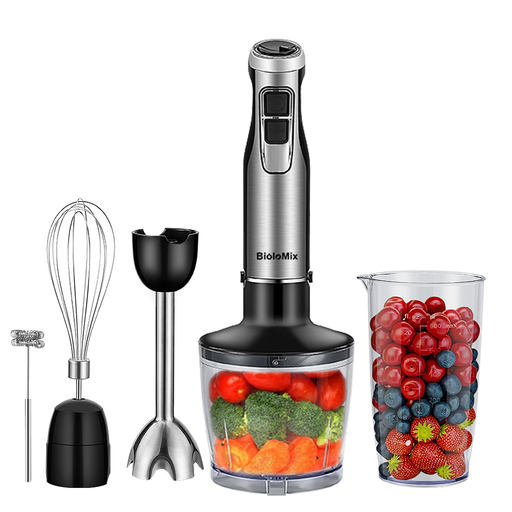 No image available
For raita, blend the yoghurt base and stir in the cucumber separately afterwards.
The product name lists 6 speed settings; the description mentions a removable blending foot.
 No image available
For blending the base; to keep visible chunks of cucumber, stir in the separately prepared cucumber afterwards.
The description mentions a stainless steel blending foot and a chopper.
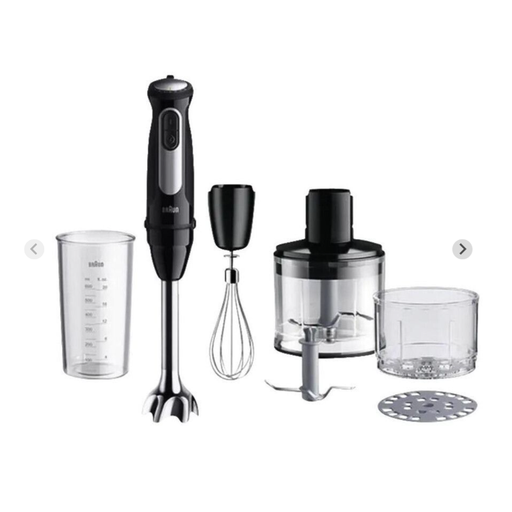 No image available
An option for blending the yoghurt base separately while keeping the cucumber in chunks.
The product description lists 25 adjustable speeds and dishwasher-safe accessories.
No, not if you want chunks of cucumber. Recipes from Swasthi’s Recipes and Spice Cravings use sliced or grated cucumber with yoghurt. Blend the base separately, then stir in the cucumber.
No. Check the exact model to see whether it includes a slicing or grating disc; the mention of a chopper alone doesn’t mean it has a grating function.
No. Check the instructions for every part of the specific model. Care instructions for the blending foot don’t automatically apply to the motor unit, lid or every attachment.
The German Federal Institute for Risk Assessment recommends keeping perishable foods at a refrigerator temperature of 2 °C to no more than 7 °C. It also advises keeping food chilled during transport and storing it covered and separately; the risk of microbial contamination increases the longer food is kept. This doesn’t establish a general shelf life for every raita recipe.