
Lieferung heute & morgen

Qualitätsgarantie

Willkommens-Angebote freischalten: KOSTENLOSE Lieferung | Bis zu 80 % RABATT | Kostenlose 30-Tage-JoyPlus-Testphase
App herunterladen
Hand tools need to suit the job, the working environment and the fasteners you’re using. A budget set may be enough for occasional repairs around the home. For vehicle maintenance, plumbing or regular assembly work, however, precise sizing, durable materials and suitable storage all matter.
Many disappointing purchases aren’t caused by a lack of tools, but by unclear product information. Before buying, DIYers, mechanics, plumbers and hobbyists should look out for three common pitfalls.
A tool set with lots of pieces may seem versatile at first glance. What matters, though, is whether the sizes included are right for the jobs you have in mind. A small household needs different tools from a car workshop. For metric fasteners, sizes such as 8 to 19 mm or 6 to 22 mm are often more practical than a set full of rarely used options.
Cr-V steel, or chrome vanadium steel, is used in many spanners, pliers and socket components. The material name alone doesn’t tell you everything about durability. Heat treatment, surface finish, manufacturing method and the fit on screws or nuts are also important.
If you’re buying tools made from carbon steel or alloy steel, check the product description carefully. A chrome-plated or black-oxide finish can make cleaning easier and improve surface protection, but it’s no substitute for proper storage.
In confined spaces, such as an engine bay or under a sink, tool length isn’t the only thing to consider. The working angle matters too. A ratcheting spanner set with a small return angle may be more practical there than a straight spanner. With a reversible ratchet or socket set, also check that the drive square and compatible sockets fit together.
Pliers and spanners are commonly made from chrome vanadium steel or comparable alloys. For everyday use, look for:
Water pump pliers should grip the workpiece securely without requiring you to keep adjusting them. For delicate surfaces, strap wrenches with a rubber strap may be more suitable, as they apply less concentrated pressure to the workpiece.
The maximum opening needs to suit the nut, pipe or workpiece. Water pump pliers that are too small aren’t practical, while oversized pliers can make it harder to control small components. With an adjustable spanner, also consider the jaw thickness, scale and how the movable jaw is guided.
For specialist jobs, don’t rely on a general-purpose tool in place of the right design. For example, a brake pipe spanner has an open ring shape designed for brake pipe fittings. For woodworking, by contrast, the clamping range, throat depth and protective caps of a screw clamp set are more important.
When choosing ratcheting spanners and ratchets, check the tooth count, working angle and permitted load. A higher tooth count can allow for a smaller working angle, but it shouldn’t be treated as the only measure of quality. What matters is whether the mechanism suits the job.
A long lever, such as a breaker bar or sliding T-bar, can transfer considerable force. This also puts more strain on the tool and the fastener. Only use extensions if the manufacturer says they’re suitable. For safety-critical work on a vehicle, follow the vehicle manufacturer’s guidance and use suitable torque tools.
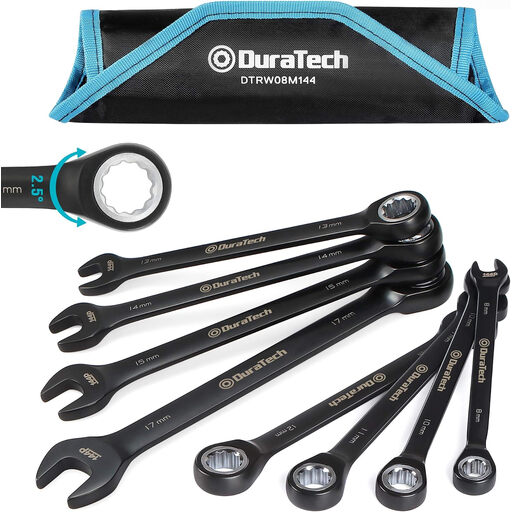
Why it suits this user: The set covers 8, 10, 11, 12, 13, 14, 15 and 17 mm, making it suitable for maintenance work on vehicles, machinery and around the home.
The sizes are clearly specified and the spanners are stored in a roll pouch. The stated 2.5-degree working angle is useful in confined spaces.
Cr-V steel, a 144-tooth ratchet mechanism and space-saving storage.
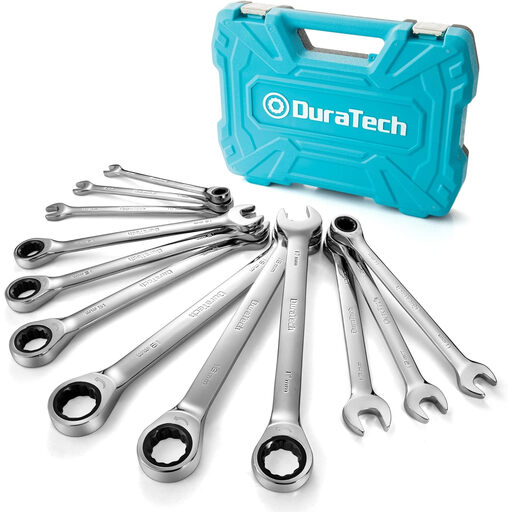
Why it suits this user: The combination of ring and open ends covers metric sizes from 8 to 19 mm and is designed for regular assembly and maintenance work.
The size range is clearly specified. The storage case has marked sizes, helping reduce the risk of putting individual spanners away in the wrong place.
Cr-V steel, 72 teeth and a stated working angle of 5 degrees.
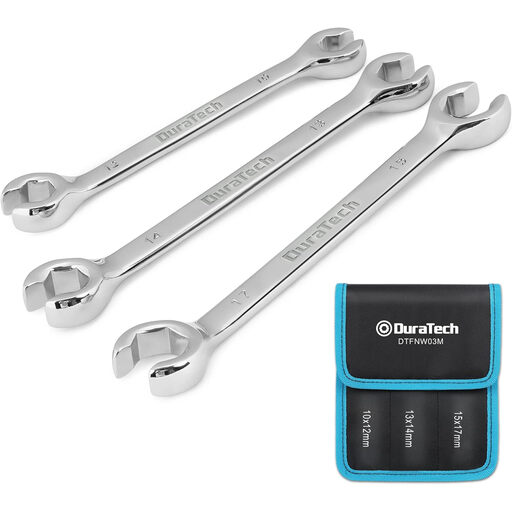
Why it suits this user: For work on brake pipes or pipe fittings, the specialist open ring design is more practical than a standard open-ended spanner.
The three sizes are listed as 10 x 12, 13 x 14 and 15 x 17 mm. This lets you check that the set is suitable for your needs before buying.
Heat-treated Cr-V steel, a 15-degree offset and a roll pouch.
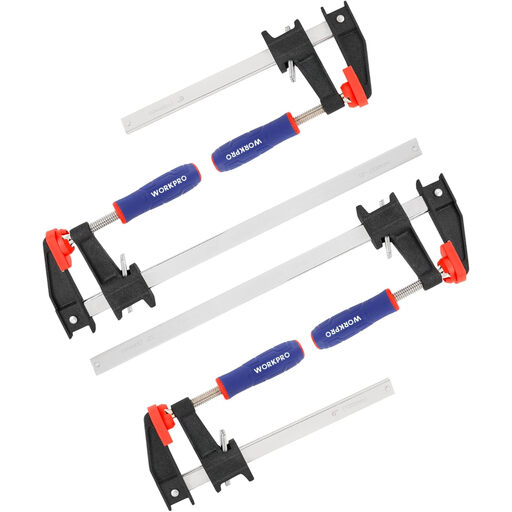
Why it suits this user: Two clamping ranges of 150 and 300 mm offer options for small repairs, glue-ups and medium-sized woodworking projects.
The clamping ranges and 80 mm throat depth are specified. Protective caps help reduce pressure marks on workpieces.
Four clamps, quick adjustment and a stated clamping force of 272 kg.
We’ve put together a complete, regularly updated list of products that meet these strict selection criteria and fully comply with the safety regulations in force in the EU.
After use, remove dust, oil and moisture from your hand tools. Lubricate moving joints as directed by the manufacturer. Tools with damaged handles, bent jaws or worn teeth should be taken out of use.
For every job:
For home and DIY jobs, a spanner set, water pump pliers, an adjustable spanner, a reversible ratchet with suitable sockets and screwdrivers are useful essentials. For woodworking, add a screw clamp set. For vehicle maintenance, you may also need a ratcheting spanner set and a brake pipe spanner.
Both materials can be suitable for different types of hand tool. Cr-V steel is often used for pliers and spanners, while carbon steel is also used to make durable tools. Heat treatment, workmanship, surface protection and proper use all affect how long a tool lasts.
A ratchet is particularly useful when working space is limited or you need to undo lots of similar fasteners. In open spaces, a standard ring or open-ended spanner may be enough. For delicate or safety-critical fasteners, always choose the right tool type and size.