
Lieferung heute & morgen

Qualitätsgarantie

Willkommens-Angebote freischalten: KOSTENLOSE Lieferung | Bis zu 80 % RABATT | Kostenlose 30-Tage-JoyPlus-Testphase
App herunterladen
Whether you’re looking for DIY tools, automotive tools or plumbing tools, there’s a wide choice of hand tools available. Many products look similar at first glance, but can differ considerably in their materials, size range and ease of use. It’s worth checking a few details systematically before you buy, whether you’re shopping for your home, workshop or building site.
A tool set with lots of pieces can look appealing at first. What matters, though, is whether the sizes included are right for the jobs you have in mind. A socket set with metric and imperial fittings can be useful for vehicles and machinery. For everyday furniture assembly, however, a compact ratchet set with bits and small sockets is often enough.
Before you buy, check:
Descriptions such as ‘extra tough’ or ‘professional quality’ don’t tell you much without technical details. More useful information includes specifics about chrome vanadium steel, alloy steel, carbon steel, heat treatment, jaw opening or permitted torque.
A shiny finish alone also says nothing about a tool’s load capacity. With a torque wrench or ratchet, the drive size and maximum load need to be compatible. Using a tool outside its intended range can damage components or cause it to slip.
Water pump pliers aren’t automatically a substitute for a pipe wrench for every pipe connection. Their adjustable, serrated jaws are suitable for a range of round, flat or hexagonal shapes. For delicate surfaces, a strap wrench with a rubber strap may be a better choice. For hose clips, meanwhile, hose clamp pliers with a flexible shaft make it easier to reach into tight spaces.
Always choose a tool that suits the job, the available space and the material you’re working with.
For many hand tools, heat-treated chrome vanadium steel is a useful, specific material description. With pliers, look for well-made joints, jaws that close evenly and non-slip handles. Cable cutters and crimping pliers should specify the cable or wire range they’re designed for.
For tools with rubber components, such as an oil filter wrench, you should also consider wear, storage and permitted load. Avoid leaving rubber in contact with sharp edges, high heat or harsh liquids for long periods.
The length affects both leverage and accessibility. A 200 mm pair of pliers is easier to handle in tight spaces, while a longer model can offer greater leverage. With water pump pliers, the maximum jaw opening and adjustment mechanism are particularly important.
For crimping pliers, the cable cross-section must match the die. According to the product information, the Drillpro model covers 12 AWG to 2/0 AWG or 4 to 70 mm². For electrical work, you should still check that cable lugs, connectors and wires are compatible with the die.
Never use ordinary metal hand tools on live electrical installations. For electrical work, follow the appropriate safety precautions and applicable regulations.
When choosing a socket set, consider the drive size, socket sizes and how well the sockets fit. According to the product description, the PROBUILDER set includes a 3/8-inch ratchet handle, a 1/4-inch handle, an extension, bits, and metric and SAE sockets from 4 to 15 mm or 5/32 to 11/16 inch.
The DURATECH ratchet handle combines 1/4, 3/8 and 1/2 inch drives. The stated maximum torque varies considerably between drive sizes. Keep these figures in mind before use. They’re no substitute for a calibrated torque wrench when precise tightening is required.
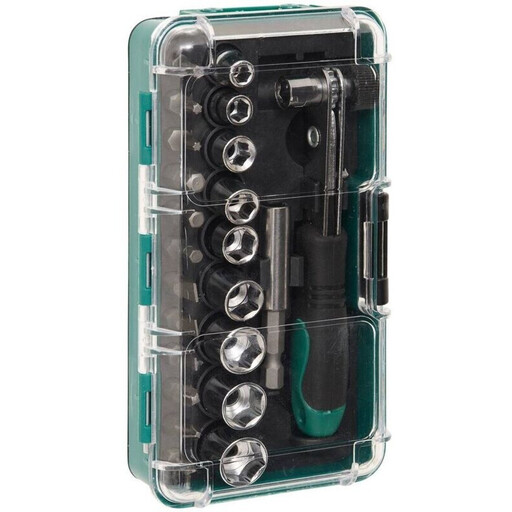
Why this product suits this user: This compact set covers basic fastening and assembly jobs around the home, with furniture and for minor repairs. It includes 11 bits, 9 sockets from 4 to 12 mm and a 1/4-inch ratchet handle.
The number of pieces is manageable, and the storage case keeps the bits and sockets clearly organised. That means you won’t end up buying a large case full of components you rarely need.
Compact dimensions, a magnetic adapter and metric sockets from 4 to 12 mm.

Why this product suits this user: This set covers general gripping, cutting and installation jobs. The combination pliers, long-nose pliers, side cutters and water pump pliers are each designed for different tasks.
The four different tool types help prevent you from using one pair of pliers for tasks it isn’t suited to. The product information specifies heat-treated alloy steel, along with PP and TPR handles.
Four clearly defined uses and a 244 mm pair of water pump pliers.
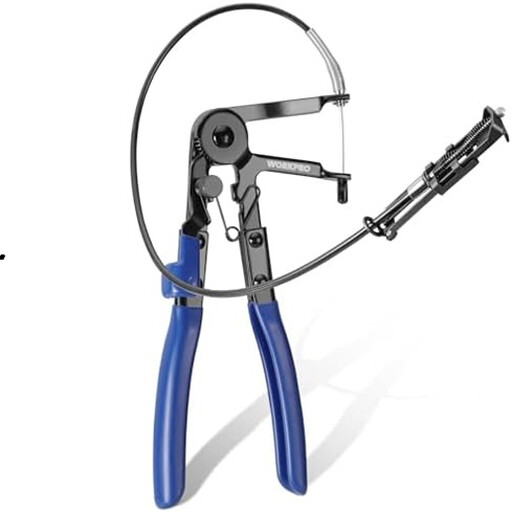
Why this product suits this user: The 67 cm flexible shaft is designed for hard-to-reach hose clips on motor vehicles, radiator hoses and fuel lines.
The long shaft is designed to tackle the common problem of limited access in the engine bay. The stated opening range of 10 to 50 mm clearly indicates the tool’s suitable applications.
Ratchet lock to hold the clamp in position and PVC-coated handles.
We’ve put together a comprehensive, regularly updated list of products that meet these strict selection criteria and fully comply with the safety regulations in force in the EU.
For many households, it’s useful to have combination pliers, long-nose pliers, side cutters, water pump pliers, screwdrivers, a small socket set and a tape measure. For vehicle maintenance, add a ratchet, extensions and suitable sockets. What you need will depend on the repairs you plan to do.
Their lifespan depends on the materials, workload, storage and care. Frequent overloading, rust, damaged handles or a worn joint can all shorten a tool’s life. Follow the stated maximum cutting capacity or torque limits.
A tool set makes sense if you regularly need several sizes and functions, and want to keep them together. For occasional specialist jobs, such as using an oil filter wrench or hose clamp pliers, buying just the tool you need can help reduce costs and avoid unused pieces.