
Lieferung heute & morgen

Qualitätsgarantie

Willkommens-Angebote freischalten: KOSTENLOSE Lieferung | Bis zu 80 % RABATT | Kostenlose 30-Tage-JoyPlus-Testphase
App herunterladen
Selecting the right carry-on suitcase involves a careful consideration of material properties, dimensions, weight, and functional features. A hard-shell carry-on suitcase offers superior structural protection for your belongings, making it a popular choice for air travel. Your final decision should be based on technical specifications and full compliance with airline carry-on policies.
The functional features of a suitcase determine its practicality. The following criteria are essential for making an informed purchasing decision.
The choice of material directly impacts the suitcase's weight, resilience, and durability.
The IATA (International Air Transport Association) provides recommendations for carry-on sizes, but airlines set their own binding limits. A widely accepted dimension is 55 x 40 x 20 cm. It is essential to check the specific regulations of your airline before travelling, as these dimensions include wheels, handles, and external pockets. A compliant cabin trolley helps you avoid extra fees at the gate.
Modern trolleys are predominantly equipped with four 360-degree rotating wheels, known as spinner wheels. These allow the suitcase to be pushed and pulled upright in any direction, significantly increasing manoeuvrability in narrow aisles and queues. Models with two wheels (uprights) must be tilted and pulled, but they often offer more stable handling on uneven surfaces.
An integrated TSA (Transportation Security Administration) lock is important for travel to the USA and other countries. It allows security authorities to open the suitcase with a master key without damaging the lock or the case itself. For travellers, it still provides protection against unauthorised access.
The following models have been selected based on their technical specifications and practical value.

Why We Recommend This Product This model combines the material advantages of 100% polypropylene with standard carry-on dimensions. Its low tare weight of 2.41 kg maximises your packing allowance. The inclusion of a TSA lock and a YKK zipper, commonly found in higher-priced luggage, points to a well-thought-out design.
Advantages
Who It's For This model is a functional choice for business and leisure travellers looking for a single, durable, and lightweight carry-on trolley for regular air travel.

Why We Recommend This Product This hard-shell luggage set offers a comprehensive solution for various travel needs. It consists of four suitcases of different sizes, plus a travel bag and a toiletry bag. The suitcases are made from durable ABS material and can be nested inside one another for space-saving storage.
Advantages
Who It's For The set is suitable for families, couples, or individuals who need a flexible luggage setup for various trip durations and appreciate a uniform look.
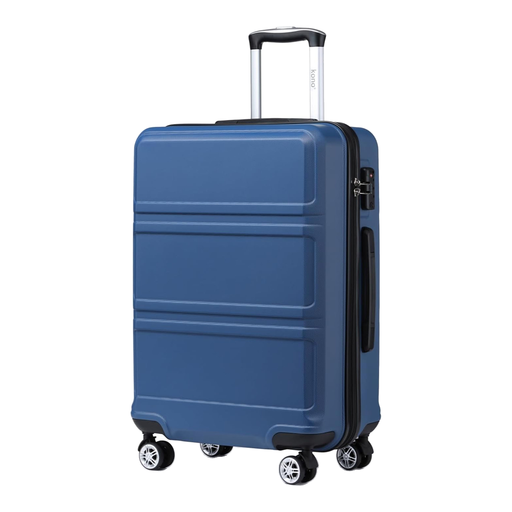
Why We Recommend This Product This model is a pragmatic option for price- and quality-conscious travellers. Made from a 100% ABS hard shell, it provides solid protection at a weight of 2.5 kg. With dimensions of 52 x 38 x 21 cm (including wheels), it falls within the usual carry-on guidelines. Equipped with a TSA lock and 360-degree wheels, it covers the essential requirements of a modern cabin trolley.
Advantages
Who It's For Ideal for weekend trippers and occasional travellers seeking a functional, lightweight, and straightforward carry-on for short trips.
If the featured models don't fully meet your needs, or if you're looking for different sizes, materials, or designs, you can find a wider selection in our main category.
Discover Our Full Range of Luggage and Suitcases
1. What is the advantage of a hard-shell suitcase over soft-sided luggage? A hard-shell carry-on suitcase offers better protection for fragile items inside. The rigid outer shell is more resistant to impacts and pressure. Additionally, hard-shell suitcases are generally more water-repellent and easier to clean than fabric cases.
2. What are the permissible dimensions for a carry-on suitcase? The permitted dimensions vary by airline. A common guideline is 55 x 40 x 20 cm. However, it is essential to check your airline's exact regulations before your flight, as deviations can lead to additional charges. The measurements always include external parts like wheels and handles.
3. Is a 4-wheel suitcase better than a 2-wheel one? A 4-wheel suitcase (spinner) offers greater manoeuvrability on smooth surfaces like those in airport terminals. It can be pushed upright alongside you, which reduces strain on your wrist. A 2-wheel suitcase (upright) must be tilted and pulled, which can be more advantageous on uneven terrain like cobblestones, as the wheels are usually larger and more robust. The choice depends on personal preference and typical usage.