
Lieferung heute & morgen

Qualitätsgarantie

Willkommens-Angebote freischalten: KOSTENLOSE Lieferung | Bis zu 80 % RABATT | Kostenlose 30-Tage-JoyPlus-Testphase
App herunterladen
Hard, mineral-rich water is a daily reality in many regions. It is characterised by a high concentration of dissolved minerals, primarily calcium and magnesium ions. These minerals can lead to visible limescale deposits on shower heads, fixtures, and tiles. Furthermore, users often report adverse effects on their skin and hair, such as a feeling of dryness or brittleness. A shower filter for hard water is a technical device designed to reduce the concentration of these and other substances in your shower water.
The functionality of these filters is based on various physical and chemical processes. Depending on the model, different filter media are used to remove specific substances from the water. The goal is to improve water quality directly at the point of use—the shower.
Choosing the right water filter for your shower should be guided by an analysis of technical parameters. The following aspects are crucial for functionality and compatibility.
A filter's effectiveness is determined by the materials it uses. Common media include:
A multi-stage filtration system that combines several of these media can address a broader spectrum of substances.
There are two primary designs:
Both variants typically use the standard G1/2-inch thread, which allows for tool-free installation in most households.
Shower filter housings are often made of ABS plastic or chrome-plated metal. ABS is known for its durability and heat resistance. The crucial factors for long-term use are the lifespan of the filter cartridges and their availability. Replacement intervals vary depending on the manufacturer's specifications, water hardness, and frequency of use. These running costs should be factored into the purchasing decision.
Based on the technical criteria above, we are showcasing three products that take different approaches to in-shower water filtration.

Why we're featuring it: This model is an external filter that stands out with what the manufacturer claims is a 34-stage filtration system. The combination of KDF-55, calcium sulphite, and Vitamin C spheres aims for a comprehensive reduction of chlorine, heavy metals, and sediment. Its external design makes it a flexible retrofit solution.
Advantages:
Best for: Users who are satisfied with their current shower head but want to add a high-performance, separate filtration unit to improve their water quality.
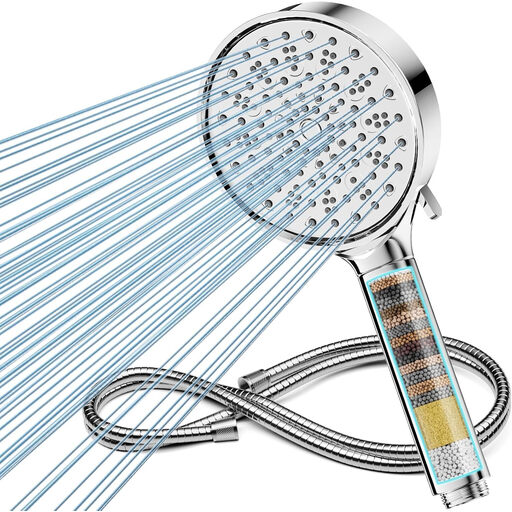
Why we're featuring it: This product is an all-in-one solution that combines a shower head with a filter and a matching hose. The integrated 20-layer filtration system also uses KDF, calcium sulphite, and activated carbon. A key feature is its six adjustable spray patterns, which enhance the showering experience.
Advantages:
Best for: Users looking to replace their entire shower head assembly and benefit from both filtered water and an enhanced shower experience with multiple spray patterns.
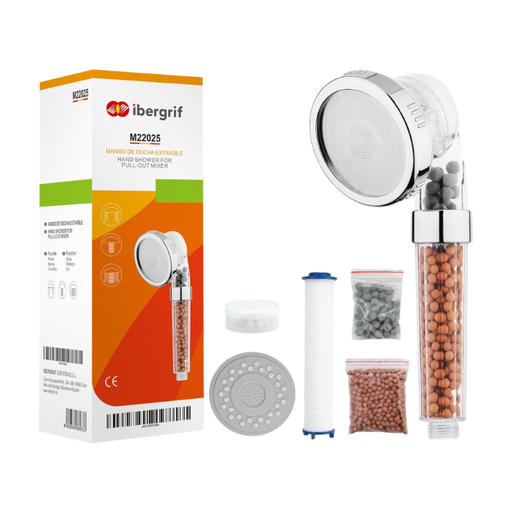
Why we're featuring it: The Ibergrif shower head relies on a three-layer filtration system with mineral beads and a PP filter. According to the manufacturer, the design is engineered to increase water pressure by up to 200% while simultaneously reducing water consumption by up to 30%. This makes it a compelling choice for households with low water pressure.
Advantages:
Best for: Individuals in households with low water pressure, or those who are focused on reducing water consumption and prefer a system with mineral beads.
The products featured here cover specific use cases. If these models don't precisely meet your requirements, or if you would like a broader overview of available systems, you can find more solutions in our main category for Shower & Bath Fixtures.
1. How often do you need to change a shower filter? The replacement frequency depends on the product, local water hardness, and how often it is used. Most manufacturers provide a recommended service life in months or litres, typically ranging from 3 to 6 months. A drop in water pressure can be an indicator that the cartridge is saturated.
2. Does a shower filter technically make water softer? A shower filter for soft water works differently than a central water softening system, which exchanges calcium and magnesium ions for sodium ions. Shower filters primarily reduce chlorine, heavy metals, and sediment. While they can alter the structure of limescale minerals, making them less likely to form deposits, they do not remove them completely in the sense of traditional water softening. The result is often described by users as a "softer" feeling on the skin, which is mainly due to the reduction of chlorine.
3. Can a shower filter help with skin issues? By reducing potential irritants like chlorine, chlorine by-products, and heavy metals from tap water, the stress on skin and hair can be lessened. Some users report an improvement in how their skin feels and a reduction in dryness. However, it is important to emphasise that a shower filter is not a medical product and does not promise any therapeutic effects.
Authored by: Joybuy Product Recommendation Officer