
Lieferung heute & morgen

Qualitätsgarantie
App herunterladen
Kategorien
Selecting a luggage set requires an analysis of material properties, functional components, and dimensions. A hardside luggage set offers distinct advantages in terms of content protection and durability. This article analyses the technical criteria relevant for an informed purchasing decision and presents a selection of models based on these parameters.
By: Joybuy Product Recommendation Officer
When evaluating a hardside suitcase, four main components are crucial: the shell material, the wheel system, the locking mechanism, and the interior organisation.
The outer shell is the primary protective barrier for your luggage. Many modern suitcases use a material blend of Acrylonitrile Butadiene Styrene (ABS) and Polycarbonate (PC).
The combination of both materials in a composite shell aims to merge their advantages: the lightness and scratch resistance of ABS with the flexibility and shock absorption of PC. The result is a lightweight yet robust suitcase structure.
A trolley's manoeuvrability is largely determined by the type and quality of its wheels. A 4-wheel hardside suitcase, often called a spinner, offers multi-directional mobility. This allows you to push the suitcase upright beside you instead of pulling it behind, reducing strain on your arm and shoulder.
The choice of wheel material is also relevant. Wheels made from Thermoplastic Elastomers (TPE) provide rubber-like flexibility, resulting in quieter rolling and better shock absorption on uneven surfaces.
For international travel, especially to the USA, luggage with a TSA lock is an essential feature. The Transportation Security Administration (TSA) is the American aviation security agency. A TSA-accepted lock allows security personnel to open and inspect the luggage with a master key without damaging the lock or the suitcase. Without such a lock, a locked suitcase may be forcibly opened if an inspection is necessary.
A 3-piece luggage set typically covers the three most common travel needs:
A well-designed interior with cross-straps and a zippered divider secures the contents and prevents them from shifting during transit.
The following models from the British Traveller brand have been selected based on their specifications. They can be purchased individually or combined to create a visually cohesive set.
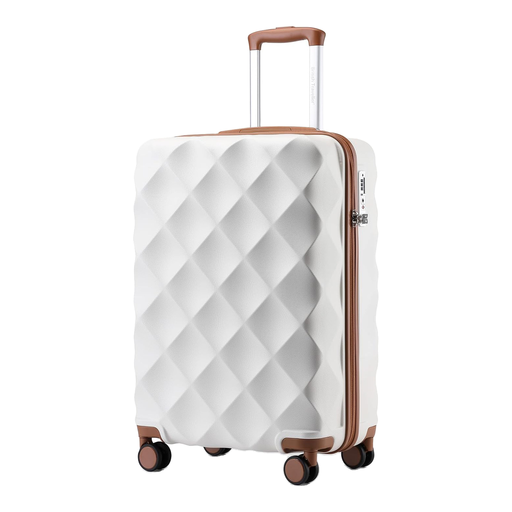
Why we recommend this product: The combination of a very low weight of 2.35 kg and cabin-friendly external dimensions (54 x 36.5 x 21.5 cm) makes this model a functional choice for air travel. The ABS-PC material provides the necessary protection.
Advantages:
Who it's for: Business travellers and weekenders who need a lightweight and regulation-compliant hardside carry-on suitcase.
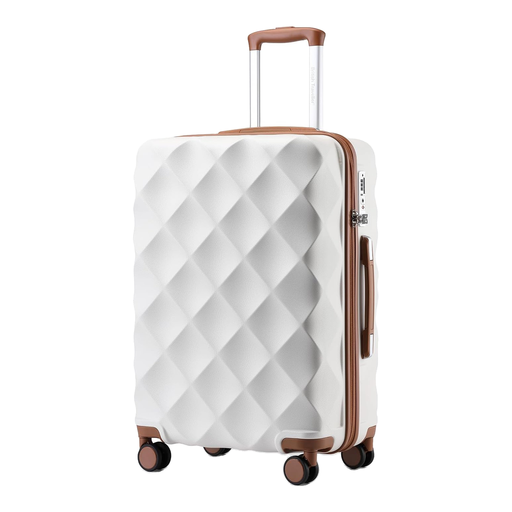
Why we recommend this product: With a 57-litre capacity, this suitcase offers a perfect balance between packing volume and manageability. Its weight of 3.1 kg is on the low side for a suitcase of this size, which helps reduce the overall luggage weight.
Advantages:
Who it's for: Individuals or couples looking for a versatile suitcase for their annual holiday or longer journeys.
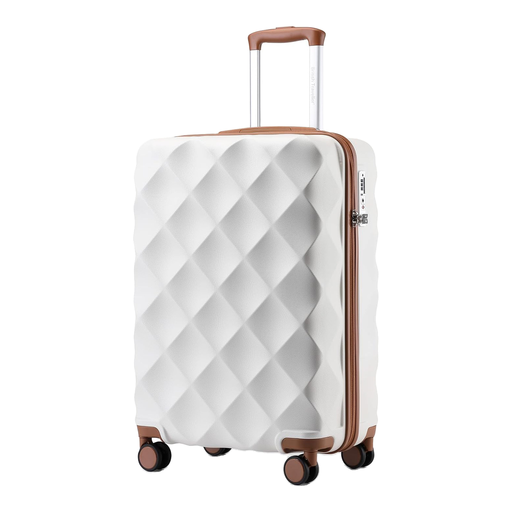
Why we recommend this product: The high capacity of 91 litres makes this model ideal for long-term travel or as a family suitcase. Despite its size, the tare weight remains relatively low at 3.9 kg, making it easier to comply with airline weight restrictions.
Advantages:
Who it's for: Long-term travellers, families, or individuals who need to transport a large amount of luggage.
Combining these three models creates a functionally and visually coordinated 3-piece luggage set in a Cream finish, offering versatile options for various trip durations.
If you are looking for other luggage pieces or accessories in similar shades, you will find a selection of options, including the cream bag, in our corresponding category.
1. What should you look for in a luggage set? The key criteria are the shell material (e.g., an ABS-PC blend for a good balance of weight and stability), the type of wheels (4 x 360° spinner wheels for high manoeuvrability), an integrated TSA lock for international travel, and the appropriate size and interior layout for your intended use.
2. What are the advantages of a hardside suitcase over a softside one? A hardside shell offers superior protection for fragile items inside the suitcase and is more resistant to moisture penetration. It is also generally easier to clean. Softside suitcases, on the other hand, often provide more packing flexibility and usually feature convenient exterior pockets.
3. Is ABS or Polycarbonate (PC) better for suitcases? Both materials have specific properties. Pure PC is more flexible and impact-resistant, but also more expensive. Pure ABS is lighter and more rigid. A composite construction of ABS and PC, as used in the featured models, combines the positive attributes of both materials: the lightness of ABS and the durability of PC.