First, check whether your existing headphone output can drive your headphones loud enough without any unwanted background noise. A lossless file alone isn’t a reason to add an amplifier. For music from a computer, a USB DAC with a built-in headphone amplifier is a straightforward option; if you already have an analogue source, a standalone analogue amplifier may be all you need. Neumann identifies sensitivity and impedance as factors to consider together. The connection you actually use and how easily you can adjust the volume also matter.
Who might benefit from a headphone amplifier?
Listeners with hard-to-drive headphones
To find out whether your existing output provides enough volume for your headphones, consider their sensitivity and impedance together. Neumann identifies both as relevant factors, so impedance alone won’t give you the answer.
Listeners enjoying lossless music on a computer
If you play music files on a laptop or PC, look for a suitable digital input, an appropriate headphone output and an easy-to-reach volume control.
Listeners who prefer a low volume in the study
If you usually listen quietly, make sure you can adjust the volume precisely with your headphones, and assess playback with your own setup.
What should you look for when buying?
Keep using your existing headphone output
A good fit if: your wired headphones play loud enough through the output you already have, and you don’t hear any unwanted background noise.
Trade-off: you won’t gain any extra inputs or amplifier headroom.
USB DAC with a built-in headphone amplifier
A good fit if: your computer outputs music digitally and you’d like conversion and amplification in one device. FiiO says the K11 also has optical and coaxial inputs.
Trade-off: power ratings are only comparable when measured at the same load and on the output you’ll actually use. They don’t, on their own, prove an audible improvement in sound quality.
Standalone analogue headphone amplifier
A good fit if: you already have a DAC or another analogue source and mainly need extra amplification. The Lake People G103-S MKII has an RCA input.
Trade-off: you’ll still need a DAC to provide an analogue signal from a digital computer source.
First, check that the amplifier suits your headphones. Then consider the signal path from your source, followed by how easy it is to use at low volumes.
| What matters |
What to check before buying |
Who is this particularly important to? |
| Compatibility with your headphones |
Check your headphones’ sensitivity, impedance and plug against the output you’ll actually use and its power ratings. |
If my headphones aren’t loud enough through the output I already have, I want to consider the relevant figures together. Around 36% of consumers focus on finding the right amplification for their headphones. |
| Source connection |
Match your PC or laptop’s output to the right USB, optical, coaxial or analogue input. |
When listening to music from my computer, I want to know whether I can connect my source directly. Around 29% of consumers prioritise a connection that suits their music source. |
| Listening at low volumes |
Listen quietly with your own headphones, and turn the volume down before changing the amplification. |
If I listen quietly in a peaceful study, I want to adjust the volume precisely and assess playback with my own setup. Around 21% of consumers particularly value controlled listening at low volumes. |
| Ease of use and setup |
Check the power supply, what’s included and how the outputs you plan to use work. |
If I want to keep my desk setup simple, I only need the features and connections I’ll actually use. Around 14% of consumers place particular importance on ease of use and limiting extra equipment. |
Avoid common buying mistakes
-
Comparing the highest milliwatt rating without considering the output or load
Power ratings can vary depending on the headphone output and impedance. A figure for a different connection or load won’t necessarily tell you how the amplifier will perform with your setup.
Only compare ratings for the plug you’ll actually use and for a similar load.
An unsuitable connection may mean you need an extra cable or leave an output unused.
-
Expecting an analogue amplifier to replace a USB DAC directly
A standalone analogue amplifier such as the Lake People G103-S MKII takes an analogue signal through RCA. A computer with a digital output needs a DAC first to provide an analogue signal.
Map out the signal path from your music source to your headphones, then check which devices and connections you’ll need.
Depending on your existing setup, you may need an additional DAC and connecting cables.
-
Overlooking the power supply and output behaviour
According to the iFi manual, the ZEN DAC 3 can be powered via USB or a DC supply. The DacMagic 200M manual states that its line output is disabled while headphones are connected.
Check what’s included and how the outputs switch in your setup, particularly if you want to use both headphones and active speakers.
You’ll need an additional power supply to power the ZEN DAC 3 separately via DC. The DacMagic 200M’s line output isn’t available while headphones are plugged in.
Brands and models to help guide your choice
FiiO
The K11 combines a desktop DAC with headphone amplification and several digital inputs.
- FiiO says the K11 has USB, optical and coaxial inputs, plus separate 6,35-mm and 4,4-mm headphone outputs.
- The stated output power depends on the connection and load. Figures for the 4,4-mm output don’t apply to headphones connected to the 6,35-mm output.
iFi audio
The ZEN DAC 3 is a USB DAC with a built-in headphone amplifier, designed for a desk setup with a USB music source.
- According to iFi, the model features PowerMatch, 6,35-mm and 4,4-mm headphone outputs, and fixed or variable rear outputs.
- The manual says that a separate DC power supply isn’t included. Any further sound quality benefits haven’t been independently verified.
Lake People
The G103-S MKII is worth considering if you already have an analogue source and are looking for a separate headphone amplifier.
- Lake People lists an RCA input for the S version, two unbalanced 6,3-mm outputs and internally adjustable Pre-Gain.
- This model isn’t described as offering direct USB DAC functionality. Make sure the 230-V version and its connection are suitable for your existing source.
Cambridge Audio
The DacMagic 200M combines a DAC and headphone connection with support for several digital sources.
- Cambridge Audio’s revised manual lists USB, digital inputs and Bluetooth.
- According to the manual, the line output is disabled when headphones are connected. Bear this in mind if you want to use active speakers in the same setup.
Suitable products on Joybuy
This product is an option for a digital desk setup with a USB DAC and built-in headphone amplifier.
 No image available
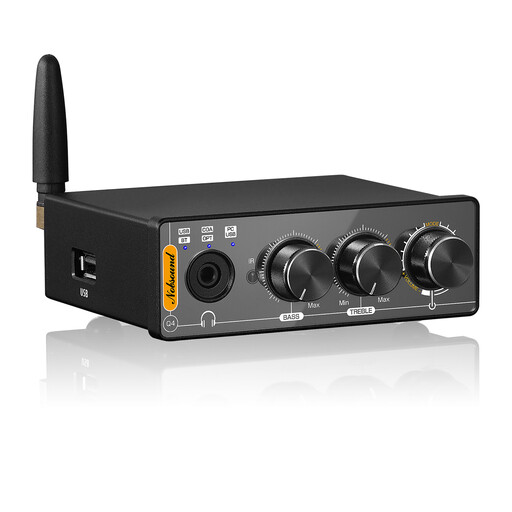
Nobsound Q4 USB audio gaming DAC with Bluetooth and headphone amplifier
A DAC with a built-in headphone amplifier is a good choice for a digital desk setup. Check that the inputs you need match your source and that the external DC power supply suits your setup.
The product description lists an optical input, Bluetooth, 24 Bit/192 kHz, treble and bass controls, and a remote control.
Joybuy
Frequently asked questions
Does a headphone amplifier automatically make lossless files sound better?
No. The file format alone doesn’t prove that adding another amplifier will make a difference. First, check that your existing output provides enough volume with your headphones and delivers playback without unwanted noise. Sensitivity and impedance are relevant headphone specifications to consider.
How do I connect a USB DAC and a standalone analogue amplifier?
A USB DAC such as the iFi ZEN DAC 3 takes the digital signal via USB-C. The Lake People G103-S MKII, by contrast, has an analogue RCA input. For computer audio, you’ll need an analogue output signal first, which may come from a separate DAC.
What should I bear in mind when changing the amplification and during longer listening sessions?
Turn the volume down before changing the amplification. The iFi manual warns that listening at excessive volumes can damage your hearing and equipment. The World Health Organization also points out that both volume and the duration of sound exposure matter.
What are my rights when buying a headphone amplifier online in Germany?
For a typical online purchase from a business seller in Germany, you generally have 14 days from receiving the goods to cancel the purchase, subject to statutory exceptions. The European Union’s Your Europe website also states that goods purchased in the EU come with a minimum two-year legal guarantee. The Verbraucherzentrale notes that statutory consumer rights and a voluntary guarantee are not the same thing.


