For digital Hi-Res files from a computer, a device with a USB DAC and headphone amplifier is a sensible starting point if you don't already have a suitable DAC. If you already use a DAC with an analogue output, you can choose a purely analogue amplifier. In either case, check the headphone connection, power ratings at the appropriate load, power supply and desk space required – not just the highest stated sample rate.
Who these amplifiers are for
PC listeners with Hi-Res files
If you play music files on your computer, a USB DAC with a headphone amplifier can bring conversion, a headphone connection and volume control together on your desk. FiiO and iFi audio document products designed to do just that.
Listeners with demanding headphones
The right output and a power rating suited to your actual headphone load are what matter here; a single, general power figure isn't enough to make a comparison. FiiO lists different power ratings for the K11 depending on the output.
Listeners who already have a DAC
If digital-to-analogue conversion is already taken care of, an additional analogue amplifier can complete your signal chain. iFi audio describes the ZEN CAN 3 as a purely analogue device.
What to look for when choosing
First, identify the main priority for your setup. The connections and checks you need will depend on what matters most to you.
| Priority |
What to check before buying |
Who is this most important to? |
| Digital input |
Check the USB input and the format it supports specifically; also take your playback software settings into account. |
If I play Hi-Res files from my computer, I want to know whether the input I've chosen supports the signal. Around 36% of consumers prioritise digital input. |
| Headphone connection and power |
Compare the output, the cable you need and the power ratings for the appropriate impedance and output type. |
If I'm connecting my existing headphones, I want to find the right combination of socket and amplification. Around 29% of consumers prioritise headphone compatibility. |
| Space and power supply |
Allow for the unit's dimensions and space for the plugs; check the power connection and what's included in the box. |
On a small desk, I also need room for cables and the power supply, with the controls easy to reach. Around 21% of consumers prioritise desk space and setup. |
| Existing DAC |
Check that your existing analogue output matches the amplifier's input. |
If my DAC already handles digital conversion, I want to keep using my existing signal chain. Around 14% of consumers are mainly looking to add analogue amplification. |
Avoid common selection mistakes
-
Assuming the highest sample rate applies to every input
The format limits listed for the FiiO K11 vary by input. A computer or player can also convert the signal before output; Topping explains how this can affect the displayed sample rate.
Check the specifications for the input you'll actually use, along with your audio output settings, before making a maximum specification a deciding factor.
-
Comparing power ratings for different outputs as if they were the same
For the K11, FiiO lists different power ratings at the 4.4 mm and 6.35 mm outputs for the same load. An adaptor won't turn an unbalanced cable into a balanced connection.
Only compare ratings for the connection and load you'll actually use, and check which cable your headphones need.
-
Forgetting about the DAC in the signal chain when choosing an analogue amplifier
The iFi ZEN CAN 3 is a purely analogue amplifier and doesn't convert digital files into an analogue signal itself.
Check the complete path from your computer to your headphones, as well as the analogue output available on your DAC.
-
Measuring only the unit itself
On a small desk, plugs, cables and the power supply all need space too. According to FiiO, the K11 needs a 12 V DC power supply; the optional 5 V DC power supply for the iFi ZEN DAC 3 is not included, according to its manual.
Measure the available space with the plugs connected, and make sure the power connection suits your planned setup.
The optional 5 V DC power supply for the iFi ZEN DAC 3 is sold separately.
Key brands at a glance
FiiO
The FiiO K11 combines a desktop DAC with a headphone amplifier and offers USB, optical and coaxial inputs.
- FiiO lists 6.35 mm and 4.4 mm headphone outputs, plus three gain levels, for the K11.
- Format limits vary by input; the K11 needs a 12 V DC power supply.
iFi audio
The ZEN DAC 3 combines a USB DAC and headphone amplifier; the ZEN CAN 3 is a purely analogue addition for an existing DAC.
- According to the manual, the ZEN DAC 3 has USB-C, 6.35 mm and 4.4 mm headphone outputs, as well as switchable gain.
- The ZEN CAN 3 doesn't handle digital-to-analogue conversion. The optional 5 V DC power supply for the ZEN DAC 3 is not included.
Fosi Audio
The K5 Pro is a compact DAC and headphone amplifier with USB-C, optical and coaxial inputs.
- The product specifications list a 3.5 mm headphone output and RCA outputs.
- Fosi Audio specifies 24 bit/192 kHz for optical and coaxial input; this figure cannot automatically be applied to USB.
Joybuy product selection
The selection below focuses on a compact analogue headphone amplifier for setups where an analogue signal is already available.
 No image available
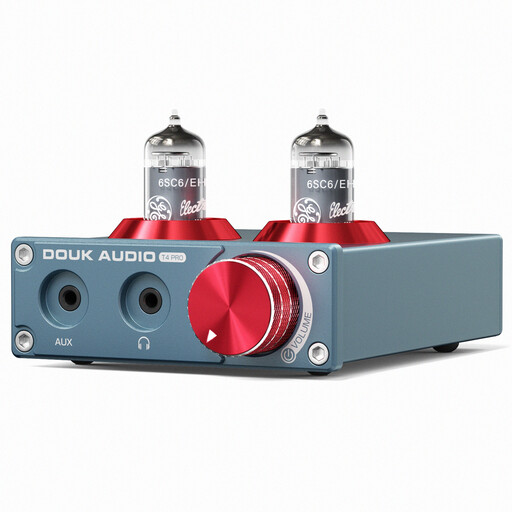
Douk Audio T4 PRO Mini Valve tube headphone amplifier
A good fit if your computer already outputs an analogue 3.5 mm signal and you're looking for a desktop amplifier for your headphones.
Inputs: MM phono and 3.5 mm AUX. Headphone impedance: 32–300 Ω; stated output power: 150 mW at 32 Ω.
Dimensions: 95 × 117 × 30 mm. According to the packing list, a 12 V power supply is included.
For digital files, the signal must be converted to analogue before it reaches the amplifier.
View at Joybuy
Frequently asked questions
Do I need a DAC as well as a headphone amplifier for Hi-Res files?
To connect digital files to a purely analogue amplifier, you'll need digital-to-analogue conversion upstream. A USB DAC with a headphone amplifier, such as the FiiO K11, combines both functions; the iFi ZEN CAN 3, by contrast, is purely analogue.
Why does my device show a different sample rate from the music file?
The rate shown may reflect the signal rate actually reaching the device. Topping notes that a computer or playback software can convert the signal first, so check your audio output settings and, if available, your player's exclusive mode.
What should I bear in mind when connecting it for the first time and listening for longer periods?
Start at a low volume, especially when changing the gain setting. The World Health Organization gives 80 dB for up to 40 hours a week as an example of safe listening; you can't automatically tell whether you're at this level from the position of the volume control.
What rights do I have when shopping online in Germany?
For a typical online purchase from a trader, you generally have 14 days from delivery to withdraw from the contract, subject to statutory exceptions. Separately, EU consumer information states that goods are covered by a statutory guarantee against the seller for at least two years; a voluntary manufacturer's guarantee does not replace this right.
Is the CE marking an independent endorsement of sound or quality?
No. The CE marking is the manufacturer's declaration that the product complies with the relevant EU rules; it isn't an independent assessment of sound quality. The rules that apply to a particular device, and whether its marking is correct, need to be checked for that product.


