For downloaded concert recordings, a USB DAC with a headphone amplifier or a battery-powered device is usually a good place to start if there’s no spare socket where you listen. Depending on the model, a USB DAC draws power from the playback device, while a battery-powered device needs charging. An analogue amplifier such as the Douk Audio U3 requires an existing analogue signal; a desktop DAC such as the FiiO K5 Pro needs a separate power supply.
Who these devices are for
Listeners short on spare sockets
If you play concert files on a computer or mobile device and don’t want to use another mains socket, check whether the specific device runs via USB or on its battery, and what powers it in each case. FiiO describes different power sources for the BTR15 depending on its operating mode.
Owners of wired headphones
If you want to keep using your existing headphones, the right plug and the output you’ll actually use are key. The documented connections differ, for example, between the DS2-2024 from Fosi Audio and the U3 from Douk Audio.
Listeners comparing several recordings
If you’re checking recordings one after another, try to keep the volume and tone controls consistent. Check which gain settings, bass controls or equalisers each model offers; FiiO and Fosi Audio list these adjustment options for some models.
What to look for when buying
USB DAC with headphone amplifier
A good fit if: you play files directly from a computer or compatible mobile device and don’t want to use an extra mains socket.
The trade-off: The source device supplies the power. Connections, operating system support and any adapters you might need depend on the model.
Battery-powered amplifier with DAC
A good fit if: you want to listen without using an extra socket and choose between operating modes depending on your playback device.
The trade-off: The battery needs charging, and battery life can vary considerably between operating modes.
Analogue headphone amplifier
A good fit if: your existing source already outputs a suitable analogue audio signal.
The trade-off: You’ll also need digital-to-analogue conversion for digital files; the Douk Audio U3 accepts a stereo RCA signal.
Desktop DAC with separate power supply
A good fit if: there’s a suitable spare socket where you listen and extra digital inputs or controls matter to you.
The trade-off: A separate power supply won’t solve the problem of limited sockets; according to the manufacturer, the FiiO K5 Pro requires 15 V DC.
| Priority |
What to check before buying |
Who it matters most to |
| Power supply |
Check the operating mode, power source and cables needed for a computer, phone or Bluetooth connection. FiiO describes the BTR15 as drawing power from a computer or its battery, depending on the operating mode. |
If I don’t want to use another socket where I listen, it matters whether the device is powered by the source or its own battery. Around 36% of consumers consider avoiding an extra mains socket their top priority. |
| Headphone connection |
Check that the plug matches the output you’ll use, such as 3.5, 4.4 or 6.35 mm, and whether you need an adapter. |
If you want to keep using your wired headphones, you need a compatible connection, not just a high power rating. Around 29% of consumers give this compatibility the most weight. |
| Consistent playback for comparisons |
Check whether you can adjust the gain, equaliser or tone controls, and keep the settings consistent when comparing recordings. |
When checking several recordings one after another, I don’t want to mistake changes in settings for differences in the recordings. Around 21% of consumers put reliable comparisons first. |
| Source connection and controls |
Check that your available USB or analogue output matches the device input. Also check operating system support and whether the controls are easy to reach. |
If you want to play concert files easily from your existing source, make sure it has the right input and that the controls are within easy reach. Around 14% of consumers prioritise source connections and controls. |
Common buying mistakes
-
Assuming a USB data connection also supplies power
A USB cable connecting a device to a computer doesn’t automatically power the device as well. The Fosi Audio Q4 manual lists a separate 5 V power connection alongside the PC USB cable; the FiiO K5 Pro uses an external 15 V power supply.
Check the data connection, power input and what’s included separately for each model.
-
Trying to connect digital files directly to an analogue-only amplifier
According to the manufacturer, the Douk Audio U3 has a stereo RCA input. It can’t take the digital audio data from a file directly.
Before buying, trace the signal path from your playback device to your headphones and check whether you already have an analogue output or need a DAC as well.
-
Assuming battery life is the same in every operating mode
FiiO quotes around eight hours for the BTR15 under certain Bluetooth test conditions and around three hours in PHONE mode. These figures apply to the respective operating modes.
Only compare battery life figures for the connection you actually plan to use.
Make sure you have a suitable way to charge the battery if you use it while listening.
Brands and model ranges to consider
FiiO
The range includes the battery-powered BTR15, the Micro-USB-powered E10K and the desktop K5 Pro, which has an external 15 V power supply.
- The power supply is specified for each of these models; the stated battery life for the BTR15 depends on its operating mode.
- The K5 Pro needs a separate power supply, so it’s not an obvious choice for a listening space with limited sockets.
Fosi Audio
The DS2-2024 is a USB-C DAC with 3.5 and 4.4 mm outputs; the DAC-Q4 is designed for a permanent setup with several digital inputs.
- The documented inputs and outputs make it easier to check that your source and headphone connections are compatible.
- For the Q4, the manual lists a separate 5 V power connection alongside the PC USB cable.
Creative
Creative describes the Sound Blaster PLAY! 4 as a compact, USB bus-powered DAC for compatible computers and mobile devices.
- Creative documents a USB-C interface and a four-pole CTIA headphone socket.
- Check the published system requirements against your specific source before buying; USB-C alone doesn’t guarantee compatibility.
Douk Audio
The U3 is an analogue option for a source with a stereo RCA output.
- According to the manufacturer, a USB-to-DC cable and headphone adapter are included.
- A power supply isn’t included; the RCA input isn’t a substitute for a DAC with sources that only output digital files.
iFi audio
The GO link Max is a compact USB DAC with 3.5 and 4.4 mm headphone outputs.
- The two documented outputs give you connection options for headphones with a matching plug.
- Before buying, check which output matches your headphones and which connection your playback device supports.
Joybuy products
This selection includes a desktop DAC with a separate power supply for digital sources and adjustable tone settings.
 No image available
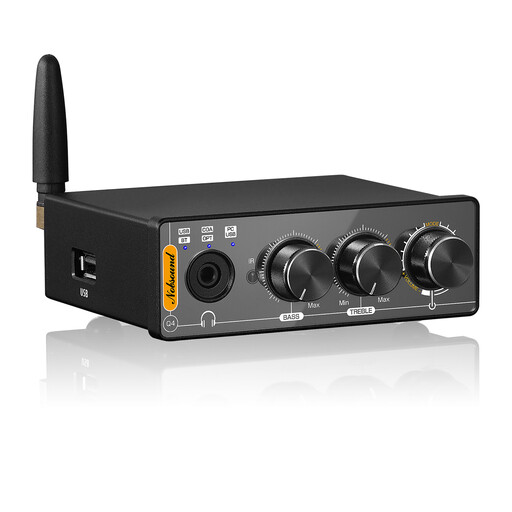
Nobsound Q4 USB audio DAC with Bluetooth and headphone amplifier
A good fit if you want to play digital concert files through compatible inputs and can provide a separate power supply where you listen.
USB, optical and coaxial inputs, as well as bass and treble controls, are specified for this model. The product title lists 24-bit and 192 kHz; the description says it uses an external DC power adapter.
View at Joybuy
Frequently asked questions
Will a headphone amplifier play my downloaded files by itself?
No. You select and play the file on a connected playback device. A DAC such as the FiiO BTR15 can convert the USB audio signal in the appropriate mode; the analogue Douk Audio U3, on the other hand, requires an analogue RCA signal.
What should I bear in mind when connecting it and listening for longer periods?
Turn the volume down before connecting and keep the gain or tone controls as consistent as possible when comparing recordings. The German Environment Agency points out that both high sound levels and prolonged exposure to sound can damage your hearing.
What applies in Germany if a product is faulty or you order online?
The statutory legal guarantee for faulty goods is distinct from a voluntary warranty and is generally the seller’s responsibility. Online purchases usually come with a 14-day right to cancel; the consumer advice centre recommends checking the terms of your specific purchase.
Where should I take an old amplifier in Germany?
Electrical equipment must not go in household waste. The German Environment Agency lists local collection points and suitable take-back options at retailers; retailers have statutory take-back obligations depending on the circumstances.


