
Lieferung heute & morgen

Qualitätsgarantie

Willkommens-Angebote freischalten: KOSTENLOSE Lieferung | Bis zu 80 % RABATT | Kostenlose 30-Tage-JoyPlus-Testphase
App herunterladen
The search for a new tumble dryer leads many to a key question: How can you lower energy costs without compromising on drying performance? A heat pump dryer is a frequently considered solution for this. These appliances use modern technology to dry laundry gently and with significantly lower electricity consumption.
This article serves as a guide for anyone looking to buy a tumble dryer. We'll highlight the crucial criteria to consider when choosing a suitable model for your household and present a selection of appliances with different features.
By: Joybuy Product Recommendation Officer
The decision for a specific model depends on individual needs. Three main factors help to narrow down the selection: energy efficiency, capacity, and convenience features.
A heat pump dryer is energy-efficient by design. Unlike conventional condenser dryers, which expel hot, moist air, a heat pump appliance operates in a closed-loop system. It removes moisture from the air and reuses the recovered heat for the drying process.
The result is significantly lower energy consumption. Pay attention to the EU energy label, which indicates consumption in kilowatt-hours (kWh) per 100 cycles. Models with energy efficiency class A (according to the new A to G scale) or the older heat pump dryer A+++ label are among the most economical appliances on the market and can noticeably reduce your electricity bill in the long run.
The capacity, specified in kilograms (kg), should match the size of your household.
The noise level, measured in decibels (dB), is another important factor, especially if the dryer will be placed near living or working areas. A quiet heat pump dryer has a value of around 62 dB or less. Models below 60 dB are considered exceptionally quiet.
Modern heat pump dryers offer features that make daily life easier.
Here is a selection of models that cover different requirements in terms of capacity, features, and budget.
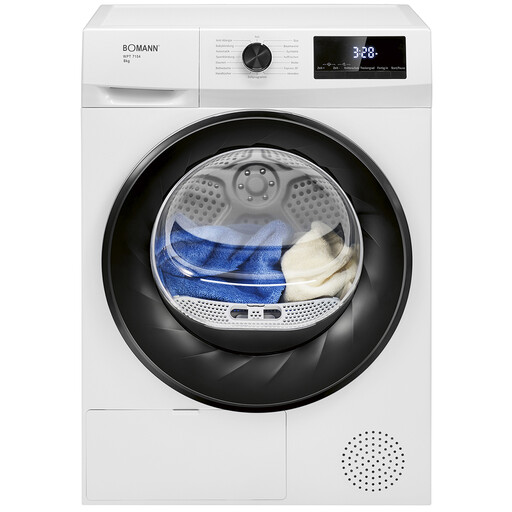
Why This Model Stands Out
The Bomann WPT 7154 is a practical all-rounder for families. It doesn't require a permanent water connection, as the condensed water is collected in a container. This makes installation very flexible. With 15 programmes, including special cycles for baby clothes and bedding, it covers a wide range of fabric types.
Advantages
Who is this appliance for? This model is a good choice for households looking for a functional and flexible appliance with enough capacity for daily family life, who also value a straightforward installation.
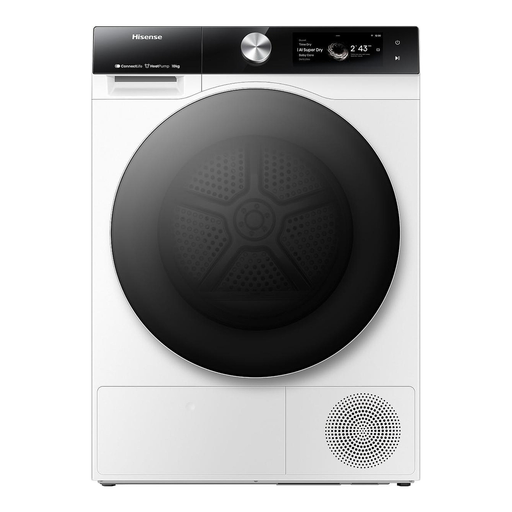
Why This Model Stands Out
The Hisense DH7S107BW combines a very large capacity with smart technology. With a 10 kg capacity and a 125-litre drum, it effortlessly handles large laundry items like duvets. Control via the ConnectLife app allows you to monitor and adjust drying programmes from anywhere.
Advantages
Who is this appliance for? Ideal for large families or households with high laundry volumes who want the convenience of smart control and an extra-large load capacity.
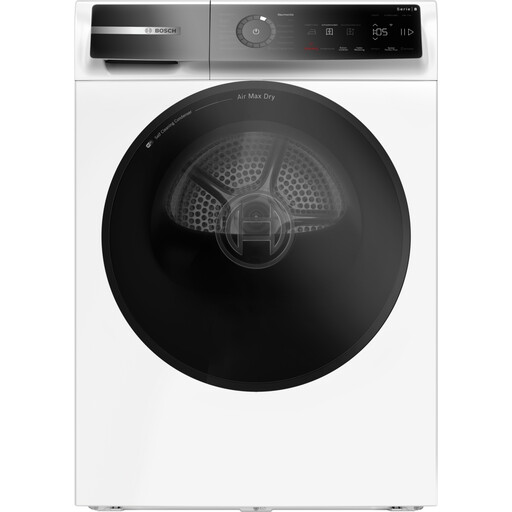
Why This Model Stands Out
The Bosch WRB247C40 from the Serie 8 is designed for maximum efficiency and convenience. With an energy consumption of just 79 kWh per 100 cycles (energy efficiency class A), it is extremely economical. The self-cleaning condenser ensures consistently high performance without manual maintenance. At 57 dB, it is also an exceptionally quiet appliance.
Advantages
Who is this appliance for? This model is aimed at demanding households that place the highest value on energy efficiency, whisper-quiet operation, and low-maintenance convenience.
Haven't found the right model for your needs yet? There is a wide variety of other appliances with different features and in various price ranges.
Discover more models in our Best-Rated Heat Pump Dryer category.
1. What is the difference between a condenser dryer and a heat pump dryer? A classic condenser dryer generates heat with a heating element, similar to a hairdryer. This is energy-intensive. A condenser dryer with a heat pump, as a heat pump dryer is also known, uses a more efficient technology that reuses heat in a closed-loop system. As a result, it consumes up to 50% less electricity and dries laundry at lower temperatures, which is gentler on the fibres.
2. How much electricity does a heat pump dryer use? The electricity consumption varies depending on the model and energy efficiency class. Modern and highly efficient appliances like the featured Bosch dryer consume around 79 kWh per 100 drying cycles. Other good models are often in the range of 110 to 180 kWh per 100 cycles. In comparison, an old condenser dryer can use over 500 kWh for the same number of cycles.
3. Does a heat pump dryer need to be connected to a water drain? No, not necessarily. All heat pump dryers have a condensed water container that needs to be emptied manually after a few drying cycles. However, most models also offer the option of connecting an included hose directly to a wastewater drain. This automatically drains the water and saves you from having to empty the container.