
Lieferung heute & morgen

Qualitätsgarantie

Willkommens-Angebote freischalten: KOSTENLOSE Lieferung | Bis zu 80 % RABATT | Kostenlose 30-Tage-JoyPlus-Testphase
App herunterladen
The search for a new tumble dryer can be a challenge. With rising energy costs and a growing desire to preserve clothing for as long as possible, the heat pump dryer is increasingly in the spotlight. These appliances promise lower electricity consumption and gentler care for your fabrics. But which model is right for your needs?
This guide is designed to help you navigate your options. It presents objective criteria for your selection and showcases a range of models with different specialities to make your decision easier.
Before you decide on a model, several fundamental characteristics should be considered. These parameters help you better assess the functionality and running costs of an appliance.
An energy-efficient dryer is not only good for the environment but also for your wallet. Heat pump dryers use advanced technology that recycles process heat in a closed-loop system. Compared to conventional condenser dryers, they dry at lower temperatures, which significantly reduces energy consumption. Pay attention to the EU energy label, which ranges from A (very efficient) to G (inefficient). Appliances in the top classes lead to noticeable long-term savings on electricity bills.
The capacity, specified in kilograms (kg), should match the size of your household. For families or multi-person households, a 9 kg heat pump dryer is often a suitable choice, as it can easily handle drying bedding or larger loads of laundry.
Another important aspect is the noise level. A quiet tumble dryer is particularly advantageous if the appliance is located inside your home or near living areas. The noise emission is indicated in decibels (dB). Models with values around 65 dB or lower are considered comparatively quiet during operation.
Modern dryers offer a range of features that make everyday life easier. For example, a dryer with a steam function can refresh clothes, remove odours, and reduce wrinkles, saving you the hassle of ironing. A smart dryer with app control allows you to start the appliance remotely, check its status, or download special programmes. Such features offer additional convenience and flexibility.
Here you will find a curated selection of models that cater to different needs. The descriptions are based on the product data provided by the manufacturer.
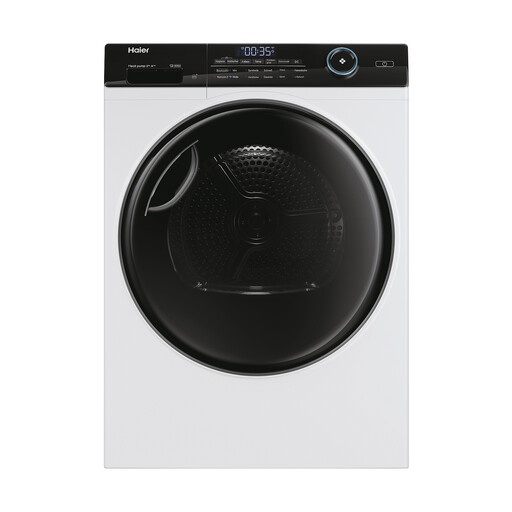
What sets this appliance apart: The Haier dryer from the I-Pro 5 Series combines a large capacity with intelligent care functions. The I-Refresh steam function uses micro-steam to remove odours and smooth out wrinkles without requiring a full wash cycle. Control via the hOn app also offers a high degree of flexibility in daily life.
Pros:
Who is this appliance for? This model is an excellent choice for tech-savvy households and families who need a large load capacity and value advanced fabric care features like steam treatment.
View Product: Haier I-Pro 5 Series HD90-A3959
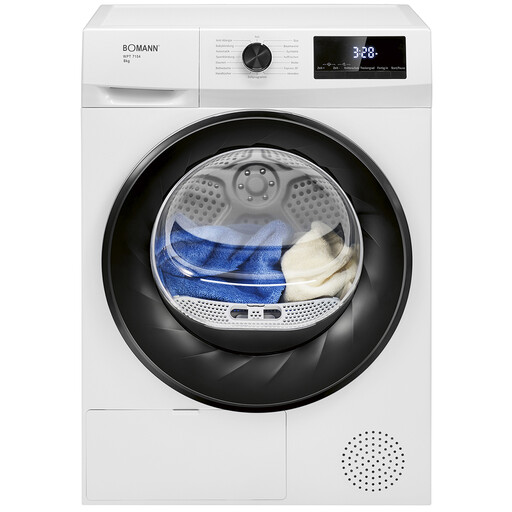
What sets this appliance apart: The Bomann WPT 7154 is distinguished by its highly flexible installation. Since no fixed water connection is required, it can be operated anywhere with a standard power outlet. With 15 programmes and an anti-crease function, it offers a solid set of features for daily use.
Pros:
Who is this appliance for? Ideal for households looking for a straightforward and flexibly installable dryer. Those who can do without smart app functions and appreciate particularly quiet operation will find this a practical appliance.
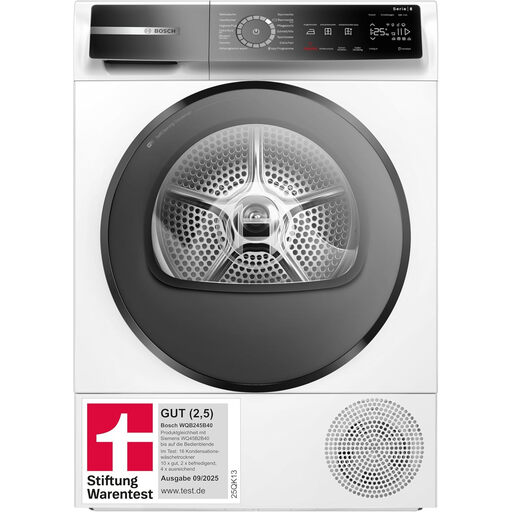
What sets this appliance apart: This Bosch heat pump dryer from Serie 8 is designed for maximum efficiency and convenience. With an A+++ energy efficiency class and AutoDry technology, it dries laundry with sensor-controlled precision. The Home Connect app allows for seamless integration into a smart home and an exceptionally quiet operating noise level of just 61 dB.
Pros:
Who is this appliance for? This model is aimed at quality-conscious users who value top-tier energy efficiency, minimal operating noise, and the benefits of a smart, connected home appliance network.
View Product: BOSCH Serie 8 WQB245B40
The appliances presented here are just a sample of the available options. Every household has different requirements for capacity, features, and budget. If you want to compare more models or filter by specific characteristics, you are sure to find the right appliance in our broader selection.
Discover more heat pump dryers here.
Technically, a condenser dryer with a heat pump is simply a heat pump dryer. The main difference lies in how heat is generated. Traditional condenser dryers use a heating element to heat the air, which is very energy-intensive. A heat pump dryer, on the other hand, works like a refrigerator in reverse: it uses a heat pump to warm and dehumidify the air in a closed circuit. This process occurs at much lower temperatures, which can reduce electricity consumption by up to 50% or more and is gentler on your laundry.
Electricity consumption depends heavily on the energy efficiency class and frequency of use. A modern A+++ class appliance often consumes less than 2 kWh per drying cycle. The EU energy label specifies the average energy consumption for 100 cycles, which provides a good basis for comparison. Models in classes A++ and A+++ are often more expensive to purchase but pay for themselves over the years through lower operating costs.
No, not necessarily. All heat pump dryers collect the water extracted from the laundry (condensate) in a container that must be emptied manually after every one or two drying cycles. However, most models also offer the option to connect the appliance directly to a wastewater drain using an included hose. This saves you the task of emptying the container and offers added convenience.