Families who need school clothes dried at short notice
If individual suitable items need to be ready to wear again quickly on rainy days, the actual programme duration and the load it can handle matter more than the word ‘quick’.


If school clothes regularly need to be dry by the next day when it rains, a heat pump tumble dryer could be the right solution — provided you plan the space or stacking arrangement safely. First check the measurements and installation requirements, then look at the load capacity and which fabrics are suitable for a quick programme. If you regularly dry larger loads, also compare drum capacity and energy use per 100 Eco cycles.
If individual suitable items need to be ready to wear again quickly on rainy days, the actual programme duration and the load it can handle matter more than the word ‘quick’.
If you’re considering stacking a washer and dryer, check the available space, room for the door to open, and compatibility between the washing machine, tumble dryer and stacking kit.
When drying different fabrics together, check every care label first and choose a suitable programme.
| What matters | What to look for | Who it matters most to |
|---|---|---|
| School clothes dry in time | Check the quick programme’s permitted load and the fabrics it can handle. A stated quick cycle time does not automatically apply to a full load. | If individual school items need to be dry by the time they’re next needed, check that the specific quick programme is suitable; around 29% of consumers prioritise getting clothes dry in time. |
| Fitting the appliance into a small space | Measure the height, width and depth, as well as the space needed to open the door. For a stacked setup, check that the specific appliances and stacking kit are compatible. | If you have limited floor space, you’ll want to know before buying whether a freestanding appliance or a secure stacked setup will fit; around 23% of consumers prioritise installation. |
| Energy use with frequent drying | Compare energy use in kWh per 100 Eco drying cycles on the current EU energy label, and take your actual load sizes into account. | For regular loads, Eco energy use helps you estimate running costs; around 18% of consumers prioritise ongoing electricity costs. |
| Different types of clothing | Check the care symbols on every item. A suitable programme does not override a label that says not to tumble dry. | If you want to plan for school clothes, sports kit and delicate items together, you’ll need to follow the care instructions for each item; around 18% of consumers prioritise fabric care. |
| Moisture and noise | Check the condensation efficiency and noise level for the Eco programme on the label, as well as the intended location for the appliance. | If the appliance will be near living or sleeping areas, noise and moisture levels in the room may affect your choice; around 12% of consumers prioritise these factors. |
A stated 40-minute programme does not mean a full 8- or 9-kg load will dry in the same amount of time.
Check the manual for the quick programme’s permitted load, suitable fabrics and intended drying result.
For safe stacking, the specific appliances and the accessories you use must be compatible.
Matching measurements alone don’t prove compatibility. Before buying, check the model numbers and the approved stacking kit.
Remember to include a suitable stacking kit and, if needed, professional installation in your plans.
Since 1 July 2025, tumble dryers have used the EU A to G scale. Ratings from different scales are not directly comparable.
Check the current energy label or the matching EPREL entry for the full model, and compare energy use per 100 Eco cycles.
The care label may specifically say that the item must not be tumble dried.
Air-dry items that aren’t suitable for the dryer, and sort the rest of your laundry according to its care instructions.
The Serie 8 WQB245B40 is a 9-kg model worth considering if you have larger loads but limited space.
The iQ700 WQ35B2B30 is an 8-kg option to consider when comparing quick programmes and installation dimensions.
The TR9T75680 is an 8-kg example to consider if you’re comparing programmes for mixed loads.
The B3TSW48C9ZW adds an 8-kg sensor-controlled heat pump tumble dryer to the comparison.
The T1 TWC640WP 8kg is another 8-kg option to consider when comparing features across models.
Here you’ll find heat pump tumble dryers for school and family laundry, from smaller to larger loads. Compare the stated capacity. If you need to dry individual items in a hurry, check which load size and fabrics are suitable for a quick programme.
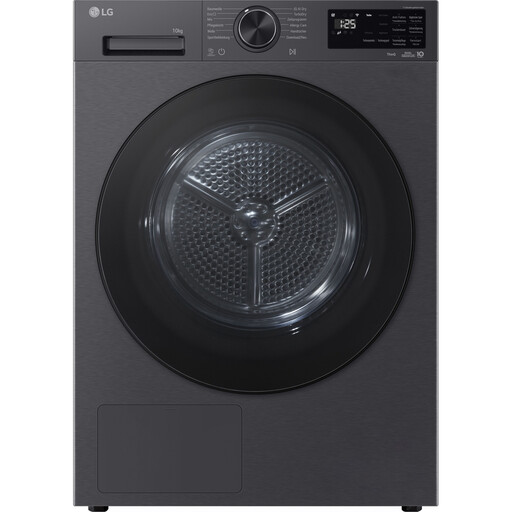 No image available
The stated capacity makes this model worth considering for larger school and family loads.
Features listed in the product name: energy efficiency class C, Dual-Inverter heat pump, AI Dry, TurboDry, self-cleaning condenser and Wi-Fi.
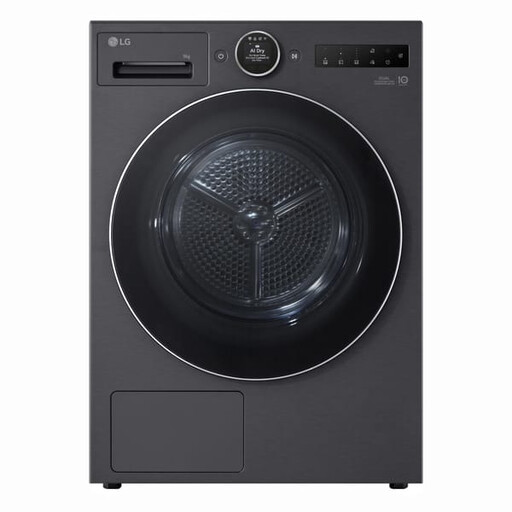 No image available
This model could suit individual items you need in a hurry, provided the Quick-30 programme is suitable for the fabric and load.
Features listed in the product name: energy efficiency class A, AI Dry, Dual-Inverter heat pump, self-cleaning condenser, Sensor Dry and Wi-Fi.
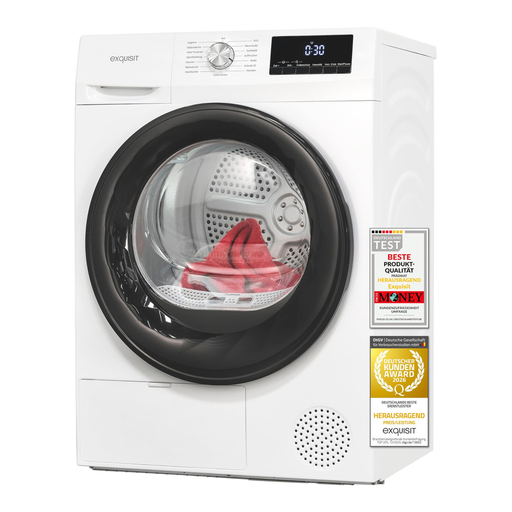 No image available
The stated capacity offers a smaller-load option; if you need to dry items in a hurry, check the conditions for the Quick-30 cycle.
Features listed in the product name: 15 drying programmes, a start delay of 4 to 24 hours, anti-crease function and digital time display.
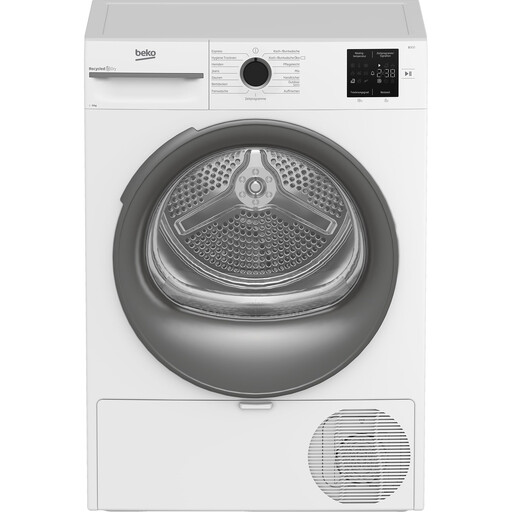 No image available
With its stated 9-kg capacity, this model is worth considering for larger, regular laundry loads.
Features listed in the product name: energy efficiency class E, 15 programmes, AquaWave drum and white finish.
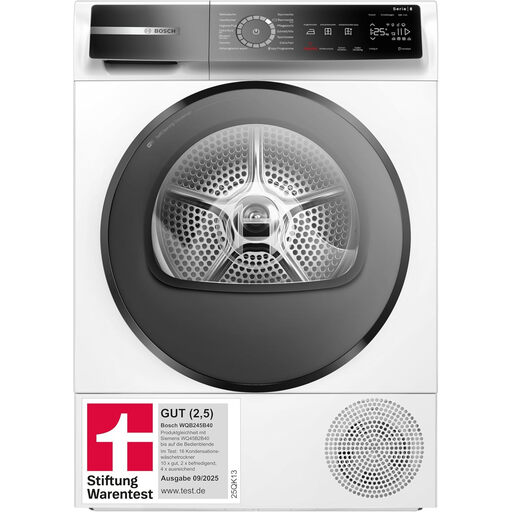 No image available
The 9-kg capacity may suit larger family loads; if you need to dry individual items in a hurry, check the conditions for the Quick-40 programme.
Features listed in the product name: energy efficiency class C, AutoDry, Smart Dry, self-cleaning condenser, Home Connect and white finish.
No. Check the care symbol on every item: GINETEX distinguishes between drying at a normal or low temperature and ‘do not tumble dry’. A delicate-care programme does not override a warning against tumble drying.
Measure the appliances and the space, then check that the washing machine, tumble dryer and stacking kit are compatible with the specific models. For the setup described by Bosch Home Appliances Germany, the tumble dryer goes on top; Bosch recommends getting professional help with installation.
First compare the kWh per 100 Eco drying cycles on the current energy label. Then work out your expected number of drying cycles and use your own price per kWh. The Eco figure is not a guaranteed energy-use figure for a quick programme.
Tumble dryers sold in the EU use the current energy label, with a scale from A to G. Among other details, the label shows energy use, capacity, programme duration, condensation efficiency and noise for the stated comparison programme. Older A+++ ratings are not current ratings on this scale.
Clean the lint filter after every drying cycle. Follow the instructions for your specific model when cleaning the heat exchanger or condenser; the AEG service guide notes that the process can vary between appliances.