Choose a heat pump tumble dryer based first on the space available for the appliance and its door, then on the capacity that suits your usual cotton loads. Also compare the specific model’s condensation efficiency, energy consumption and programme duration. A shallower cabinet alone won’t solve problems with clearance for an open door, room humidity or load size.
Who should consider these options?
Households short on space
When there’s hardly any room for an airer in winter, you’ll need to plan the appliance depth, door clearance and access particularly carefully. Beko lists a depth of 54,5 cm for the BM3T37210W1; Bosch recommends checking the available space and appliance dimensions when stacking.
Households with larger cotton loads
If you regularly dry towels or other large loads of cotton laundry, compare the stated capacity with the space you actually have. The Verbraucherzentrale lists capacity, programme duration and noise level as important buying criteria.
Households with a room that’s sensitive to humidity
In poorly ventilated or humidity-sensitive indoor spaces, the specific model’s condensation efficiency is an important figure to compare. The Verbraucherzentrale points to the energy label as a source of information about relevant tumble dryer features.
What should you look for when buying?
| Consideration |
What to check when buying |
Who it matters most to |
| Space and access |
Compare the appliance depth and, if stated, the depth with the door open against the available space. If stacking, also check that the stacking kit is compatible. |
If I’m short on space, the appliance must fit in the designated area with its door and connections. Around 29% of consumers say available space is their main concern. |
| Capacity for cotton laundry |
Compare the capacity in kilograms and the cotton or Eco programme with your usual laundry loads. |
If I often dry towels, I want a suitable capacity without assuming this means smaller dimensions or lower running costs. Around 23% of consumers put load size first. |
| Room humidity |
Compare the specific model’s condensation efficiency and condensation class; also check how the condensed water is disposed of. |
If the drying room needs to stay low in humidity during winter, I pay particular attention to condensation efficiency. Around 18% of consumers say room humidity is their main concern. |
| Energy consumption |
Compare kWh per 100 Eco drying cycles and capacity using the same current label basis. Your own costs will also depend on your electricity tariff and usage. |
If I dry laundry often, I want to compare the stated consumption clearly, rather than treating old and new energy classes as equivalent. Around 18% of consumers place the greatest importance on running costs. |
| Programme duration and noise |
Check the specific model’s Eco programme duration and dB(A) rating. Only use quick programmes for the stated fabrics and load sizes. |
If I have several loads to dry one after another, or the tumble dryer is near a living area, running time and operating noise are key. Around 12% of consumers say time or noise is their main concern. |
The Verbraucherzentrale lists capacity, programme duration and noise level as buying criteria. The latest details for the specific model can help you weigh up your space, laundry volume and room requirements.
Common buying mistakes
-
Measuring only the appliance with the door shut
For the Siemens WT45HV94, the manufacturer lists a cabinet depth of 61,3 cm and a depth of 109,6 cm with the door open at 90°. So the space needed to load and unload it may be considerably greater than its closed depth.
Before buying, check the door clearance, access and connections against the dimensions of the specific model.
-
Assuming old A+ ratings are equivalent to the current A class
The EU energy label for household tumble dryers changed to an A-to-G scale on 1 July 2025. The European Commission explains this rescaling, so the previous plus classes are not directly comparable.
Compare current models using the A–G label and the figure in kWh per 100 Eco drying cycles.
-
Assuming a quick programme will dry a full load of cotton
Bosch’s 40-minute programme is intended for small loads of synthetic fibres and lightweight fabrics, not full loads of cotton in general.
For cotton, check the programme duration and corresponding load size for the specific appliance.
-
Planning to stack appliances without checking compatibility
For a stacked setup, the washing machine, tumble dryer and stacking kit must all be compatible, and there must be enough space. Bosch says the tumble dryer should go on top, not the washing machine.
Check the specific appliance combination and stacking kit before buying.
Depending on the combination, you may need a suitable stacking kit and, in some cases, professional help with installation.
Key brands at a glance
Beko
The BM3T37210W1 is a 7-kg example to consider if you’re looking for a shallower appliance.
- Beko lists a depth of 54,5 cm and sensor drying for this model.
- The stated energy class is E. You’ll also need to allow space for the door and connections.
Bosch
The WRB247C90 is a 9-kg example with stated noise levels and condenser maintenance details.
- Bosch lists 57 dB(A) and a self-cleaning condenser for this model.
- The appliance depth is 62,7 cm. These specifications apply to this model only, not to all Bosch tumble dryers.
Siemens
The WT45HV94 is an 8-kg example with details on door clearance and condensed water drainage.
- Siemens lists a drainage hose and a depth of 109,6 cm with the door open.
- A self-cleaning condenser is not listed for this model; its cabinet depth is 61,3 cm.
AEG
The TR7T65680 is an 8-kg example to consider when checking programme features and condensation efficiency.
- AEG lists MixDry and a condensation efficiency of 86% for this model.
- Manufacturer claims about gentler or quicker drying are not independent performance tests.
Miele
The TWC640WP is another 8-kg example, featuring DirectSensor and Miele@home.
- Miele lists these features for this specific model.
- Check the full appliance dimensions and details on condensation and programme duration for your chosen location.
Heat pump tumble dryers at Joybuy
The Joybuy models below are heat pump tumble dryers suitable for cotton laundry, with a range of capacities and stated appliance dimensions.
 No image available
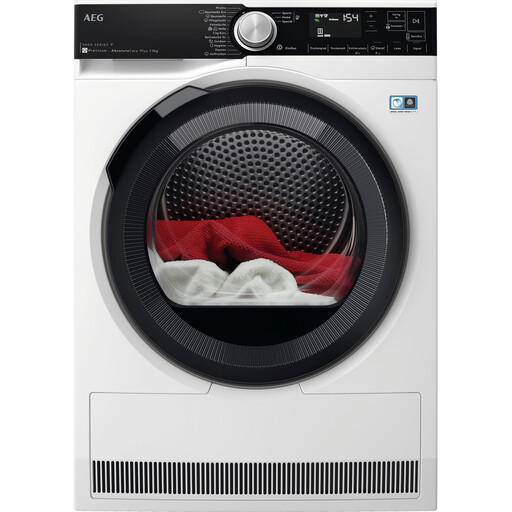
AEG TR9DW80690 Series 9000, 9 kg
A cotton programme is listed for larger cotton loads.
Capacity: 9 kg. Condensation efficiency: 91%. Consumption: 106 kWh per 100 cycles. Appliance depth: 660 mm. Energy class C.
View at Joybuy
 No image available
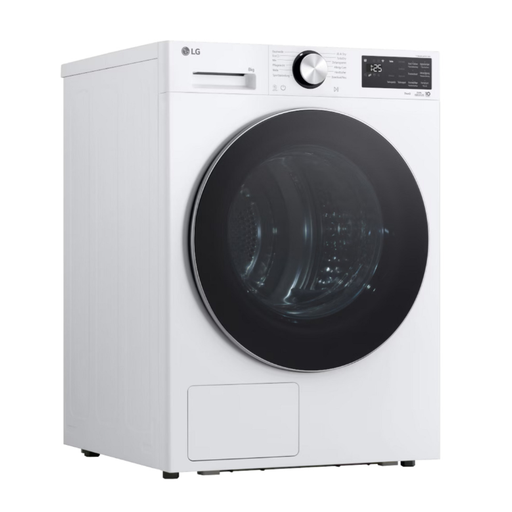
LG RT80X72W, 8 kg
A cotton programme and an 8 kg capacity are listed for cotton laundry.
Condensation efficiency: 91%. Consumption: 85 kWh per 100 cycles. Appliance depth: 660 mm; 1.140 mm with the door open at 90°. Energy class B.
View at Joybuy
 No image available
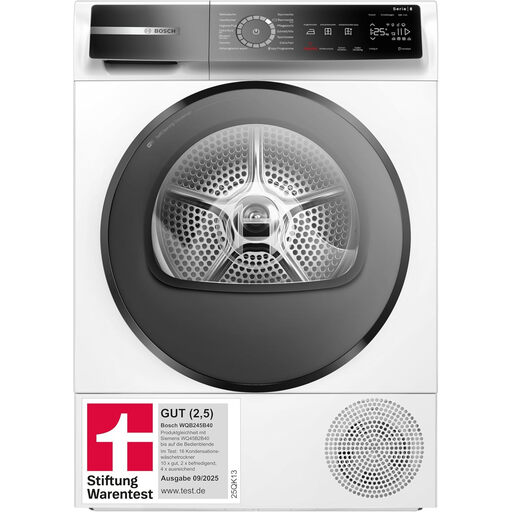
Bosch WQB245B40 Serie 8, 9 kg
A cotton programme and 9 kg capacity are listed for larger cotton loads.
Condensation efficiency: 88%. Consumption: 110 kWh per 100 cycles. Appliance depth: 613 mm; 1.105 mm with the door open at 90°. Eco programme at full load: 3 hours and 15 minutes. Energy class C.
View at Joybuy
 No image available
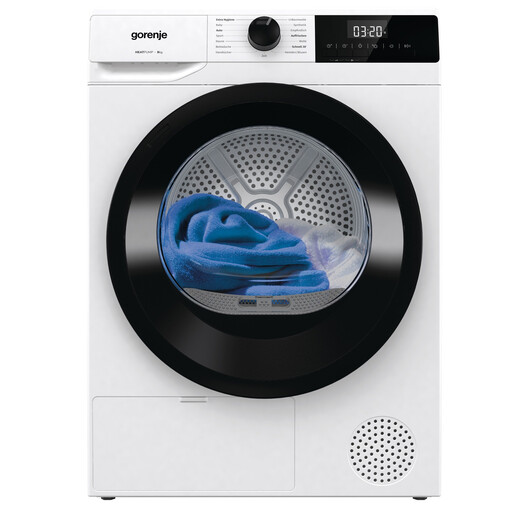
Gorenje DHNE82, 8 kg
The stated 8 kg capacity makes this an option for regular cotton laundry.
Appliance depth: 550 mm. Condensation efficiency: 85%. 15 drying programmes and a 135° door opening are listed.
View at Joybuy
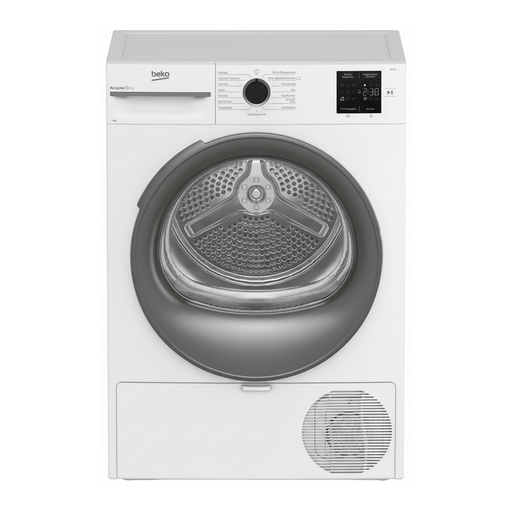 No image available
Beko BM3T38210W1, 8 kg
A cotton programme and an 8 kg capacity are listed for cotton laundry.
Appliance depth: 54,5 cm. 15 programmes and energy class E are listed.
View at Joybuy
Frequently asked questions
What information helps when comparing energy consumption?
The current EU label shows consumption in kWh per 100 drying cycles on the Eco programme, as well as capacity and programme duration. To estimate your own costs, you’ll also need your electricity price and the expected number of cycles.
Can you put a tumble dryer on top of a washing machine?
Yes, provided the specific appliances are suitable for stacking and you use a compatible stacking kit; the tumble dryer goes on top. Check the available space and accessory compatibility for both models. Bosch recommends getting professional help with stacking.
What should I bear in mind when maintaining the appliance?
The Verbraucherzentrale recommends regularly cleaning the lint filter and condenser according to the appliance instructions, and avoiding dust build-up, as lint and dust can pose a fire risk. Whether the condenser is self-cleaning, and what maintenance is still required, depends on the model.
How can I compare old and new energy classes?
Since 1 July 2025, household tumble dryers have used the rescaled EU energy label from A to G instead of the previous plus classes. Compare specific appliances using the current label and consumption figure, rather than assuming, for example, that A+ is equivalent to A.


