
Lieferung heute & morgen

Qualitätsgarantie

Willkommens-Angebote freischalten: KOSTENLOSE Lieferung | Bis zu 80 % RABATT | Kostenlose 30-Tage-JoyPlus-Testphase
App herunterladen
A heat pump tumble dryer dries your laundry at a lower temperature and doesn't need a vent hose. That makes it an appealing option for flats, utility rooms and households that use a dryer regularly. However, eye-catching marketing claims don't automatically lead to the right appliance.
Three typical buying mistakes are particularly worth noting:
An 8 kg heat pump tumble dryer is often suitable for couples and medium-sized families. If you have lots of towels, bedding or several washes a week, a 9 kg heat pump tumble dryer gives you more flexibility. However, the capacity should match your washing machine: a noticeably larger dryer drum can be useful if you regularly dry bulky items.
Also check:
With an appliance that is 59.8 cm wide and more than 60 cm deep, even a slightly tight installation space can become problematic.
The current energy label for household appliances uses a scale from A to G. A tumble dryer with energy efficiency class B can therefore be a sensible choice in terms of consumption, but buyers should still compare the specific value per 100 cycles.
The AEG TR8T75789 is listed with 85 kWh per 100 cycles and 0.85 kWh per cycle. The Bosch WQB246D41 is stated as having 265 minutes at full load and 160 minutes at partial load. A longer cycle time is not unusual with heat pump technology, because it operates at lower temperatures. What matters is whether the appliance dries the laundry evenly and switches off automatically.
For open-plan living areas or evening use, it's worth checking the noise level. The Bosch WQB246D41 is rated at 59 dB with noise emission class A. The AEG TR8T75789 is listed at 63 dB with noise emission class B. These figures give you a much clearer picture than vague terms like "Silent" alone.
A dryer with self-cleaning can reduce the maintenance needed on the condenser. Even so, the lint filter and condensate container remain important maintenance points. The lint filter should be cleaned after every drying cycle, unless the instruction manual says otherwise. Sensor programmes such as AutoDry, ProSense or similar moisture sensors can adjust the cycle time to the load.
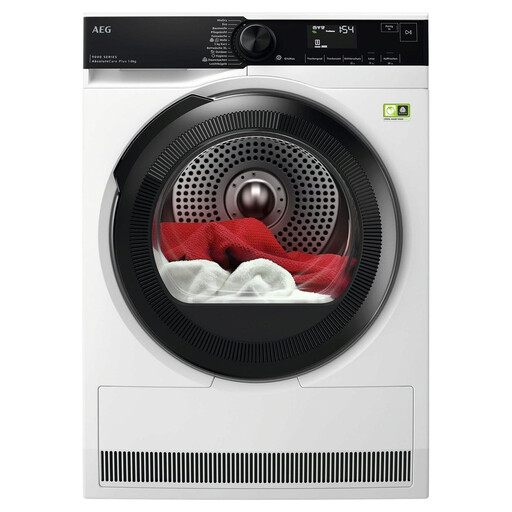
Why this product fits the profile: The 8 kg drum, sensor control and energy efficiency class B appeal to households looking for a straightforward appliance for regular everyday use.
The stated 85 kWh per 100 cycles and ProSense load detection make consumption and programme adjustment transparent.
AbsoluteCare programmes for wool and silk, MixDry for mixed cotton and synthetic loads, and a reversible door hinge.
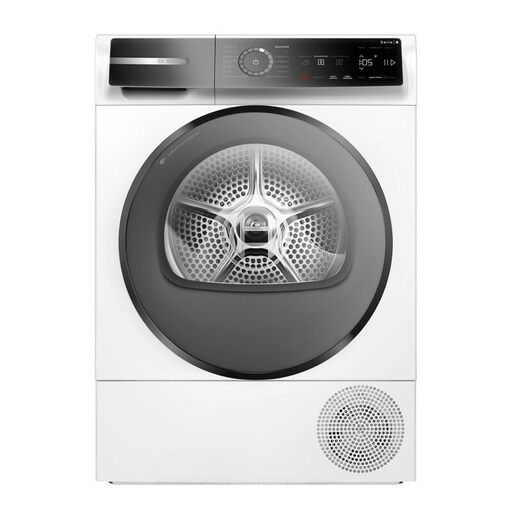
Why this product fits the profile: The 9 kg capacity, the stated noise level of 59 dB and the app connectivity suit large households with frequent drying cycles.
Self-cleaning condenser and AutoDry reduce the need for manual intervention, but do not replace cleaning the lint filter.
Home Connect, SmartDry, 1–24 hour delay start, add laundry function and noise emission class A according to product data.
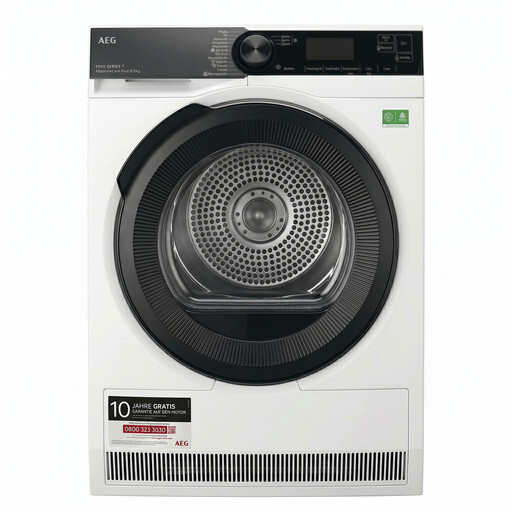
Why this product fits the profile: If you dry different fabrics such as wool, silk, bedding and sportswear, you get a choice of specialist programmes and sensor functions.
The programmes are organised by fabric type; ProSense adjusts the drying time to the load size rather than running for a fixed long period.
Woolmark Blue certification according to product data, MixDry, EcoFlow filter, interior light and energy efficiency class B.
A heat pump tumble dryer should stand on a level, stable surface. Ventilation openings must not be blocked. You'll need to plan for regular emptying of the condensate container; with a suitable drain hose, the water can be directed away directly, depending on the model.
Do not use multi-socket adaptors or unsuitable extension cables. Before cleaning and maintenance, disconnect the appliance from the mains. Items of laundry stained with oil, solvents, petrol or other flammable substances must not be placed in the dryer.
We've put together a complete, regularly updated list of products that fully meet these strict selection criteria and the safety regulations in force in the EU.
The lifespan depends on how often you use it, how well you maintain it, the load size and the availability of repairs. A general figure in years is therefore not reliable. Regularly cleaning the lint filter, loading correctly and following the instruction manual can improve operating conditions.
The cost is calculated from the consumption per cycle and your electricity price. With a stated consumption of 0.85 kWh per cycle, the calculation is: 0.85 × electricity price per kWh. Actual values may vary depending on the programme, residual moisture, load size and the spin speed of your washing machine.
Yes, provided the installation space, power supply and ventilation are suitable. Because no vent hose to the outside is needed, it can generally be positioned more flexibly than a vented dryer. For living areas, you should also consider the noise level, noise emission class and the position of the appliance.