Shared houses with lots of towel loads
If several people dry their towels together, the drum should suit your usual load sizes and allow enough cycles for everyone to use it.


For a shared house, choose a drum capacity that suits the towel loads you actually dry together. A 9 kg model may work well for larger combined loads, but it won’t necessarily be more economical if you often run smaller loads. Compare the specific model’s energy use per 100 Eco cycles, noise level, condensation efficiency and programme duration. The Verbraucherzentrale and the German Environment Agency point out that smaller drums do not automatically use less energy if they need to run more often. Also check whether the care labels on your towels say they can be tumble dried, and what cleaning the model requires.
If several people dry their towels together, the drum should suit your usual load sizes and allow enough cycles for everyone to use it.
If you’ll be using the dryer regularly, compare energy figures on the same EU label basis rather than focusing on drum size alone.
If you’re putting the appliance near rooms where people spend time, factor in its noise level, condensation efficiency and the cleaning routine it requires.
First, compare your typical towel loads with the drum capacity. Then use the label figures and the specific model’s care requirements to find an option that suits your space and the way you’ll share it.
| Buying priority | What to check | Who it matters most to |
|---|---|---|
| Capacity and availability | Your usual load sizes and the drum capacity; if you combine loads, check the space available and door dimensions too. | If we have to wait for the dryer to be free before combining our towels, suitable throughput matters to us. Around 33% of consumers put capacity and availability first. |
| Energy use with frequent use | Compare kWh per 100 Eco cycles on the current EU label with the number of cycles you expect to run. | If several people use the dryer regularly, we want to understand the stated energy use in the context of how we’ll share it. Around 27% of consumers focus primarily on energy use. |
| Noise and moisture where it’s installed | Check the label figures for noise and condensation, as well as the requirements for the specific installation location. | If the appliance is near living areas, we want to take noise and moisture there into account. Around 20% of consumers give particular weight to the impact of the appliance where it’s installed. |
| Cleaning and installation | Check how easy the filter is to access, whether the model’s condenser needs maintenance, and whether it has a water tank or drainage option. | If several people use the appliance, we need a simple agreement about filter care and a suitable place to put it. Around 20% of consumers prioritise maintenance and installation. |
A large drum won’t necessarily be more economical if you often dry smaller loads. The German Environment Agency points out that smaller drums don’t automatically use less energy either if they need to run more often.
Work out the size of your usual towel loads and compare them with the appliance’s rated capacity.
The stated Eco duration is for a standardised programme cycle. It isn’t a fixed drying time for every towel load.
Check the programme information for the specific model and allow extra time if you’ll be sharing it.
If several people want to use the dryer one after another, extra waiting time or additional cycles could affect your shared schedule.
A self-cleaning condenser doesn’t remove the need to care for the fluff filter. AEG recommends cleaning the fluff filter after every drying cycle.
Agree to clean it after every cycle, and follow the model’s instructions for any other maintenance.
Since 1 July 2025, household tumble dryers have used the EU label with an A to G scale. The previous A+++ to D scale isn’t an equivalent basis for comparing current models.
Compare models using their current labels and kWh per 100 Eco cycles, rather than comparing rating letters from different generations of labels directly.
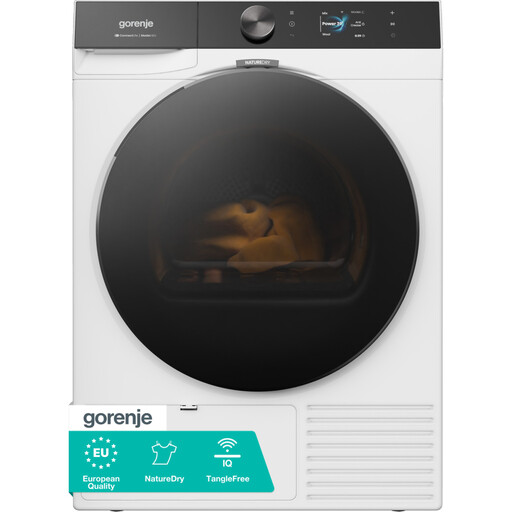
The Gorenje DHNE93/DE is a 9 kg heat pump tumble dryer with a Towels programme, moisture sensor and reversing drum.
The Siemens WQ46B2D41 is a 9 kg option with a self-cleaning condenser.
The AEG TR9W75780 is an 8 kg model with MixDry and ProSense, for drying other suitable fabrics alongside towels.
The Samsung DV90DG52A0TEEG is a 9 kg option with Optimal Dry and a reversible door.
The Exquisit TWP803-031D is an 8 kg option with a removable fluff filter and delayed start.
This selection includes heat pump tumble dryers for separate, smaller towel loads as well as models for larger combined loads run regularly. Before you buy, check that the programmes, capacity and care requirements suit your towels and the space where you’ll put the appliance.
 No image available
The 8 kg rated capacity and sensor drying are worth considering for separate loads.
The product description lists several programmes and sensor drying.
 No image available
The listed Towels programme is designed for towel loads.
The description lists 85 kWh per 100 cycles and a self-cleaning condenser. The fluff filter still needs to be cleaned regularly.
 No image available
The product description lists a Towels programme, delayed start and a time-remaining display.
It also lists 64 dB and energy efficiency rating D.
 No image available
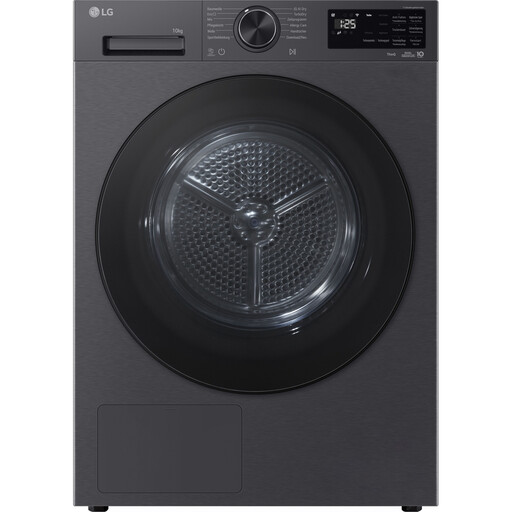
The Towels programme and 10 kg rated capacity are worth considering for larger combined towel loads.
The product description lists energy efficiency rating C, 91% condensation efficiency and 62 dB(A). It also features a moisture sensor and a self-cleaning condenser.
 No image available
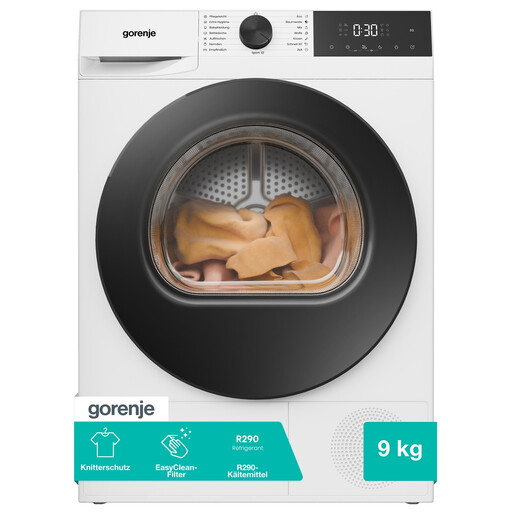
The product description lists a Towels programme and SensorDry.
It lists energy efficiency rating C. The EasyClean filter should be cleaned after every drying cycle.
No. Check the care label on every towel and follow any lower drying temperature it specifies. A Towels programme doesn’t override the care instructions.
The fluff filter should be cleaned after every drying cycle. AEG recommends this; any further maintenance of the heat exchanger depends on the model. Use the manual to agree who will take care of the filter, water tank and, if necessary, heat exchanger.
Compare the kWh per 100 Eco drying cycles on the current EU label, and take into account how many cycles you expect to run. The Towels programme you choose and the load size may differ from the standardised label conditions.
Since 1 July 2025, household tumble dryers have used the EU energy label with ratings from A to G. The previous A+++ to D scale isn’t an equivalent basis for current comparisons. The label includes information such as energy use per 100 Eco cycles, capacity, duration, noise and condensation efficiency.
No. Under EU consumer law, consumers buying from a trader have at least two years’ statutory legal guarantee from the date they receive the goods. This is separate from any voluntary manufacturer’s guarantee. The seller, type of contract and fault will determine the details of a specific claim.