People who often dry small loads
If you often dry a single small load, check whether a programme or setting takes the load size into account. Bosch Home Appliances Germany and AEG Germany describe relevant features on certain models.


If you often dry several small loads of laundry one after another, check whether the specific model can detect smaller loads or has a dedicated setting for them, and whether it offers suitable programmes for your fabrics. Also compare the running times of the programmes you plan to use and the energy label rating. This is based on the Eco programme and does not automatically predict how much your individual small loads will use.
If you often dry a single small load, check whether a programme or setting takes the load size into account. Bosch Home Appliances Germany and AEG Germany describe relevant features on certain models.
If you use your tumble dryer frequently, you’ll want to understand its energy use and avoid treating the Eco label figure as the consumption for every quick or specialist programme. The Verbraucherzentrale explains that the comparison figure is given in kWh per 100 Eco drying cycles.
If you dry delicate and everyday laundry separately, you need programmes suited to each type of fabric and running times that work for you between loads. AEG Germany and Miele list model-specific programmes for this purpose.
First, check how the model handles small loads and your fabrics. Then compare running times, energy label figures, space requirements and maintenance needs.
| Consideration | What to check before buying | Who it matters most to |
|---|---|---|
| Adjusting to small loads | Check whether the exact model offers a half-load setting or automatic load sensing, and which load sizes are permitted for the programme you want to use. | If I often dry only a small amount of laundry, I want to know whether the appliance adjusts its settings accordingly. Around 27% of consumers put small-load adjustment top of their list. |
| Energy use across separate cycles | Compare kWh per 100 Eco cycles on the same label basis, then look separately at the programmes you actually use. | When I run lots of cycles, I don’t want to estimate energy use based on a single standard figure. Around 27% of consumers prioritise the cost of running repeated drying cycles. |
| Time taken to dry several loads | Check the programme duration and load limit; only compare running times when the programme and load size are the same. | If I have several loads to dry one after another, what matters is how long the whole laundry sequence takes. Around 20% of consumers focus on switching quickly between loads. |
| Caring for different fabrics | Check the programmes and their load limits against the care labels on the fabrics you dry most often. | When I have different fabrics to dry, I want to find a suitable programme for each load rather than assume one programme is suitable for everything. Around 13% of consumers put fabric-appropriate care first. |
| Installation and maintenance | Measure the appliance depth with the door open, and check the manual, filter access and recommended route for draining condensation. | If the appliance is used frequently, I want to know in advance whether it will fit in the space and whether the regular maintenance points are easy to access. Around 13% of consumers prioritise installation and maintenance. |
The figure in kWh per 100 drying cycles is based on the Eco programme under specified conditions. It does not automatically show the energy use of a quick programme or a series of small loads.
Compare appliances on the same label basis, and also check the programme information relevant to the loads you typically dry.
Bosch Home Appliances Germany describes “Extra Short 40” on the WQA233C41 as suitable for small amounts of synthetics and lightweight fabrics. This does not guarantee the same running time for other fabrics or load sizes.
Before planning to use it, check that your fabrics and load size are suitable for the quick programme.
If your fabrics aren’t suitable for the quick programme, you’ll need to choose another programme and allow for its running time.
A condenser feature does not mean that all filters and other maintenance points can be ignored.
Read the care and installation guidance for the specific model, and follow the steps it recommends.
Bosch Home Appliances Germany lists features for small loads on the WQA233C41.
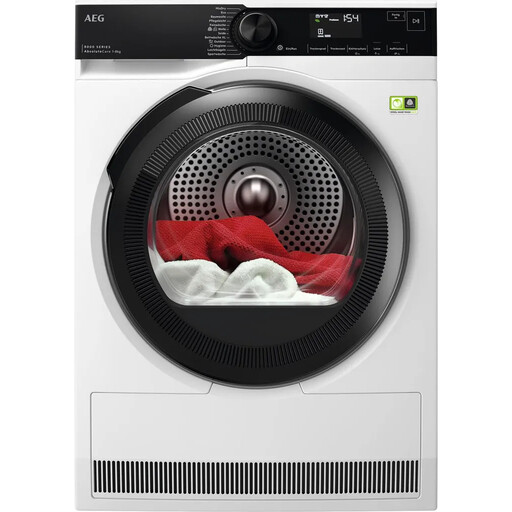
AEG Germany describes automatic load sensing and a programme for suitable mixed loads on the TR7T50680.
The B3T42249S is a heat pump tumble dryer option with OptiSense sensor drying.
Samsung Germany lists the DV90F09F4SU2 with a 9 kg rated capacity and energy class A.
Miele lists the DryCare 40 programme among the features of the TK310H WP.
These heat pump tumble dryers cater to different needs, from automatic load sensing to a wide choice of programmes. For each model, check which programmes are suitable for your fabrics and load sizes.
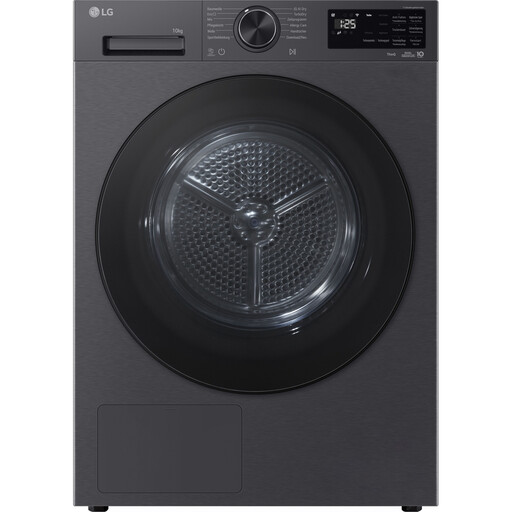 No image available
According to the product description, AI Dry adjusts the drying time and temperature based on the weight, fabric and remaining moisture.
The programme list includes a Mix programme, as well as programmes for wool and towels.
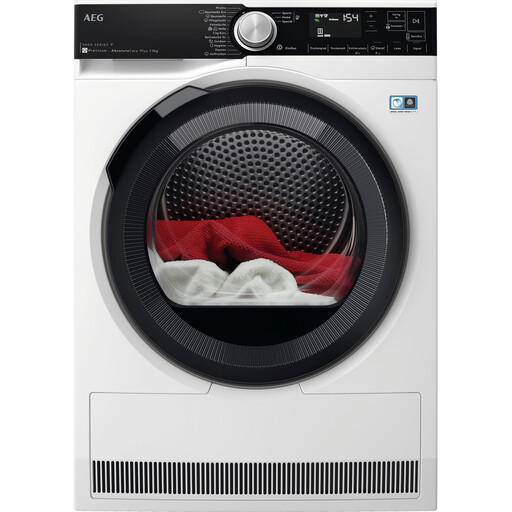 No image available
According to the product description, ProSense adjusts the drying time and energy use to the load size.
MixDry is designed for suitable mixed loads of cotton and synthetics.
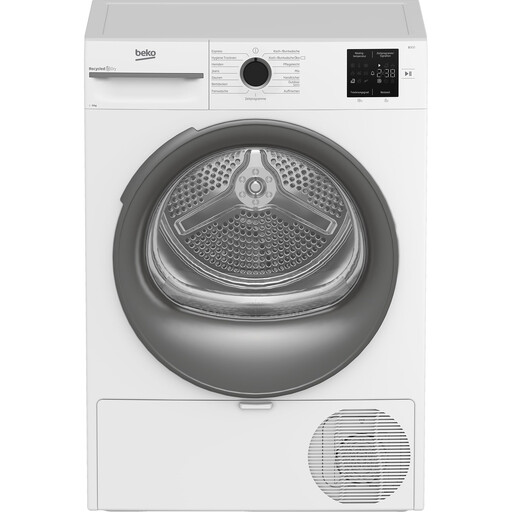 No image available
According to the product description, the programme list includes 15 programmes, including Express and Freshen Up.
With a rated capacity of 9 kg, this model is also suitable for larger individual loads between smaller ones.
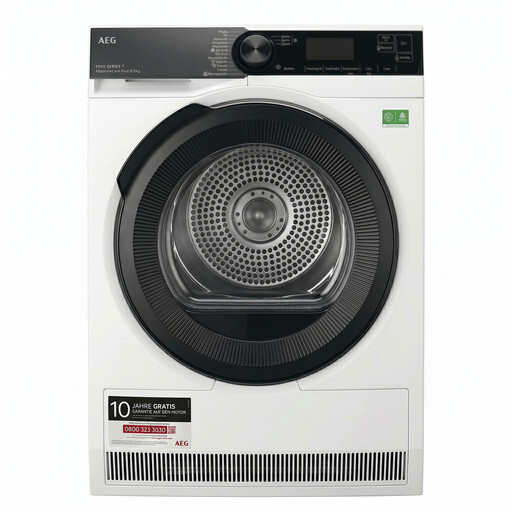 No image available
According to the product description, ProSense adjusts the drying time to the load size.
MixDry is designed for suitable mixed loads of cotton and synthetics. The programme list also includes separate programmes, such as those for wool and synthetics.
 No image available
According to the product description, ProSense adjusts the drying time and energy use to the load.
MixDry is designed for suitable mixed loads of cotton and synthetics. The programme list also includes wool and silk.
The current EU energy label shows energy use in kWh per 100 drying cycles using the Eco programme. Use this as a standardised basis for comparison; it does not show the energy use of a quick programme or your own series of small loads. The Verbraucherzentrale also explains how this label figure is calculated.
Measure the available space, including room for the door to open, and follow the installation instructions for the specific model. For longer running times, AEG Support recommends checking that you’re using suitable programmes, cleaning the filters and heat exchanger, and ensuring sufficient ventilation. Follow the appliance manual for individual maintenance steps.
Since 1 July 2025, household tumble dryers have used rescaled EU energy classes from A to G. The European Commission explains a transitional exception for appliances placed on the market before that date and still held by retailers. Electrical appliances must not go in household waste; the Umweltbundesamt lists recycling centres and suitable retailer take-back options.