Choose a heat pump tumble dryer that fits in your available space, including with the door open, and has a capacity suited to your usual cotton loads. Then compare the energy consumption, condensation efficiency and noise levels of the specific models you’re considering. Since 1 July 2025, the European Commission has required tumble dryers to use an A to G energy label scale. The German Environment Agency also points out that an oversized machine, often only half full, can use more energy per kilogram of laundry.
Who is this guide for?
Households short on space
If you want to dry clothes indoors without an airer in winter, the width isn’t the only measurement that matters. Check the depth and allow room for the door to open, too. To stack a tumble dryer on a washing machine, make sure the dryer, washing machine and stacking kit are specifically designed to work together.
Households concerned about damp
If you usually dry laundry indoors, condensation efficiency and how the condensate is handled are important factors to consider. The German Environment Agency recommends airing your home regularly when there are additional sources of moisture, such as wet laundry.
Households that regularly wash cottons
If you often dry towels, clothes or bedding, the drum capacity should suit your usual loads. The German Environment Agency points out that a tumble dryer that’s too large and often only half full can use more energy per kilogram of laundry.
What should you look for when buying?
First, check that the machine and its open door will fit in the space you have available, and that it can be safely stacked if needed. Then compare the figures that matter for your usual loads and where you plan to put it.
| What matters when buying |
What to check |
Who should pay particular attention? |
| Space and installation |
Check the appliance dimensions, the space needed with the door open and, if relevant, confirmed compatibility for stacking. |
If I’m short on floor space, I want to know whether I can use the machine and open its door where I plan to put it. Around 26% of consumers say available space is their main concern. |
| Indoor humidity in winter |
Check the specific model’s condensation efficiency and whether it has a condensate tank or drain hose. |
If I usually dry laundry in my living space, I want to collect or drain the condensate appropriately and continue to air the room as needed. Around 21% of consumers prioritise humidity in their living space. |
| Energy consumption |
Compare consumption per 100 cycles using the current energy label, and take how often you use the dryer into account. |
If I dry laundry regularly, I want to consider consumption in relation to how often I expect to use the dryer, rather than focusing only on extra features. Around 21% of consumers say running costs are their main concern. |
| Cotton load capacity |
Compare your usual load sizes with the maximum load for the cotton programme you plan to use. |
If I often dry towels or bedding, I want to avoid choosing a drum that’s a poor fit for the amount of laundry I have. Around 16% of consumers focus on finding the right capacity for cotton loads. |
| Noise near living areas |
Check the specific model’s stated noise level alongside its location and the other figures you’re comparing. |
If I plan to put the tumble dryer near a living area, I want to take its stated noise level into account without assuming it will sound exactly the same in my home. Around 16% of consumers say noise is their main concern. |
Avoiding buying pitfalls
-
Measuring only the appliance width
The appliance depth and open door can take up valuable space. If you’re stacking the dryer, the appliances must also be suitable for stacking together.
Measure the full space needed for installation and use. If you plan to stack the appliances, check that the washing machine, tumble dryer and suitable stacking kit are compatible.
-
Comparing old and current energy labels as if they were the same
Since 1 July 2025, tumble dryers have used an A to G scale. This means that letter ratings on older and current labels aren’t directly comparable.
Compare the energy consumption in kWh per 100 cycles using the current system. The European Commission explains the current label scale, while the German Environment Agency recommends considering energy efficiency when buying and using appliances.
-
Assuming a washer-dryer is just as good because it saves space
The German consumer advice centre points out that washer-dryers can use more electricity and water than separate appliances, and can’t dry a full washing load in one go.
If you’re considering a washer-dryer, compare its washing and drying capacities separately. Check that the smaller load it can dry in one go suits the amount of cotton laundry you have.
Brands and models to consider
Siemens
The WT45HV94 is one model to compare if dimensions, door clearance and condensate drainage are important in a tight space.
- Siemens lists an 8 kg capacity, 62 dB(A) noise level and dimensions of 842 × 598 × 613 mm for this model. With the door open at 90°, its depth is 1096 mm.
- According to Siemens, this model doesn’t have a self-cleaning condenser. These figures apply to the WT45HV94, not to other Siemens tumble dryers.
AEG
The TR7T851EX is an 8 kg heat pump tumble dryer with MixDry and ProSense, which AEG describes as features for mixed loads and loads of different sizes.
- AEG lists 82% condensation efficiency, 119 kWh per 100 cycles and 64 dB for this model.
- The feature descriptions come from the manufacturer. The figures given apply to this model and aren’t an independent comparison of drying performance.
Beko
According to Beko, the B3T42249S has an 8 kg capacity and sensor-controlled drying, making these useful points of comparison for regular cotton loads.
- Beko lists a width of 59.8 cm, a depth of 67.2 cm and a noise level of 63 dB for this model.
- You’ll only know whether it fits your space once you’ve considered the full installation setup and door clearance.
Haier
The freestanding I-Pro 1 HD80-E929E-DE is an 8 kg heat pump tumble dryer. Its dimensions can help you compare how much space it needs.
- Haier gives the dimensions as 596 × 650 × 850 mm, in width × depth × height order, and lists energy class E.
- The energy class and dimensions apply to this model. Haier’s claims about energy savings or hygiene programmes aren’t independently verified performance results.
Miele
The TWC640WP is an 8 kg heat pump tumble dryer with a condensate tank and integrated condensate drainage.
- Miele lists both options for handling condensate on this model.
- Whether app control or DryProtect matters to your buying decision depends on which features you’ll actually use.
Heat pump tumble dryers at Joybuy
The Joybuy models below are freestanding heat pump tumble dryers for cotton laundry. Compare their capacities and stated energy consumption, condensation efficiency and noise levels with your usual loads and the space you have available.
 No image available
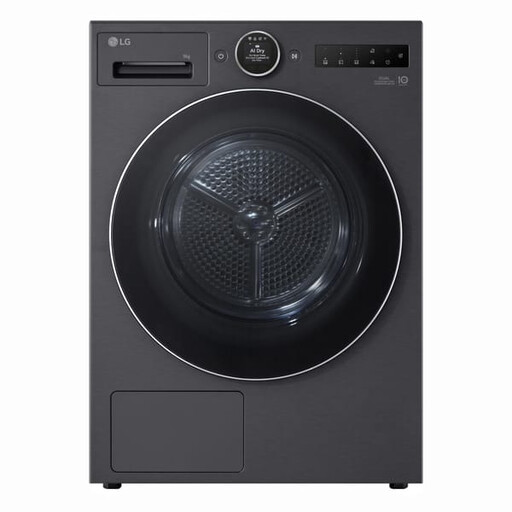
LG RT90X9B, 9 kg
For regular cotton loads, if a cotton programme and 9 kg capacity suit the amount of laundry you have.
Listed as energy class A, with 79 kWh per 100 cycles, 91% condensation efficiency and 60 dB. Check the exact dimensions and door clearance you’ll need before choosing.
View at Joybuy
 No image available
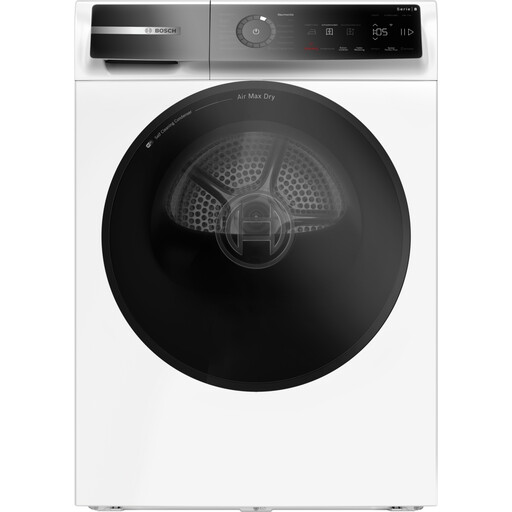
Bosch WRB247C40, 9 kg
For cotton laundry, if a 9 kg capacity and cotton programme suit your usual loads.
Described as freestanding and stackable. The listing gives energy class A, condensation efficiency class A and a noise level of 57 dB. Before stacking, check that both appliances and the stacking kit are compatible.
View at Joybuy
 No image available
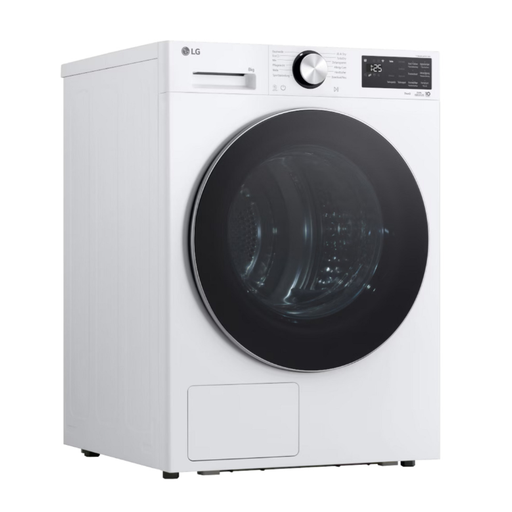
LG RT80X72W, 8 kg
For cotton laundry, if an 8 kg capacity suits your usual loads better than a larger drum.
Listed as energy class B, with 85 kWh per 100 cycles, 91% condensation efficiency and 62 dB. A cotton programme is listed; check the dimensions against your available space.
View at Joybuy
 No image available
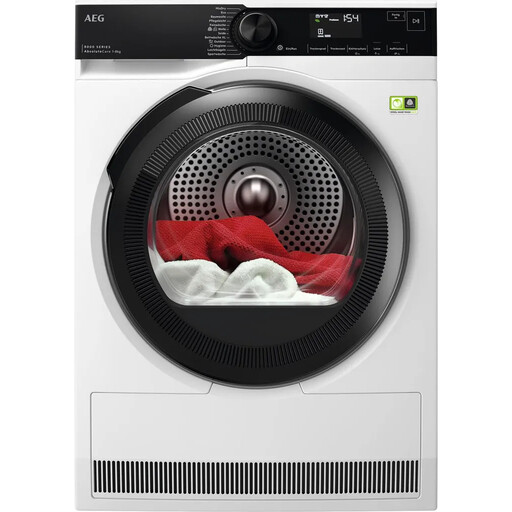
AEG TR8T75780, 8 kg
For cotton and mixed loads, if the listed programmes and 8 kg capacity suit the amount of laundry you have.
Listed as energy class B, with 85 kWh per 100 cycles, 63 dB and condensation efficiency class B. ProSense and a cotton programme are listed; check the dimensions and whether the condensate drain hose is an optional accessory.
View at Joybuy
 No image available
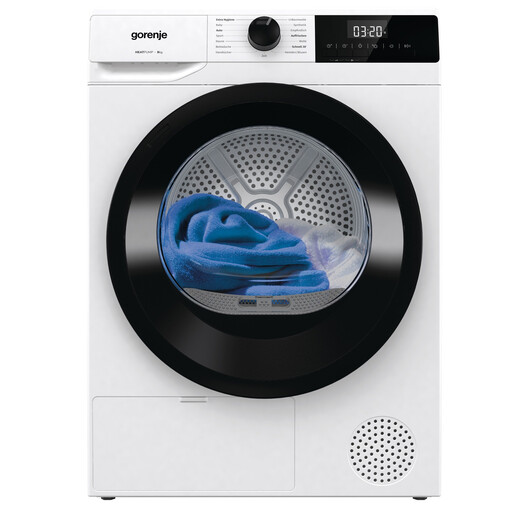
Gorenje DHNE82, 8 kg
For cotton laundry and bedding, if the listed 8 kg capacity suits your usual loads.
Listed as energy class D, with 119 kWh per 100 cycles, 85% condensation efficiency and 64 dB. The description gives an appliance depth of 550 mm and a door opening of 135°; check that you have enough space.
View at Joybuy
Frequently asked questions
Do I need an exhaust hose to the outside for a heat pump tumble dryer?
No. A condenser tumble dryer isn’t designed to vent moist air outside through an exhaust hose. The European Commission explains that the water is collected in a tank or drained away. Check how condensate is handled on the specific model you’re considering.
How do I care for the lint filter and water tank?
Siemens recommends cleaning the lint filter after every drying cycle, if possible. If no drain hose is connected, empty the condensate tank after each cycle. Follow your model’s instructions for the exact steps.
How can I estimate running costs?
Use the consumption figure in kWh per 100 cycles from the current energy label, then work out the cost based on how many drying cycles you expect to run and your electricity tariff. The label figure is for comparison and isn’t a guarantee for every load. The German Environment Agency also recommends choosing a capacity that suits the amount of laundry you actually have.
What should I consider when drying laundry in a room that’s prone to damp?
Compare the specific appliance’s condensation efficiency and check whether the condensate is collected in a tank or drained away. The German Environment Agency recommends airing your home regularly when there are additional sources of moisture, such as wet laundry. A condensation efficiency figure doesn’t measure the humidity in your home.


