First, measure the space the airer will take up while in use, then check whether you can hang cotton shirts with enough room between them. A heated winged airer folds away after use, while a tower airer makes better use of vertical space. A wall- or ceiling-mounted option keeps the floor clear, but requires suitable mounting conditions. When drying clothes indoors, you’ll need to ventilate the room to remove moisture, regardless of the heating function.
Which option suits you?
Limited floor space
If you need to keep a walkway clear, the dimensions when the airer is open matter more than its folded size. Adler gives the footprint of the AD 7821 as 148 × 52,5 cm. A ceiling- or wall-mounted option can free up floor space, provided the location and connection are suitable.
Cotton shirts on hangers
If you want to dry shirts in shape with space between them, check the number of hanger positions and how freely the shirts can hang, rather than just counting the rails or tiers. Foxydry lists hanger positions for the Pro; check the specific version and make sure there’s enough room for your shirts before choosing.
Drying clothes indoors
If you dry laundry indoors, plan for a suitable drying spot and regular ventilation as well as a heating function. The German Environment Agency points out that damp laundry adds moisture to the room.
What to look for when buying
| Buying criterion |
What to check |
Who is it important to? |
| Floor space when in use |
Dimensions when open and room to move around it; for a mounted option, check the fixing location and installation requirements. |
If I need to keep a walkway clear, the floor space taken up while drying is what matters. Around 33% of consumers put floor space first. |
| Room for cotton shirts |
Hanger positions, spacing and hanging clearance; for a tower airer, check its height and the distance between tiers. |
If I want my shirts to dry in shape, I need enough space between them and a suitable way to hang them. Around 27% of consumers prioritise this. |
| Moisture in the room |
A suitable drying spot and the option to ventilate regularly; heat does not remove moisture from the air. |
If you dry laundry indoors, you also need to be able to clear damp air. Around 20% of consumers put room humidity first. |
| Power consumption of the heater |
Compare the rated power and planned running time with an unheated alternative, without using them to estimate drying time. |
If I’m weighing up the extra heat, I want to compare the electricity used with air-drying without a heating function. Around 20% of consumers put electricity costs first. |
The percentages indicate how the four buying priorities listed here rank for this use case; they are not measured market shares. Electric models covered by the EU Low Voltage Directive must meet the relevant requirements and carry the required CE marking. The European Commission explains the scope of the directive, including equipment rated at 50 to 1,000 V AC. According to Your Europe, the CE marking is a declaration by the manufacturer, not an independent quality mark.
Common buying mistakes
-
Comparing only the folded dimensions
An airer that folds down compactly can take up considerably more floor space when in use. For the Adler AD 7821, the manufacturer gives dimensions of 148 × 52,5 × 90 cm when open and 113 × 52,5 × 8 cm when folded.
First measure the space available while you’re using the airer, then check where you’ll store it when folded.
-
Assuming more tiers mean more room for shirts
The number of tiers doesn’t tell you whether a long shirt can hang freely or if there’ll be enough space between garments.
For a tower airer, check the usable height and the distance between tiers when they’re in use. For an airer with hangers, check the number of hanger positions and the spacing between shirts.
-
Confusing heat with dehumidification
Damp laundry releases moisture into the air even when it’s on a heated airer. The heating function doesn’t remove that moisture from the room.
Choose a suitable place to dry your laundry and plan to ventilate regularly. The German Environment Agency recommends paying particular attention to regular ventilation when drying damp laundry indoors.
-
Using the wattage to estimate drying time
The rated power alone doesn’t tell you how long shirts will take to dry or how much electricity one drying cycle will use.
Compare clearly stated power ratings with how long you plan to run the airer. Don’t assume they guarantee a particular saving in time or cost.
Brands to consider
Adler
The AD 7821 is a foldable heated winged airer for anyone weighing up usable drying space against compact storage.
- For this model, Adler lists 18 heated bars, 220 W and 220–240 V, along with the dimensions when open and folded.
- The manufacturer’s stated dimensions and power rating don’t prove how long shirts will take to dry. You’ll still need to allow for the floor space it takes up in use.
Todeco
Todeco offers both heated, multi-tier airers and unheated clothes airers, so it’s important to check the specific version.
- For a heated three-tier model, Todeco lists 300 W and a capacity of up to 5 kg per tier.
- The number of tiers and the load capacity don’t tell you whether long shirts will have enough room to hang freely. Check the electrical compliance and exact version before buying.
Foxydry
Foxydry describes the Pro as a ceiling-mounted option with hanger positions and a warm-air function.
- This design can keep the floor clear if you have a suitable place to install it.
- Check the installation requirements, connection and exact version before choosing. The manufacturer’s claims about warm air aren’t an independent comparison of drying performance.
Sichler Haushaltsgeräte
The documented NC-3549 model is a small heated freestanding airer for individual items of laundry.
- The instructions list dimensions of 94 × 51 × 76 cm and a power rating of 100 W for the NC-3549.
- The instructions specify a dry room and a socket protected by a residual current device (RCD). The overall dimensions alone don’t tell you whether a shirt can hang with enough room around it.
Leifheit
Leifheit describes foldable winged airers and compact designs as unheated alternatives for comparison.
- An unheated model doesn’t need an electric heating function.
- An unheated airer still needs space while in use. Ventilation remains important when drying clothes indoors, and the models described aren’t evidence of heated versions.
Joybuy products
This selection includes a foldable winged airer for use on the floor or balcony. If a heating function is important to you, check that it’s explicitly listed for the specific version before buying.
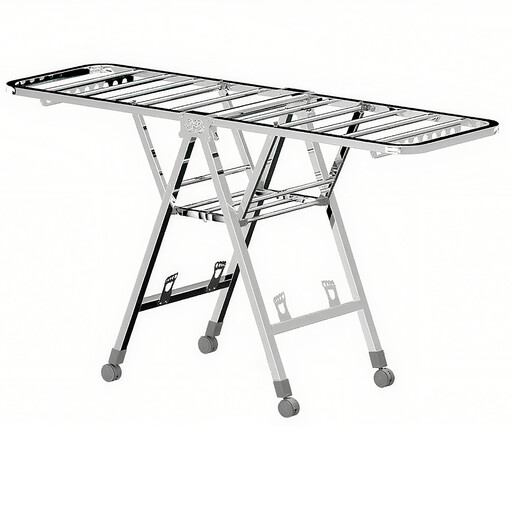 Image unavailable
SNSP foldable stainless steel winged clothes airer
According to the product description, the fold-out wings provide extra drying space, and the airer folds away for storage.
As a freestanding airer, it needs floor space while in use.
View at Joybuy
Frequently asked questions
Can I spread a cotton shirt over as many heated bars as possible?
If keeping its shape matters to you, straighten the shirt as you hang it and check that the hangers or bars leave enough room. The clothing care guidance from clevercare.info recommends smoothing cotton garments into shape when hanging them to dry. The fibre content alone doesn’t tell you whether the heating function is suitable for a particular shirt.
Do I still need to ventilate the room when using a heated airer indoors?
Yes. The German Environment Agency recommends paying particular attention to regular ventilation when drying damp laundry indoors. The airer’s heating function doesn’t vent air outside.
How can I estimate electricity use if I don’t know the drying time?
Multiply the rated power in kilowatts by the assumed running time in hours. At 220 W for four hours, that works out at 0,88 kWh if you assume the airer runs at its rated power throughout. This is a calculation example, not a measured energy consumption figure or a verified drying cycle for the Adler AD 7821.
Which electrical marking should I look for on a mains-powered clothes airer?
Electrical equipment covered by the EU Low Voltage Directive must meet the requirements set out in it and carry the required CE marking. The European Commission gives a voltage range of 50 to 1,000 V AC, among other criteria. According to Your Europe, the CE marking is a declaration by the manufacturer, not a test certificate issued by a central EU body. It must apply to the specific appliance.
Can I use the Sichler NC-3549 in a damp bathroom?
Not according to the instructions for the NC-3549: they specify a dry room and a socket protected by a residual current device (RCD). Don’t assume this model-specific instruction applies to other appliances without checking their instructions.


