Households with a mixed weekly wash
If you want to dry tea towels, clothes and larger items together, you’ll need enough separate hanging spaces and a suitable spot for the airer.


A compact heated airer may suit you if you need a few tea towels ready to use again soon. For a mixed load of weekly washing, enough space to hang items separately is key. If you need room for a full load and don’t need a heated airer, a large unheated clothes airer may be a better choice; the German Environment Agency rates clothes airers and washing lines as the most energy-efficient drying method. When drying laundry indoors, whatever type of airer you choose, you’ll need to ventilate the room to remove moisture.
If you want to dry tea towels, clothes and larger items together, you’ll need enough separate hanging spaces and a suitable spot for the airer.
If you usually hang up just a few tea towels, consider whether a compact heated airer will do the job, rather than making room for a whole load of washing.
If you don’t have a suitable outdoor drying space, choose a spot where you can ventilate the room regularly to help remove moisture.
A good fit if: you mainly need to dry a few tea towels or other small items, and you’re short on space.
The trade-off: With fewer bars, there’s less room for a mixed weekly wash.
A good fit if: you want to dry tea towels alongside other laundry and put the airer away afterwards.
The trade-off: Check the space it takes up when open and whether longer items might cover other bars.
A good fit if: you need space for a full week’s washing and heated bars aren’t a priority.
The trade-off: A larger drying area needs more floor space. The German Environment Agency rates clothes airers and washing lines as the most energy-efficient drying method.
| What matters to you | What to check before buying | Who is it most relevant to? |
|---|---|---|
| Space for a mixed weekly wash | Compare the dimensions when open, usable bars and total drying length. Any stated load capacity won’t tell you exactly how much of your particular mix of laundry will fit. | If I want to hang tea towels alongside clothes and larger items, I need enough separate hanging spaces and should also consider the floor space available. Around 40% of shoppers are likely to be mainly concerned with space for a mixed weekly wash. |
| Space to dry tea towels | Count how many towels you’ll need to dry at once, then check the number of bars, the spacing and the dimensions when open. A heating function doesn’t guarantee a particular drying time. | If you usually hang just a few tea towels, a compact design may be worth considering, without needing to make room for a large airer. Around 30% of shoppers are likely to be most concerned with drying tea towels. |
| Moisture when drying clothes indoors | Check where you can put the airer and whether you’ll be able to ventilate the room to remove moisture. The German Environment Agency identifies wet laundry as an additional source of moisture in the home. | If I dry laundry indoors, I need somewhere practical for regular ventilation; heated bars don’t replace fresh air. Around 20% of shoppers are likely to be mainly concerned with managing moisture indoors. |
| Running costs and storage | Compare the rated power and how long you expect to use the airer. For a rough calculation, use: kWh = kW × hours; multiply the result by your electricity price per kWh. | If you’re weighing up electricity use and storage space, you could also consider an unheated airer. Around 10% of shoppers are likely to be mainly concerned with electricity use and storage. |
A compact model with just a few bars and a large unheated airer solve different space problems. With a small drying area, you may need to dry a mixed load in several batches.
Estimate how many items you need to dry at once, then compare the usable hanging spaces and dimensions when open before deciding whether you need a heated airer.
Depending on the size of your wash, you may need another drying space or an extra drying cycle.
The German Environment Agency identifies wet laundry as an additional source of moisture in the home. Heated bars don’t remove moisture from the room by themselves.
Choose a spot where you can ventilate the room regularly, even if you have a heated model.
A model’s rated power doesn’t tell you how much electricity it will use per load or how long your laundry will take to dry.
Estimate electricity use from the rated power and how long you plan to run the airer. Only compare drying times if the measurements were taken under similar conditions.
The notes below relate to the specific model ranges and designs mentioned, rather than offering a general assessment of each brand.
Models 850-032 and 850-048 offer two different heated designs: a compact airer and a two-tier model.
The folding heated clothes airer AD 7821 is designed for a spot with enough room for a winged airer.
The unheated Pegasus Family Maxx is an option for mixed loads, with several hanging spaces.
The unheated Infinity Flex extends to suit different amounts of laundry.
The white HangOn version with 25 m of drying line has hanging spaces for a range of laundry items.
This selection at Joybuy includes large unheated clothes airers for mixed loads, as well as a folding heated airer for tea towels and other laundry.
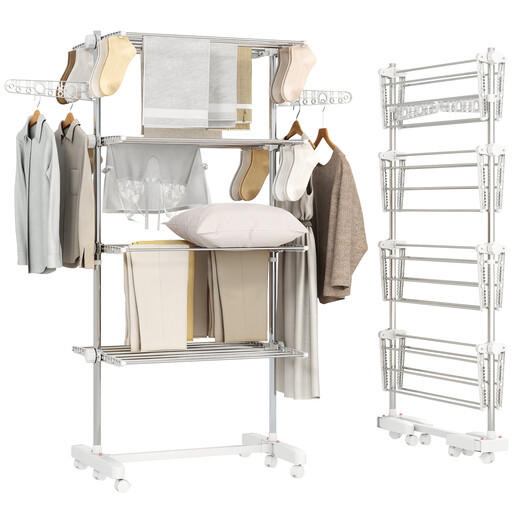 No image available
Four adjustable tiers and two side wings offer different hanging spaces for a mixed weekly wash.
The product details state a total load capacity of 60 kg, a folded width of 13 cm and six wheels, two of which lock. Integrated sock clips are designed for small items.
 No image available
For tea towels and other laundry, this airer has a central drying area and two fold-out side wings.
The product details state a power rating of 230 W and a heating temperature of 45–55 °C. These figures don’t confirm a particular drying time or the energy use per load; the airer folds away for storage.
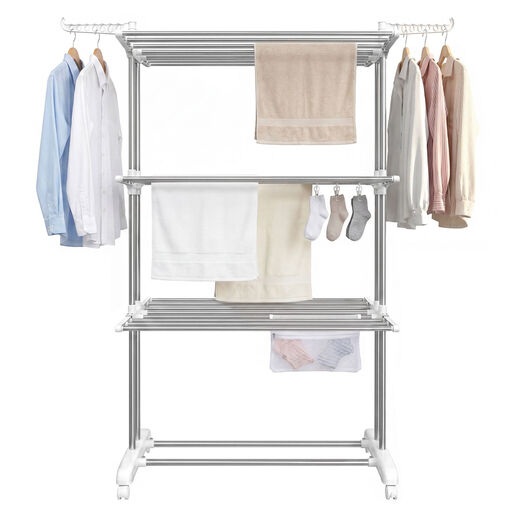 No image available
Four tiers and a lower shoe section provide different drying spaces for a mixed load; the swivel hooks are designed for smaller items.
The product details state that it has 14 hanging slots and a load capacity of 35 kg. The wheels make it easier to move, and two of them lock.
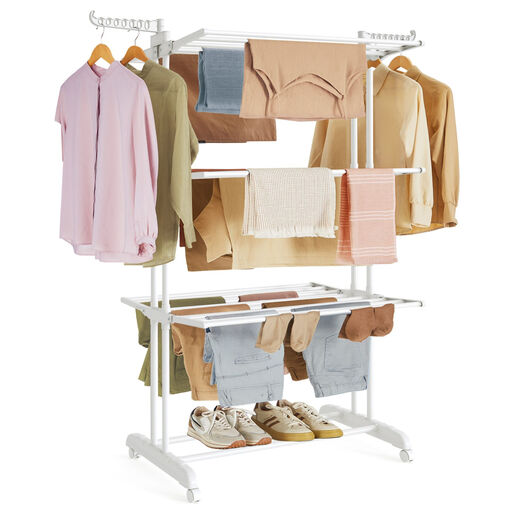 No image available
For mixed loads, this airer has four tiers, three main shelves and a lower section for shoes.
The product details state that the side wings offer 14 extra hanging spaces and that the static load capacity is 35 kg. It also has wheels, two with brakes, and folds away for storage.
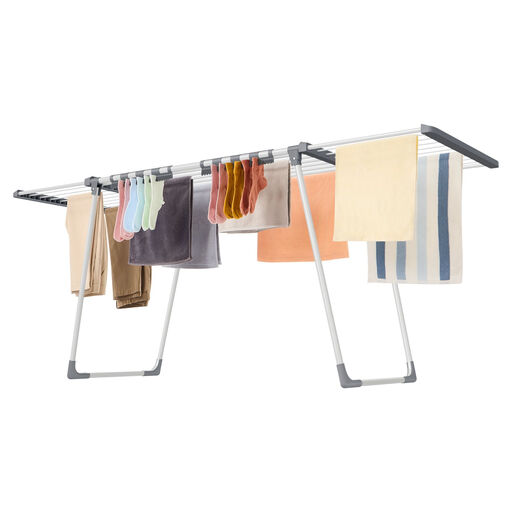 No image available
The stated drying length provides room for different items in a mixed load; integrated clips are designed for small pieces.
The product details state that it has 18 m of drying line, a load capacity of up to 18 kg and four clips. The airer folds away for storage.
No. The German Environment Agency identifies wet laundry as an additional source of moisture and recommends ventilating regularly, especially in these circumstances. Heated bars don’t remove moisture from the room by themselves.
The product details for the HOMCOM 850-048 and Adler AD 7821 state that they can be used without the heating function. Check this feature for the specific model you’re considering, as it can’t be assumed for every heated clothes airer.
Convert the rated power to kilowatts, then multiply it by the number of hours you plan to run the airer. At 220 W, assuming a continuous power draw for one hour gives a calculated figure of 0.22 kWh; this isn’t a measurement of a drying cycle.