A compact heated airer could suit you if you often dry small loads of towels, provided there is enough space between them and the location is suitable. If you need more drying space or have time to spare, you could choose an unheated airer and avoid using electricity to heat the frame. With either option, you’ll need to ventilate the room to remove moisture.
Which style is right for you?
Households that often dry small loads of towels
If you regularly hang up just a few towels, check whether they’ll fit on the rails or hooks with enough space between them. A compact towel airer and a larger winged airer have different designs; DOMO and Adler provide details about their respective models.
People with limited space to set up or store an airer
Consider both the airer’s dimensions when in use and its height and depth when folded away. Adler Europe gives a slim folded profile for the AD 7821 and a folded height of 139 cm for the AD 7831.
Households that dry laundry indoors
Extra heat doesn’t remove moisture from the room or mean you can skip checking whether the location is suitable. The German Environment Agency recommends airing the room more often when drying damp laundry indoors.
What should you look for when buying?
Compact heated towel airer
A good fit if: you usually dry just a few towels and a small footprint matters more than space for a full wash load. DOMO lists a 150 W power rating and a timer for the DO7117DR.
The trade-off: it offers less usable drying space than larger winged or tower airers, and there’s no evidence of a specific drying time.
Heated winged airer
A good fit if: you occasionally have more towels to dry at once and want to fold the airer flat for storage afterwards. Adler Europe lists 18 heating elements and folded dimensions of 113 × 52.5 × 8 cm for the AD 7821.
The trade-off: according to the manufacturer, the AD 7821 takes up 148 × 52.5 cm of floor space when open.
Heated tower airer
A good fit if: you need more hanging space for several small loads and have more room for height than floor space. Adler Europe lists 30 heated elements and open dimensions of 73 × 58 × 139 cm for the AD 7831.
The trade-off: according to the manufacturer, the model remains 139 cm tall when folded. More rails don’t guarantee a shorter drying time.
Unheated clothes airer
A good fit if: you can leave your towels to dry without a deadline and want to avoid using electricity to heat the airer. Leifheit lists 25 m of drying length for the Classic 250 Flex.
The trade-off: check that the larger drying area will fit in your room. Ventilation is important even when drying without heat.
| What matters when buying |
What to check |
Who is this most important to? |
| Usable drying space |
Measure the width and layout of the rails against your towel sizes; don’t assume all designs offer the same space. |
If you often dry small loads, make sure there’s enough room to hang several towels with space between them. Around 36% put usable drying space at the top of their list. |
| Space to set up and store |
Check the airer’s footprint when open, its height and its folded dimensions against the intended set-up and storage spaces. |
If you have limited floor space or low storage, consider the dimensions in use and when folded separately. Around 29% of consumers prioritise the space an airer takes up and how it can be stored. |
| Power consumption |
Check the rated power and actual running time. A lower wattage doesn’t necessarily mean lower costs per towel or a shorter drying time. |
If you use a heated airer regularly, the actual time it’s switched on is what matters. Around 21% put ongoing electricity use first. |
| Moisture and location |
Check that you can ventilate the room, read the appliance instructions and check its IP rating. An IP rating isn’t blanket approval for every bathroom location. |
If you dry laundry indoors or in the bathroom, you should ventilate the room and assess the specific location. Around 14% of consumers prioritise ventilation and where the airer will stand. |
Common misconceptions
-
Heating elements guarantee a drying time
The wattage and number of rails are specifications from the manufacturer, not measurements based on your load of towels. The size of the towels, the space between them and the room conditions all affect how long they take to dry.
Hang your towels with space between them and work out the electricity use from the actual running time, rather than relying on a promise about drying time.
-
Folded dimensions tell you everything about the space it needs
An airer may fold away flat but still take up a lot of floor space when in use. A tower can save floor space, but it will be taller.
Measure the space where you’ll use the airer and the place where you’ll store it separately.
-
Heating means you don’t need to ventilate or check the location
Damp laundry releases moisture into the air. In a bathroom, you also need to check the specific location for the electrical appliance.
Make sure the room is aired regularly. If you’re setting up the airer in a bathroom, check the appliance instructions and the intended location.
Brands to help guide your choice
DOMO
According to the manufacturer, the DO7117DR is a compact heated towel airer that can be freestanding or wall-mounted.
- The manufacturer lists 150 W, a timer, IPX4 and mounting kits.
- These details don’t confirm that it’s suitable for every bathroom location or guarantee a particular drying time. Its compact design offers less space than a large airer.
Adler
The AD 7821 is a heated winged airer, while the AD 7831 is a taller heated airer. They are different designs, not interchangeable size options.
- According to the manufacturer, the AD 7821 has 18 heating elements and 220 W; the AD 7831 has 30 elements and 298 W.
- The AD 7821 is 8 cm deep when folded, while the folded AD 7831 remains 139 cm tall. The manufacturer’s drying claims aren’t independent test results for towels.
Leifheit
The Classic 250 Flex is an unheated alternative with adjustable drying levels, suited to households that need plenty of space above all.
- Leifheit lists 25 m of drying length and a footprint of 151 × 61 cm.
- The airer needs a corresponding amount of floor space. As it isn’t heated, it doesn’t use electricity for heating.
Joybuy products for towels
The following Joybuy products are electric towel warmers and radiators for households that want to hang up individual towels regularly. Their designs, controls and stated power ratings vary, so check which option suits your space and how you plan to use it before choosing.
 No image available
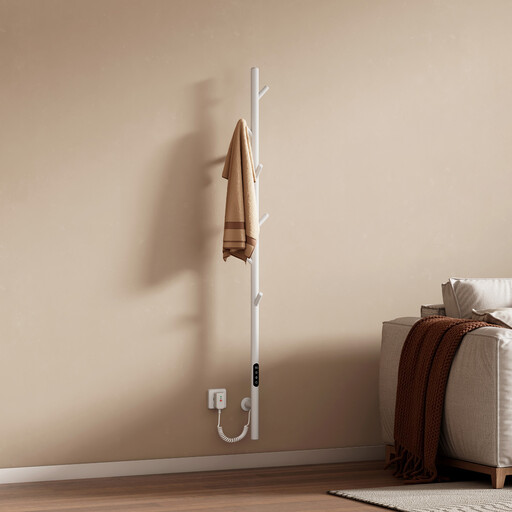
EMKE towel dryer with one rail, 6 hooks, 150 cm
For hanging several towels at different points; check that the layout suits your towels.
The specifications list 100 W, six hooks and a height of 150 cm; the title specifies one rail and a white finish.
View at Joybuy
 No image available
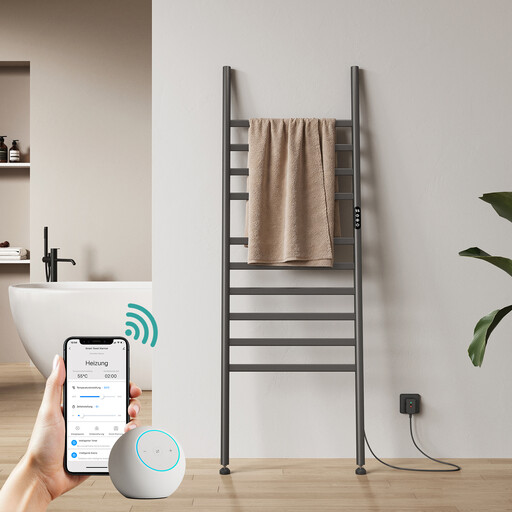
EMKE WiFi towel radiator, freestanding, 385 W, anthracite
For anyone looking for a freestanding model rather than a wall-mounted one; check the available floor space.
The product details list 385 W, a timer from 1 to 24 hours and a 160 cm cable. It’s described as a leaning design in anthracite.
View at Joybuy
 No image available
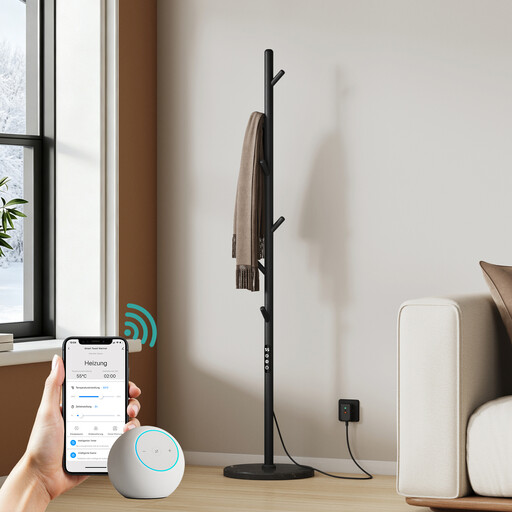
EMKE WiFi towel radiator, Tree Design, 100 W, black
For anyone looking for a drill-free option with adjustable heating times; check that it can be set up in a suitable place.
The specifications list 100 W, temperature selection, a timer from 1 to 24 hours and a 160 cm cable. It’s described as a Tree Design in black.
View at Joybuy
 No image available
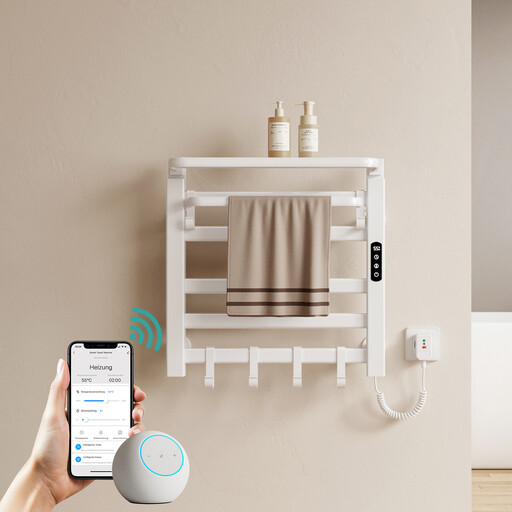
EMKE towel radiator, 50 × 50 cm, 140 W, white
For a limited amount of wall space, with extra shelf space and several hooks; note that the product description says the hooks aren’t heated.
The specifications list 50 × 50 cm, 140 W, a fold-down shelf, six hooks, IPX5 and a 1.5 m cable.
View at Joybuy
 No image available
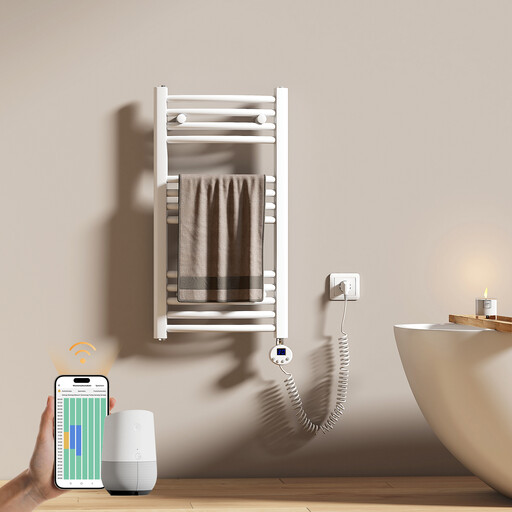
EMKE WiFi towel radiator, curved, 750 × 400 mm, white
For anyone who wants to programme heating times; compare the stated dimensions with the space available.
The product details list a temperature range of 7 to 30 °C, a 24-hour timer, weekly programmes and a flexible 1.4 m cable.
View at Joybuy
Frequently asked questions
Will a heated airer definitely dry towels within a set time?
No. You can’t work out a specific drying time from the heating power and design alone. Towel size, spacing and room conditions also play a part, so check whether you can hang the towels with enough room between them.
Can I place a heated airer anywhere in the bathroom next to a shower or bath?
No. An IP rating isn’t blanket approval for every bathroom location. Check the instructions for the specific appliance and where you intend to put it; any necessary electrical installation should be assessed by a qualified professional.
Do I still need to ventilate the room if the rails are heated?
Yes. The German Environment Agency recommends airing rooms more often when drying damp laundry indoors. A heated airer won’t remove evaporated water from the room.
How can I estimate the electricity use of a heated airer?
Multiply the power in kilowatts by the actual running time in hours to calculate the energy used in kilowatt-hours. At 150 W and two hours of continuous operation at the rated power, that would be 0.30 kWh; this isn’t a measurement of an actual drying cycle.


