Who might benefit from a heated airer?

House shares where everyone has their own face cloth

If you assign cloths to individuals, you’ll need separate places to hang them. A heated airer is no substitute for regular washing: infektionsschutz.de recommends washing flannels at a minimum of 60 °C with a heavy-duty detergent containing bleach.

House shares with limited drying space

In a shared room, hanging space, floor space and storage all need to work together. Also check whether you can find a suitable electrical location for the specific appliance.

House shares where cloths take a long time to dry

Heat assistance may be worth considering if cloths stay damp indoors for a long time. The moisture still needs to be ventilated out of the room; the German Environment Agency recommends regular ventilation when drying damp laundry indoors.

What should you look for when buying?

Consideration What to check when buying Who it matters to
Separate spaces for cloths Usable bars and the space between cloths; ways to keep them separate. If I’m hanging several personal cloths, I want them to have room without overlapping. Around 31% of consumers prioritise keeping them separate.
Drying and room humidity Space for air to circulate and a way to ventilate moisture outside. If cloths take a long time to dry indoors, I look for airflow around the hanging area and regular ventilation. Around 25% of consumers prioritise drying and moisture removal.
Space and electrical location Check the assembled and stored dimensions, as well as the specific location and connection requirements in the instructions. In a small house-share bathroom, I need to make sure there’s room for the airer and a suitable electrical location. Around 25% of consumers prioritise space and a safe electrical location.
Energy consumption Check the rated power, recommended running time and timer; consider unheated drying as an alternative. If I’d use the airer often, I want to know whether I really need the heating function for my cloths. Around 19% of consumers focus on ongoing electricity costs.

Common misconceptions

  • Confusing heated bars with disinfection

    Heat while cloths are hanging is no proven substitute for good hygiene through washing and keeping them separate. infektionsschutz.de recommends washing flannels at a minimum of 60 °C with a heavy-duty detergent containing bleach.

    Hang cloths separately and follow the care instructions for each item, too.

  • Assuming the IP rating makes every bathroom location safe

    Whether an electrical appliance can be used in a particular spot also depends on its location and the existing installation. The VDE expressly advises keeping electrical appliances away from showers and baths.

    Before buying, check the location and installation against the instructions and your existing setup. An IP rating on its own does not mean the appliance can be placed anywhere.

  • Relying on heat instead of ventilation

    As cloths dry, their water initially enters the air in the room. Heat alone won’t remove this moisture from your home.

    Start by hanging cloths separately with plenty of space around them, and ventilate regularly. Only heat the airer if you really need the extra help.

Relevant brands at a glance

DOMO

The manufacturer describes the DO7117DR as a compact heated airer that can stand on the floor or be wall-mounted, for a small number of cloths.

  • DOMO lists 150 W, a timer, IPX4 protection and floor-standing or wall-mounted use; the stated dimensions are 52,5 × 36,5 × 90 cm.
  • The IP rating doesn’t mean it can be used anywhere in a bathroom. Check the usable hanging spaces and the specific location.

Adler

Adler offers the foldable winged airer AD 7821 and the taller AD 7831, which has more heating elements.

  • According to Adler, the AD 7821 has 18 heating elements, 220 W and unfolded dimensions of 148 × 52,5 × 90 cm; the manufacturer lists IP22. For the AD 7831, Adler lists 30 heating elements, 298 W and IPX1.
  • The number of heating elements doesn’t guarantee a particular drying time for face cloths. IP22 and IPX1 don’t mean the airer can be used anywhere in a bathroom.

InnovaGoods

The manufacturer describes the Warmmat as a foldable heated winged airer with adjustable temperature and a timer.

  • InnovaGoods lists 20 heated bars, 230 W, six temperature settings from 35–60 °C, a timer of up to 12 hours and unfolded dimensions of 148 × 112 × 54 cm.
  • The airer takes up space when unfolded. The manufacturer’s drying claims don’t guarantee a particular drying time for face cloths.

Foxydry

The manufacturer describes the Foxydry Pro as a ceiling- or wall-mounted solution with air circulation and warm air, better suited to a permanent drying space.

  • Foxydry lists versions measuring 122 and 160 cm in length, with 750 W for warm-air operation.
  • Installation is more involved than with a foldable freestanding airer because it needs to be mounted and connected to the electricity supply. The model details don’t demonstrate that it’s particularly suitable for face cloths in a shared house.

Joybuy products for your drying space

The products below are heated drying solutions for towels and cloths, including foldable airers and radiators with hanging options. Before buying, check that the specific appliance is suitable for your chosen location and that its markings and documentation cover the requirements for use in Germany. Heat is no substitute for ventilation or washing.

Heated, foldable winged clothes airer

Heated winged clothes airer, 144 × 53 × 96 cm

The central drying area and two fold-out side wings provide several hanging zones. Its foldable design may also make it easier to store after use.

The product description lists 45–55 °C and 230 W.

View at Joybuy
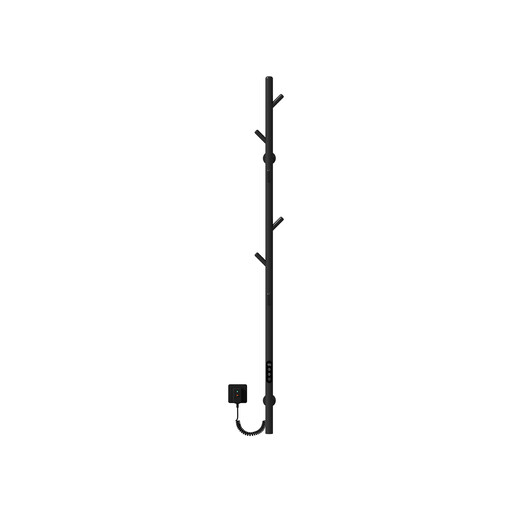
EMKE electric towel dryer with six hooks

EMKE electric towel dryer with six hooks, 150 cm

The six hooks provide separate hanging points, while the slim design may suit a room with limited floor space.

The product details list 100 W, adjustable temperature, a 1–9-hour timer and dimensions of 1500 × 125 × 140 mm.

View at Joybuy
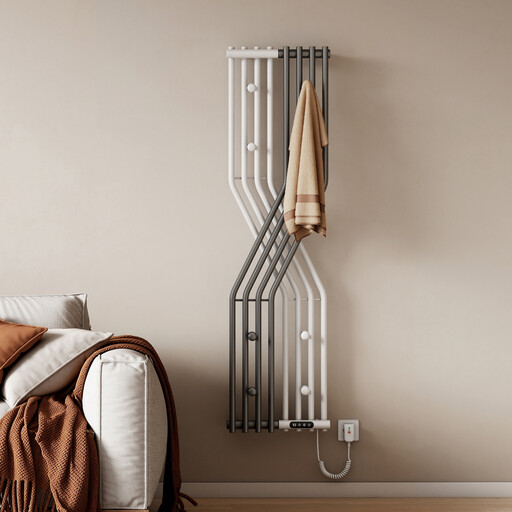
EMKE WiFi towel radiator with eight flexible hooks

EMKE WiFi towel radiator, 1400 × 375 mm, 580 W

The eight flexible hooks provide several hanging points. The product description says the appliance is designed for wall mounting.

Specifications include 580 W, adjustable temperatures from 30–70 °C and a timer.

View at Joybuy
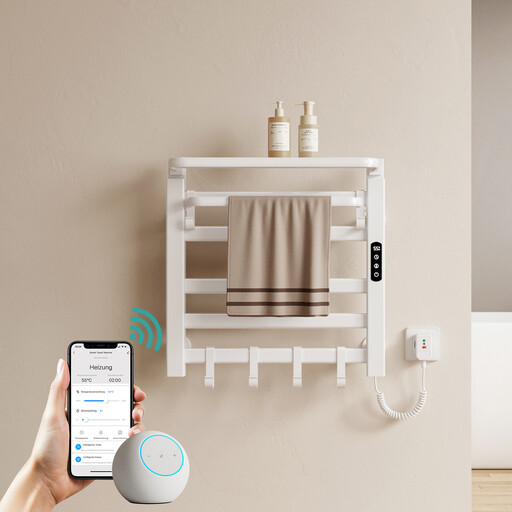
EMKE towel radiator with six hooks and a foldable shelf

EMKE towel radiator, 50 × 50 cm, 140 W, white

Six hooks, a towel rail and a foldable shelf offer a choice of hanging options. Check that this version fits the space you have in mind.

The product details list 140 W, a timer, Wi-Fi app control and IPX5 protection. The IP rating alone doesn’t confirm that it’s suitable for every bathroom location.

View at Joybuy
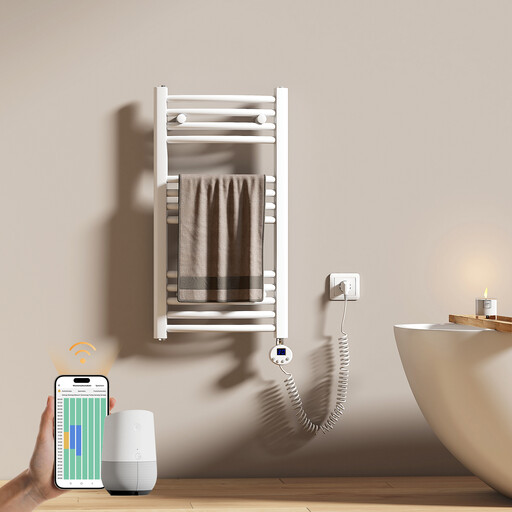
EMKE curved WiFi towel radiator, 750 × 400 mm

EMKE curved WiFi towel radiator, 750 × 400 mm

According to the product details, the curved design is intended to warm and dry towels. A timer and weekly schedule let you set when it runs.

The description also lists a thermostat and a 1,4 m cable.

View at Joybuy

Frequently asked questions

Does a heated airer make shared face cloths hygienic?

No. Heat while cloths are hanging is not proven to disinfect them. Assign cloths to individuals and follow the care instructions; infektionsschutz.de recommends washing flannels at a minimum of 60 °C with a heavy-duty detergent containing bleach.

Can I put the airer in the shared-house bathroom next to a shower or bath?

There’s no blanket approval for this. The VDE expressly advises keeping electrical appliances away from showers and baths. Check the specific location, installation and manufacturer’s instructions; even an IPX4 rating does not mean the appliance can be placed anywhere.

Do I still need to ventilate the room if I have a heated airer?

Yes, if you’re drying damp cloths indoors. The German Environment Agency recommends taking particular care to ventilate regularly when drying damp laundry inside, because heat alone won’t remove the evaporated moisture from your home.

What happens if the appliance breaks, and how does the manufacturer’s guarantee work?

Your statutory rights are separate from a manufacturer’s voluntary guarantee. The Verbraucherzentrale describes your statutory rights as a claim against the seller. If a product is faulty, repair or replacement may be available in the first instance as a remedy.

Is the CE mark an independent quality mark?

No. Where EU rules apply, the manufacturer uses the CE marking to declare that the product complies with them; it is not an independent quality mark. Check the identity of the specific appliance on offer and its accompanying conformity documentation. The mark alone also doesn’t show that the appliance is suitable for every bathroom location.