Households with frequent small loads of towels
If you only have a few large bath towels to dry after washing, make sure the rail width and layout suit your towels. If you want to put the airer away between uses, check its folded dimensions too.


If you have several large bath towels, first check whether the usable rail space can hold them with enough room between each one. For a single towel in a fixed spot, a compact heated towel rail may be a better fit. Heating uses electricity every time you use it and does not remove moisture from the room. So compare an unheated airer too, and plan for ventilation, as recommended by the German Environment Agency when drying damp laundry indoors.
If you only have a few large bath towels to dry after washing, make sure the rail width and layout suit your towels. If you want to put the airer away between uses, check its folded dimensions too.
If unheated drying works well for you day to day, a standard clothes airer avoids using extra electricity. If you use a heated model regularly, its actual running time and your electricity tariff are what matter.
If floor space is limited, or you dry wet towels indoors, plan where to put the airer and how to ventilate the room. For electrical appliances in the bathroom, you also need to consider the exact location and power connection.
First decide whether you want to dry large towels spread out on a portable airer, or whether a fixed towel rail would suit you better. For either option, you’ll need to weigh up electricity use, space and moisture removal.
A good fit if: you dry small loads of laundry in different places and want to put the airer away afterwards.
Things to consider: The airer needs floor space and electricity while in use, and your towels must fit the rails properly.
A good fit if: you mainly want to dry or warm one towel in a fixed spot.
Things to consider: The smaller hanging area may not be practical for several large, fully wet towels.
A good fit if: a permanent installation suits your room and your actual needs. A heated towel radiator provides warmth for towels and the room, while a ceiling-mounted model keeps the floor clear.
Things to consider: You’ll need to arrange installation and a power connection, and models vary in output and how they’re designed to be used.
A good fit if: your towels can dry in time with enough space and ventilation, and you don’t want to use extra heat.
Things to consider: Drying time depends on the conditions in the room, and moisture still needs to be removed.
| What matters to you | What to look for | Who should pay particular attention |
|---|---|---|
| Hanging large towels | Compare the usable rail width and layout with the dimensions of your towels; check the airer’s dimensions when opened out. | If I want to hang wide bath towels fully spread out, with space between them, the rails need to be wide enough. Around 31% of consumers prioritise having enough space for large towels. |
| Electricity use with frequent use | Multiply the rated power by the actual running time per use, then compare the result with your electricity price. Wattage alone doesn’t tell you the cost of drying one towel. | If I’d use the appliance often, I want to weigh up its electricity use against an unheated option. Around 25% of consumers prioritise low running costs. |
| Setting up and storage | Check the dimensions when opened out and folded. For fixed appliances, consider the fittings and intended location. | If there’s little space in my bathroom, I need an option that fits both while it’s in use and when it’s put away between small loads. Around 19% of consumers prioritise limited floor and storage space. |
| Room humidity and location | Check whether you can ventilate the room and where the appliance is approved for use. An IP rating does not automatically mean it is suitable for every location in a bathroom. | If wet towels are drying in a damp room, I want to remove the moisture and make sure the electrical appliance is in a safe location. Around 25% of consumers prioritise room humidity and a suitable position. |
Even warmed towels release moisture into the air. Heating does not replace ventilation.
Choose a location that also gives you a practical way to ventilate the room.
The wattage indicates the rated power, not the measured electricity used per load. Repeated or prolonged use will still consume electricity.
Take actual running time and your electricity tariff into account. Compare drying results only when the loads are similar.
A compact towel rail and a folding winged airer have hanging areas with different layouts.
Before you buy, check your towel dimensions, the usable rail width and the space available between towels.
An IP rating alone cannot confirm whether a particular appliance can be used in a specific spot in your bathroom. The VDE advises keeping electrical appliances away from showers and baths.
Follow the appliance instructions and have any planned permanent bathroom installation assessed by a qualified professional.
The DO7117DR is a compact heated towel rail which, according to the manufacturer, can be freestanding or wall-mounted.
The AD 7821 is a folding heated winged airer for towels and small loads of laundry that need drying in different places.
The Sani Bathroom Radiator 600 Wifi is a fixed combination of towel warmer and bathroom heater, not a folding clothes airer.
Foxydry Pro is a ceiling-mounted option with air circulation and warm air, for when floor space and permanent installation matter more than portability.
The following Joybuy products include heated folding airers and electric heated towel rails. Before choosing, check that the hanging area, dimensions and intended location suit your bath towels and your room.
 No image available
The folding design may suit you if you want to put the airer away between small drying loads.
According to the product information: 230 W, 45–55 °C, a central section with two fold-out side wings, and a maximum load of 10 kg. Check that the rail layout can hold your bath towels with enough room between them.
 No image available
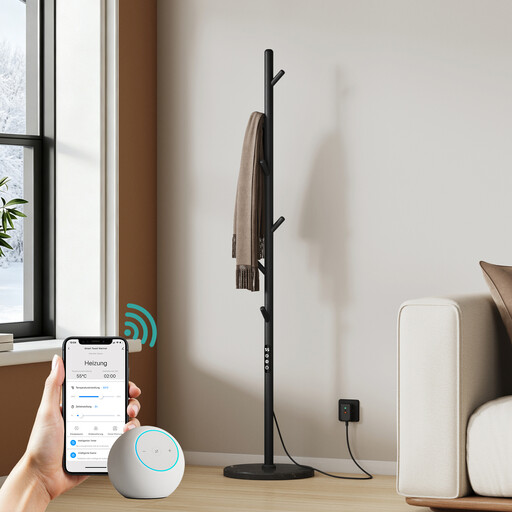
This option is described as an electric heated towel rail for a fixed towel spot; it does not have fold-out wings.
The title states 100 W. The product description lists app control, a timer, temperature control and a 160-cm cable. The title describes this version as ‘Without Drilling’.
 No image available
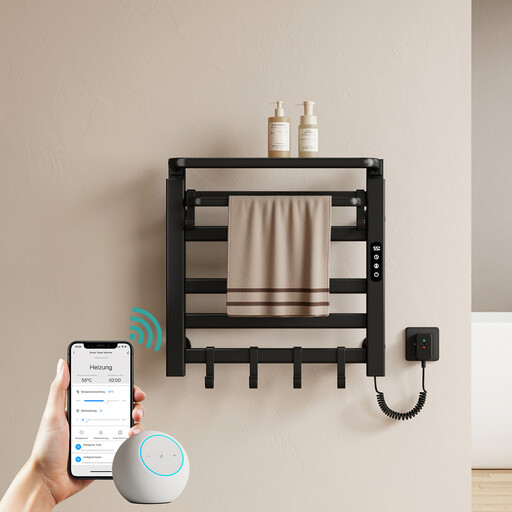
This option may be worth considering if you need extra hanging points as well as a towel rail; check the dimensions against the space available.
The title states 50 × 50 cm, 140 W and IPX5. The product description lists a fold-down shelf, six hooks and an additional towel rail, and distinguishes between heated and unheated sections. The IP rating does not replace checking whether the appliance is suitable for your specific bathroom location.
 No image available
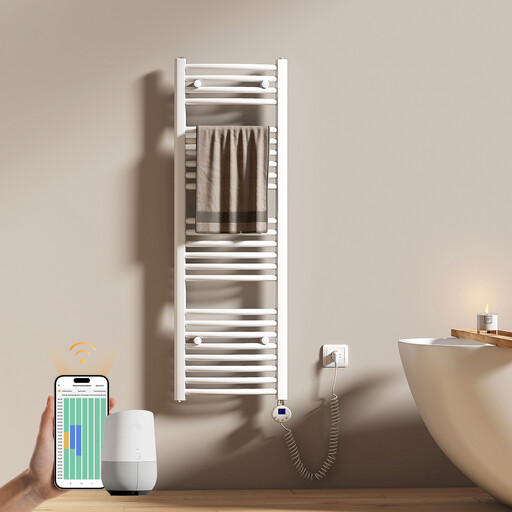
This option is described as a bathroom radiator and towel dryer. Check that its larger dimensions and intended installation suit your room.
The product description lists a 1.4-m cable, a pre-installed heating element, a thermostat, a 1–24-hour timer and weekly programmes.
 No image available
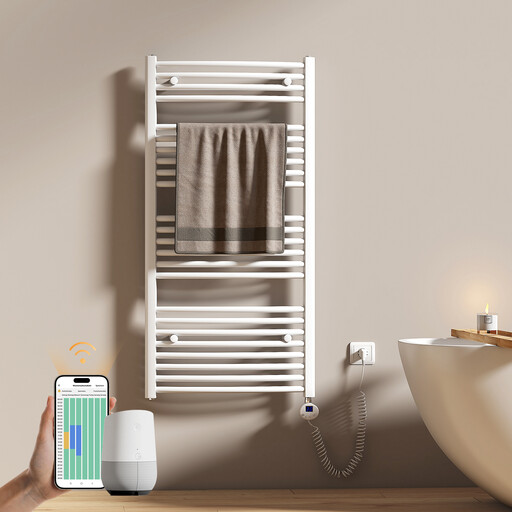
The larger of the two listed options is described as a bathroom radiator and towel dryer. Compare its dimensions with the space available and your own requirements.
The product description lists a 1.4-m cable, a pre-installed heating element, a thermostat, daily timers and weekly programmes.
Compare the usable rail width and layout with your towels spread out. Check the appliance dimensions too; the number of heated elements alone doesn’t tell you whether your towels will fit.
Not based on an advertising claim or IP rating alone. The VDE advises keeping electrical appliances away from showers and baths. The appliance’s approval, power connection and installation all need to be assessed for the specific location.
Yes, if the towels are releasing moisture indoors. The German Environment Agency recommends regular ventilation when drying damp laundry in living spaces; moisture in the bathroom also needs to be removed.
For a rough estimate, multiply the rated power in kilowatts by the actual running time in hours, then factor in your electricity price per kilowatt-hour. Compare appliances only with similar loads and a drying result that meets your needs; wattage alone does not tell you the electricity used per load.
Check the product identity, manufacturer’s information, CE marking, and any required instructions and warnings in German. The German Federal Network Agency lists these points for its market surveillance. CE marking is the manufacturer’s responsibility and is not the result of independent product testing.