Families who change tea towels frequently
If you regularly need several freshly washed tea towels, separate rails and a suitable drying spot are important. Adler Europe lists 18 heated elements for the AD 7821.


A heated airer could be a good choice if you regularly need several tea towels dry again as part of family life, and have a suitable spot where you can ventilate the room. A foldable airer offers more drying space spread across its frame, while a compact freestanding or wall-mounted model takes up less room; both use electricity, and heat is no substitute for washing used towels or ventilating the room. If you only have a few towels and there’s no rush, a non-electric airer is another option.
If you regularly need several freshly washed tea towels, separate rails and a suitable drying spot are important. Adler Europe lists 18 heated elements for the AD 7821.
If you can’t leave an airer set up all the time, consider its footprint, design and where you’ll store it. The manufacturer says the DOMO DO7117DR can be freestanding or wall-mounted, while Adler Europe says the Adler AD 7821 folds flat.
When drying clothes indoors, you need to consider both removing moisture and the extra electricity used by heated rails. For sources of moisture such as wet washing, the German Environment Agency recommends ventilating regularly; air-drying without electricity requires no extra energy to heat the airer.
When choosing an airer for tea towels, consider the usable drying space and a suitable place to ventilate, as well as the design and electricity use.
| What matters to you | What to look for when buying | Who should pay particular attention? |
|---|---|---|
| Drying towels regularly | Check how many rails you can use separately for your towels, and whether the airer fits in the space available when fully opened. Manufacturers’ drying-time claims aren’t measurements for your towels. | If several tea towels need to be ready again regularly as part of family life, I’d prioritise practical drying space. Around 40 % of consumers put frequent towel changes first. |
| Moisture and towel hygiene | Check the instructions for the specific model’s location and installation, and make sure you can ventilate the room. Plan to wash your towels regularly, whatever drying appliance you use. | If you dry towels indoors, you’ll want to remove the moisture and continue washing used towels regularly. Around 30 % of consumers prioritise a suitable drying spot and towel hygiene. |
| Floor space and storage | Measure the width, depth and height of the space where you plan to put it, as well as the storage space available. With a wall-mounted model, factor in the installation location and cable routing. | If there’s little free space in your kitchen or utility area, the key question for me is where the appliance can stand and where you can store it afterwards. Around 20 % of consumers put a small footprint first. |
| Electricity use | Factor in the rated power and how long you plan to use it; for a rough energy calculation, multiply kW by hours. The rated power alone doesn’t tell you how much energy a full drying cycle uses. | If you want to avoid extra electricity costs, compare heated rails with a non-electric airer and consider how long you’ll use it for. Around 10 % of consumers prioritise keeping extra electricity costs low. |
Drying a tea towel that has already been used doesn’t automatically make it clean.
Plan when to change and wash your towels, regardless of which airer you choose. The Verbraucherzentrale recommends regularly washing towels that can harbour germs at a temperature of at least 60 °C.
Even with heated rails, evaporated water ends up in the room.
Choose a suitable drying spot where you can ventilate, and adjust how you ventilate to the room and how you use it. For additional sources of moisture, such as wet washing, the German Environment Agency recommends ventilating regularly.
Depending on the room and how you use it, you may need to ventilate more, which can affect heating requirements.
An appliance that uses a cool airflow works differently from one with heated rails.
Check the technology described and clarify any conflicting power figures for the specific version of the appliance before comparing models.
The rated power of appliances with different designs doesn’t, by itself, show how much energy each one needs to dry the same towels.
Only compare them using the same load and a known running time. Without those measurements, you can’t determine which is more efficient.
Your actual electricity costs also depend on how long you run the airer and your electricity tariff.
The foldable Adler AD 7821 is designed for hanging several towels separately, and can be put away after use.
The DO7117DR could suit you if you want to dry a few towels at a time and need to choose between freestanding and wall-mounted use.
The Classic 200 Flex is a non-electric alternative if you want to hang tea towels alongside other family washing.
The Elektro-Wäscheständer 900 is a different type of appliance: according to the supplier, it uses a cool airflow rather than heated rails.
The following Joybuy products include heated drying racks and electric towel warmers. Before choosing, check which design suits your tea towels, the space available and your intended location for placing or mounting the appliance.
 No image available
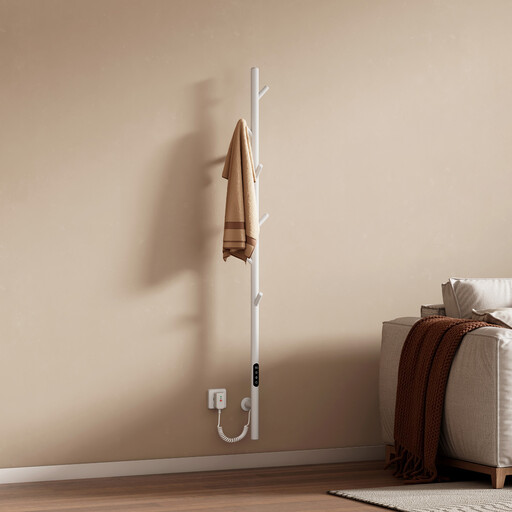
The heated drying area with fold-out side wings could work well if you want to hang several towels and put the rack away afterwards.
Specifications include 45–55 °C, 230 W and a load capacity of up to 10 kg.
 No image available
The rail and six hooks offer different hanging options; check whether this arrangement works for your tea towels.
Specifications include 100 W, temperature control from 30–70 °C and a timer from 1–9 hours. The description also mentions app control.
 No image available
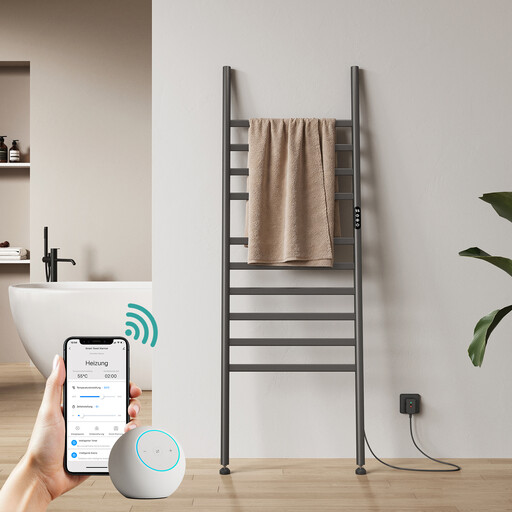
The freestanding design is an option if you’re looking for an appliance that doesn’t need drilling; check that the space you have in mind is suitable for this design.
Specifications include 385 W, a temperature setting of 30–70 °C and a timer from 1–24 hours. The description mentions app and voice control.
 No image available
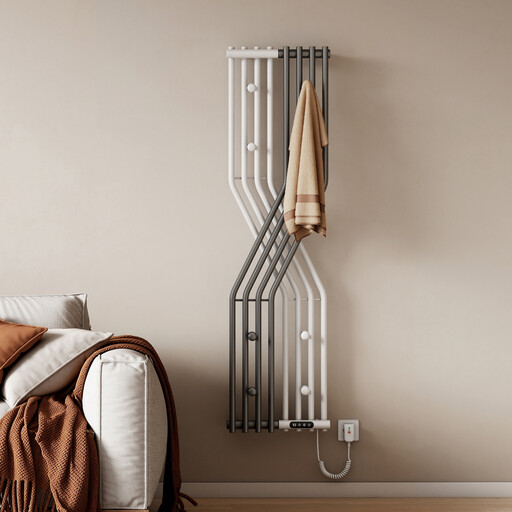
Wall mounting could be a good fit if you have a suitable place to install it and don’t want a freestanding appliance on the floor.
Specifications include 580 W, a temperature setting of 30–70 °C and eight flexible hooks. A timer is also listed; check the installation instructions for your intended location.
 No image available
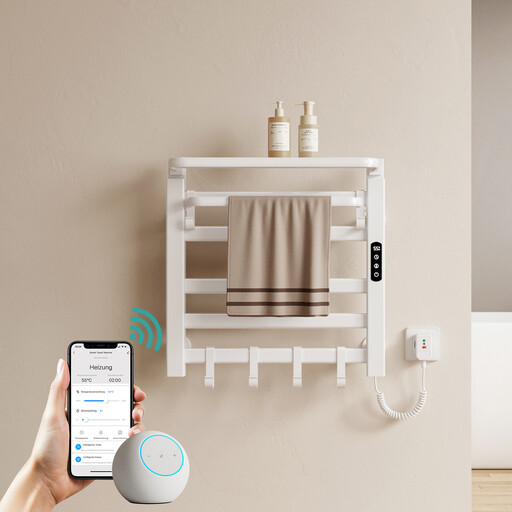
Six hooks and a towel rail provide hanging options; the fold-down shelf may be useful if you’d also like some extra storage space.
Specifications include 140 W, temperature control from 30–70 °C and IPX5. The product details also mention Wi-Fi app control.
No. Drying isn’t washing or a proven disinfection method. The Verbraucherzentrale recommends regularly washing towels that can harbour germs at a temperature of at least 60 °C; heat from the airer isn’t a substitute for washing them.
Choose a suitable place to dry them and ventilate the room so moisture can escape. For additional sources of moisture, such as wet washing, the German Environment Agency recommends ventilating regularly; a heated airer doesn’t remove evaporated moisture from your home.
No. The type of appliance alone doesn’t prove it’s suitable for every location. The manufacturer lists IPX4 and freestanding or wall-mounted use for the DOMO DO7117DR, and IP22 for the Adler AD 7821. What matters is the instructions, the intended location and, where necessary, professional installation of the specific model.
Multiply the power consumption in kilowatts by the actual running time in hours, then multiply the result by your price per kilowatt-hour. 220 W is equivalent to 0.22 kW, but that doesn’t give you a guaranteed figure for energy use per towel dried.
No. The wattage alone doesn’t show how much energy an appliance needs to dry the same towels. You’d need to compare the same load and running time, and also take your electricity tariff into account.