Regular workwear washing
If you wash workwear frequently, compare the usable hanging space and load capacity with the amount of laundry you have. The number of advertised features alone doesn’t tell you whether there’s enough room for each item.


A heated airer could suit you if you want to dry washable workwear indoors with extra warmth, and its footprint, load capacity and power consumption are right for the amount of laundry you have. If electricity use or humidity is your main concern, an unheated airer may be a better choice. The German Environment Agency recommends ventilating regularly when drying clothes indoors, and you should always follow the care label for each item.
If you wash workwear frequently, compare the usable hanging space and load capacity with the amount of laundry you have. The number of advertised features alone doesn’t tell you whether there’s enough room for each item.
If you’ll need certain washable items again soon, consider whether a heating function suits your routine and your room. It doesn’t guarantee a set drying time.
If space is limited, consider both the design of the airer and how well the room can be ventilated. Extra heat from the airer won’t remove the moisture produced during drying.
A good fit if: you want to dry a small to medium amount of workwear and have a suitable space for the airer.
The trade-off: The airer needs electricity, and its heat doesn’t replace ventilation.
A good fit if: you want to keep the floor clear, regularly dry longer or multiple items, and can install it suitably.
The trade-off: The installation and the electricity needed for the warm-air function must suit your room and routine.
A good fit if: you have enough time and hanging space, and don’t need extra electric heat.
The trade-off: There’s no heat to help with drying, and you’ll still need to remove moisture when drying clothes indoors.
| Criterion | What to look for | Who it matters most to |
|---|---|---|
| Room humidity and ventilation | Check how you can ventilate the room and whether the chosen position is suitable. | If I dry clothes in the utility room, I need to be able to remove the moisture; the heating function doesn’t replace ventilation. Around 25% of consumers put room humidity first. |
| Having workwear ready for your next shift | Compare heated rails and warm-air functions according to the items you need to dry and your routine; neither guarantees a set drying time. | If I need certain items again soon, I want to choose a heat function that fits my routine. Around 25% of consumers prioritise having their workwear ready on time. |
| Amount of laundry and space | Measure the floor or mounting space, then check the hanging capacity and stated load limit for the specific model. | If I need to dry several jackets or pairs of trousers at once, I need space for both the clothes and the airer. Around 20% of consumers focus mainly on laundry volume and available space. |
| Workwear care | Read the care label for each item and check the airer’s instructions. | If my workwear has different care requirements, I want to use the right drying method for each item. Around 15% of consumers put fabric care first. |
| Electricity use | Factor in the power consumption of the function you’ll actually use and how long you’ll use it; the wattage alone doesn’t show how efficient it is per load of laundry. | If I use the airer regularly, I want to know which function I’ll use and for how long. Around 15% of consumers focus mainly on electricity use. |
Heat from the airer won’t automatically remove the moisture released during drying from your utility room. The German Environment Agency recommends ventilating regularly when drying clothes indoors.
Before choosing where to put the airer, check how you can ventilate the room and plan for this separately from the heating function.
Power consumption alone doesn’t tell you how long a particular amount of workwear will take to dry. You can’t compare different designs and functions by wattage alone without using the same drying task and comparable operating conditions.
Compare the function you’ll actually use and how long you’ll use it for your amount of laundry, rather than using a single power rating to estimate drying efficiency per load.
GINETEX distinguishes between symbols for natural drying and tumble drying. A label for one drying method doesn’t automatically mean that an item is suitable for contact with heated rails.
Read the entire care label and the airer’s instructions before drying an item on it.
Freestanding heated airers for different laundry loads and space requirements.
Wall-mounted airers with motorised lowering and cold- and warm-air functions.
Unheated clothes airers for when hanging space matters more than switchable heat.
This selection includes a folding heated airer and a retractable washing line for air-drying clothes indoors.
 No image available
This folding design could suit you if you’re looking for a heated airer for your utility room that you can fold away when it’s not in use.
It’s listed with a load capacity of up to 10 kg, a power consumption of 230 W and a heating range of 45–55 °C. Check the weight of your laundry, and bear in mind that electricity use depends on how long you actually run it.
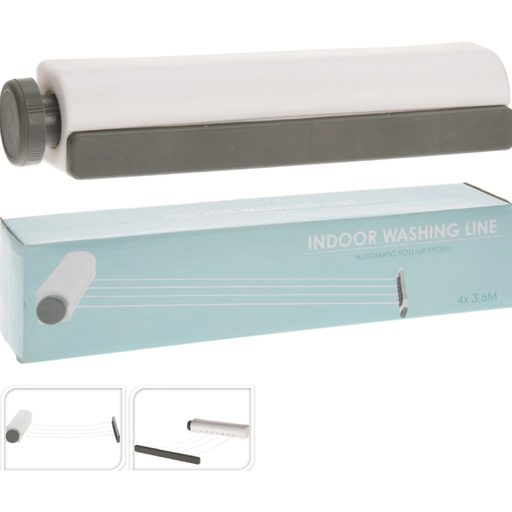 No image available
This washing line is an option if you want to hang clothes indoors without leaving a freestanding airer in place.
It has four lines with a total hanging length of 14.4 m and is designed to fit between two walls up to 360 cm apart. Check the distance between your walls and make sure the chosen mounting position is suitable.
No. The German Environment Agency recommends ventilating regularly when drying clothes indoors, because the airer’s heating function won’t remove moisture from the room by itself. In a cold basement, you should also adapt your ventilation to the time of year.
Multiply the power consumption of the function you actually use, in kilowatts, by the number of hours it runs to calculate consumption in kilowatt-hours. The wattage alone won’t tell you how long your workwear will take to dry or how much electricity each load will use.
Just because workwear is washable doesn’t automatically mean you can dry it on heated rails. GINETEX distinguishes between symbols for natural drying and tumble drying, so check the full care label for each item and the airer’s instructions.
The EU Low Voltage Directive applies to mains-powered equipment rated from 50 to 1,000 V AC that is made available on the German market. The Federal Network Agency lists the CE mark, product traceability, correct manufacturer details and German-language instructions with the necessary usage and warning information among the checks made during market surveillance.
Don’t put it in your household rubbish. The German Environment Agency lists municipal collection points and returning it to a retailer when buying a new one as options. Take-back obligations don’t apply to every retailer; the Stiftung ear, the German register for waste electrical equipment, lists retailers with at least 400 m² of sales space for electrical and electronic equipment among those covered.